










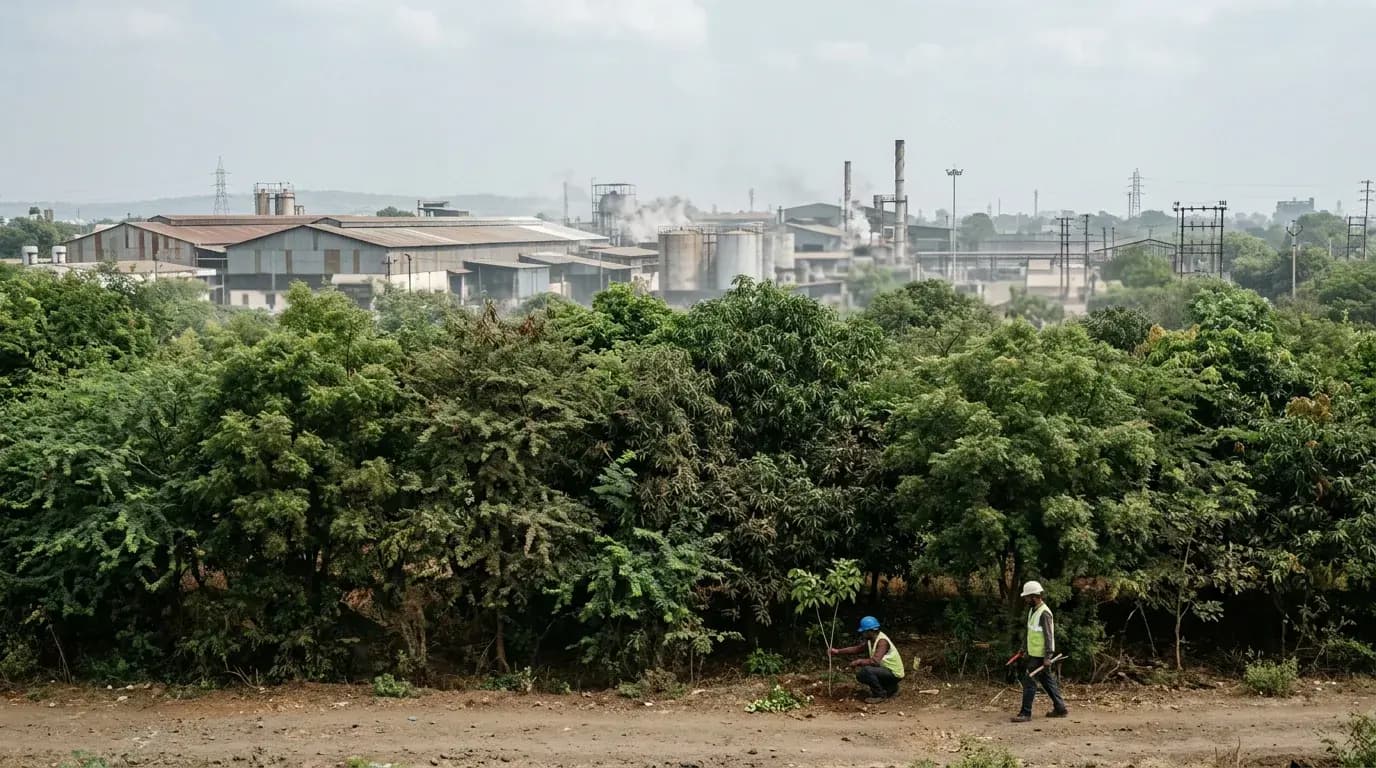
Green Belt Development for Industries consultants in Uran.
Green Belt Development for Industries in Uran, on the ground where the work actually is, the mangroves and wetlands around the port, and the salt pans and fishing villages of the Uran coast, with one team on it from the site survey until the survival data says it took.
Why Uran
The local ground green belt development for industries sits on.
- Decided with
- Mangrove Cell (Maharashtra Forest Department) · MCZMA · Uran Municipal Council · CIDCO · JNPA · MPCB Raigad
- Local ground
- The mangrove creeks around Nhava Sheva, the Panje and Dongri wetlands, the salt pans and fishing villages of the coast, and the logistics yards around Dronagiri
- Typically for
- Industrial units, estates, MIDC plots, chemical and manufacturing sites
Uran is low, flat land between the harbour and the hills around Dronagiri, and much of it was once creek, mudflat and salt pan. Mangroves still line the creeks around the port, and wetlands such as Panje and Dongri fill with flamingos and other migratory birds each winter. The port, the logistics yards and the new roads have taken a large share of this ground. Green work here is about planting and protecting on saline, wind-blown land: for the villages, workers and birds that share it.
Green belts around Uran's yards, warehouses and tank farms face conditions few nurseries plan for: salt-laden wind, brackish groundwater, compacted fill and a steady film of road dust. We plant dense rows along the boundaries facing roads and villages, choose natives that tolerate salinity and emissions, and water through the first dry seasons from treated water where the site has it. Each tree is counted and recorded against the consent or clearance condition, so the belt can be shown as well as seen. The work is carried from our base in the region by named people, start to finish, not passed down a chain.
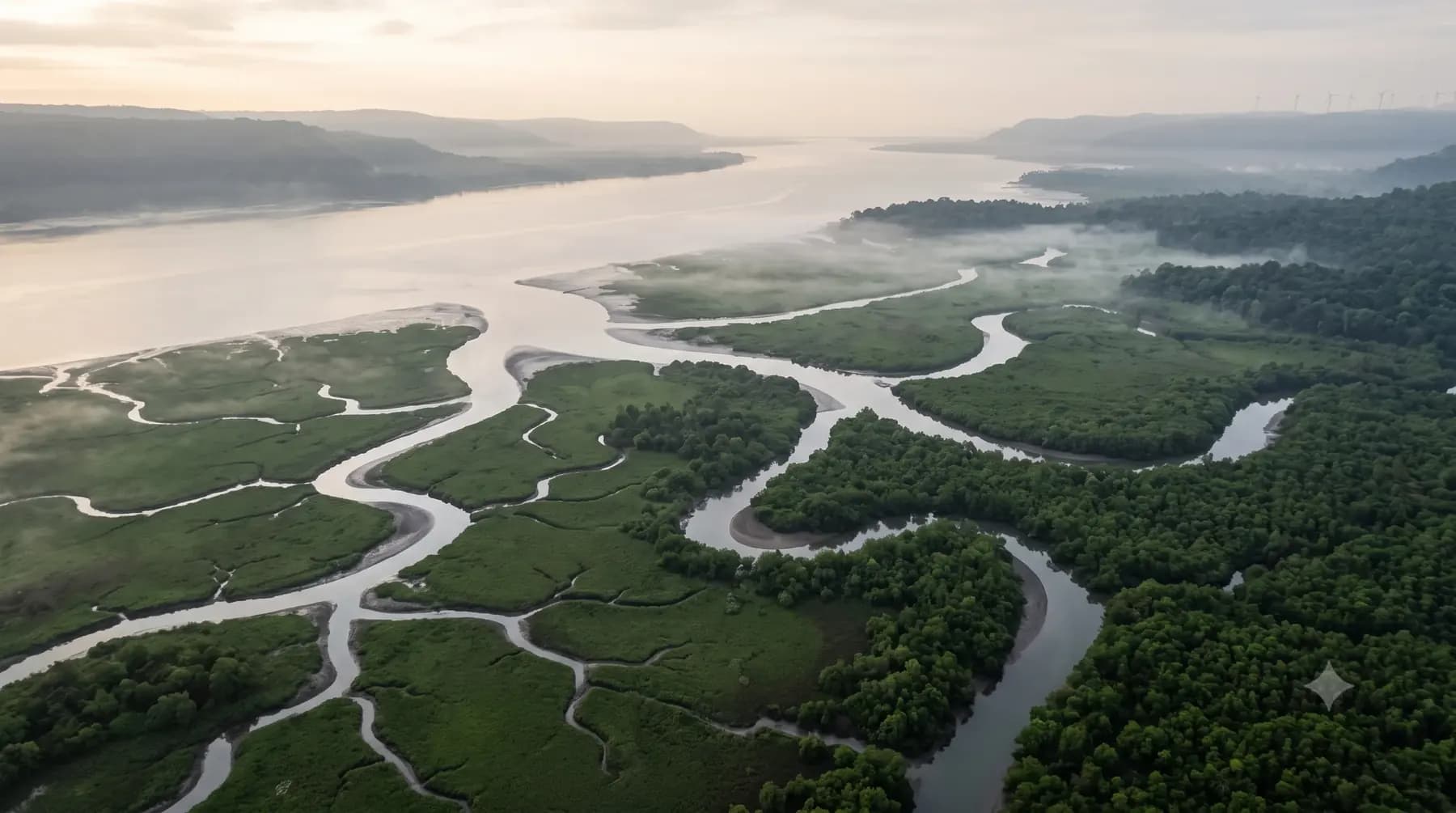
Green Belt Development for Industries · Uran
The clearance asks for a third of the plot in green. We make that third actually work.
Local demand
What drives green belt development for industries in Uran.
The second driver is the working landscape itself. Warehouses, container yards and tank farms stand on bare fill with little shade, and truck traffic keeps dust in the air through the dry season. Consents and clearances ask for green belts, and operators need planting that tolerates salt spray and poor soil. In the villages and in Uran town, open space is scarce, and the wetlands draw birders and residents who want them kept. The demand is for planting that suits a working coastline: and people ready to look after it.
Container traffic is Uran's defining source of dust and fumes. Thousands of trucks use the port roads every day, many idling in queues outside terminal and CFS gates, and villages along the routes have long complained about what settles in their homes. The Harit Sagar guidelines ask ports to plan for more green cover within their estates. For yard and warehouse operators, a well-kept green belt is part of consent compliance and part of staying on workable terms with the village next door.
How it works
Green Belt Development for Industries, from survey to survival.
- 01/04
Condition & buffer planning
The EC and consent green-cover conditions read, and a buffer plan sized and structured to meet them on the available plot.
- 02/04
Species selection
Pollution- and dust-tolerant native species chosen for attenuation, screening and survival at an industrial boundary.
- 03/04
Planting & establishment
Multi-row planting and the establishment care a buffer needs to close its canopy.
- 04/04
Compliance records
Documentation of the green cover developed and maintained, for the post-EC compliance file.
Every stage, in detail
Proof
Comparable work we've delivered.
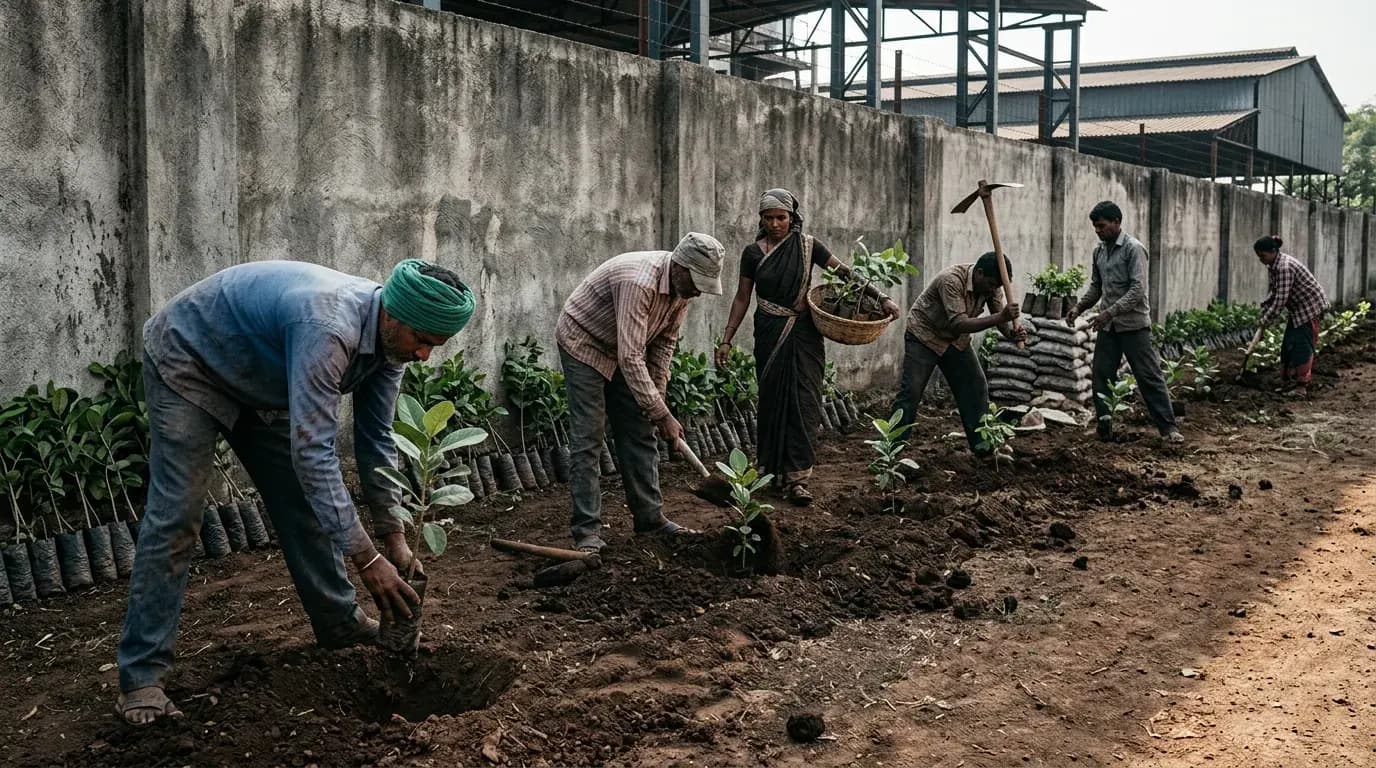
Jamnagar, Gujarat
Miyawaki Plantations at Jamnagar and Junagadh
Land preparation, soil treatment, plantation and irrigation delivered phase-wise in four months.
The record
The work, project by project.
Mandate, method and measured outcome, written end to end for every project on this list.
The Mayor's residence for the Panvel Municipal Corporation, built from concept to completion: columned elevations, terraces, landscape, external works and architectural lighting.
Read the case studyOn the ground
Across Uran, and the belt around it.
Local means the node, not the pin on the map. We carry green belt development for industries across the Uran nodes and the wider Mumbai Metropolitan Region: where the units, plots and projects actually sit.
Nodes we work across in Uran
Also across the Mumbai Metropolitan Region
Straight answers
Green Belt Development for Industries in Uran: common questions.
01Our tank farm needs a green belt, but fire rules limit what we can plant near the tanks. How do we manage both?
By keeping the belt where it belongs: along the outer boundary, clear of the tank dykes, pipe racks and fire-tender access. Inside the safety distances, we leave low grass or bare ground as the fire plan requires. Species for the belt are chosen to shed little dry litter and pruned so they never bridge towards the tanks. The belt then satisfies both the consent and the fire audit.
02Can green cover really help against the dust from container traffic?
It helps where it is dense and placed correctly. A layered belt of trees and shrubs along the road edge catches dust on its leaves, slows the air behind it and is washed clean by the rain. It does not replace paved roads and wheel washing, but beside a yard, a school or a village, it reduces what settles indoors.
03How long does green belt development for industries take in Uran, and who is involved?
Mangrove Cell (Maharashtra Forest Department) · MCZMA · Uran Municipal Council · CIDCO · JNPA · MPCB Raigad are the bodies an Uran project works with. On timing: planting seasonal; establishment 2–3 years. KIPL sets out a realistic Uran schedule once the site and the scope have been read, and carries the work through to the outcome, with comparable work on the record such as Miyawaki Plantations at Jamnagar and Junagadh.
By industry
The same filing, read for your sector.
- 01
Townships & Area DevelopmentCore
The layout-level green network committed in the 8(b) EIA is a mapped, measurable obligation carried across a decade of build-out.
Green Belt Development for Industries for Townships & Area Development - 02
Chemical IndustryCore
Clearance conditions typically bind a chemical unit to green belt across roughly a third of its plot area, as an odour and emission buffer.
Green Belt Development for Industries for Chemical Industry - 03
Distilleries & EthanolCore
Odour from spent wash storage makes the green belt a functional buffer with a stated width and species mix, not a landscaping line item.
Green Belt Development for Industries for Distilleries & Ethanol - 04
Sugar IndustryCore
Bagasse handling and boiler particulates make the mandated green belt an actual dust barrier, monitored as an EC condition.
Green Belt Development for Industries for Sugar Industry - 05
Industrial & ManufacturingCore
Consent conditions bind an industrial plot to green belt around roughly a third of its area, with survival evidence expected at renewal.
Green Belt Development for Industries for Industrial & Manufacturing - 06
Industrial Corridors & MIDCCore
Corridor master plans reserve a green belt percentage at node level, and the buffer to surrounding villages is a planning-stage commitment.
Green Belt Development for Industries for Industrial Corridors & MIDC - 07
Data Centres & IT Parks
Green belt is the standard EC answer to DG noise and thermal load at the campus boundary, and its area is a stated condition.
Green Belt Development for Industries for Data Centres & IT Parks - 08
Mining & Minerals
Safety-zone and dump-face plantation is a mine-closure obligation, measured by survival rather than by saplings supplied.
Green Belt Development for Industries for Mining & Minerals
In the press
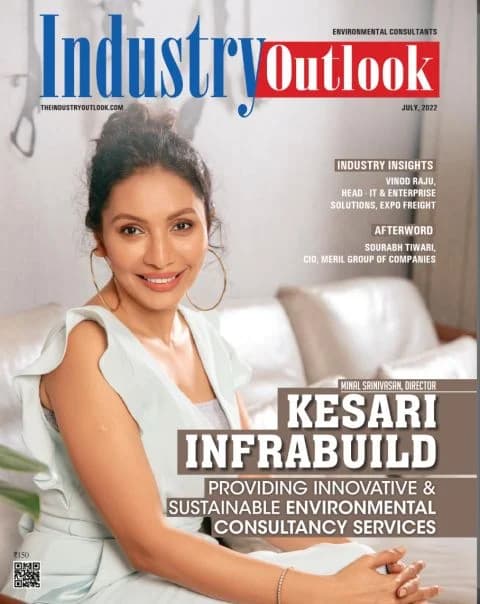
Covers, features and conversations: the work, talked through.

Keep exploring
Where this connects.
The service
01Green Belt Development for Industries, in full: and the practices that run beside it.
- Green Belt Development for Industries: the full service
- Miyawaki Urban Dense Forestation
- Tree Management
- Public Gardens & Biodiversity Parks
- Sustainable Landscaping
Clients & partners
The work is trusted where the stakes are highest.
Two decades of clearances, treatment plants and green infrastructure delivered for India’s builders, industry and public bodies, and the global engineering firms beside them.





























































Sideways
Green Belt Development for Industries beyond Uran, and what else we do there.
Also in Uran
CGWA Groundwater NOCCivil EPCCRZ ClearanceCSR / CER AdvisoryEffluent Treatment PlantsEnvironment ClearanceEnvironment Management & Mitigation PlanEnvironmental AuditsESG Advisory & ReportingExtended Producer ResponsibilityForest ClearanceGreen Building CertificationIntegrated Solid Waste ManagementMiyawaki Urban Dense Forestation
Green Belt Development for Industries in Uran? Start with the ground you have.
One conversation to walk the site and plan for what survives: not just what gets planted.