










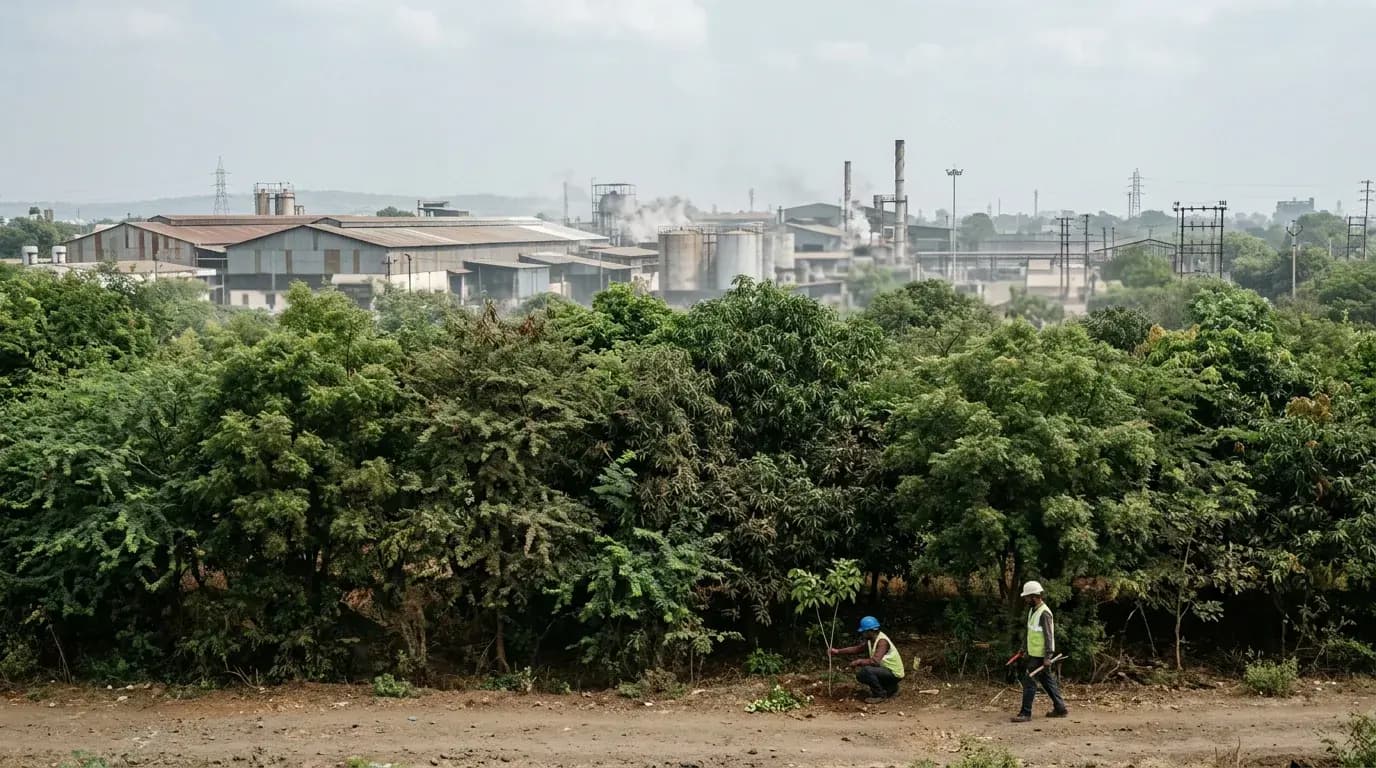
Green Belt Development for Industries consultants in Bhiwandi.
Green Belt Development for Industries in Bhiwandi, on the ground where the work actually is, the warehouse parks along the Mumbai–Nashik highway, the Kamwari river and the dense wards of the old town, with one team on it from the site survey until the survival data says it took.
Why Bhiwandi
The local ground green belt development for industries sits on.
- Decided with
- BNCMC Tree Authority · BNCMC Garden Department · MMRDA · Maharashtra Forest Department · MPCB Thane
- Local ground
- The warehouse parks of Kasheli, Kalher, Purna and Val, the old town wards and the Kamwari river
- Typically for
- Industrial units, estates, MIDC plots, chemical and manufacturing sites
Bhiwandi has lost its green in two ways at once. The old town grew wall to wall around its looms, leaving lanes with barely a tree and few gardens. Out on the highway, farmland and scrub became acres of roofing and truck yards that hold the day's heat long into the evening. Between them run the Kamwari river and the creek edge towards Kasheli. Green work here means putting shade back where people work and live: on ground that floods in July and bakes in April.
Green belts in Bhiwandi are asked of warehouse parks, of larger industrial plots, and of units whose clearance or consent sets a green-cover condition. The boundary often faces a village, the highway or a housing colony, so the belt has to screen dust, glare and truck noise as well as count trees. We plan dense, layered rows along the exposed edges, choose native species that tolerate dust and seasonal waterlogging, and keep the plantation records that inspections and compliance reports draw on. The work is carried from our base in the region by named people, start to finish, not passed down a chain.
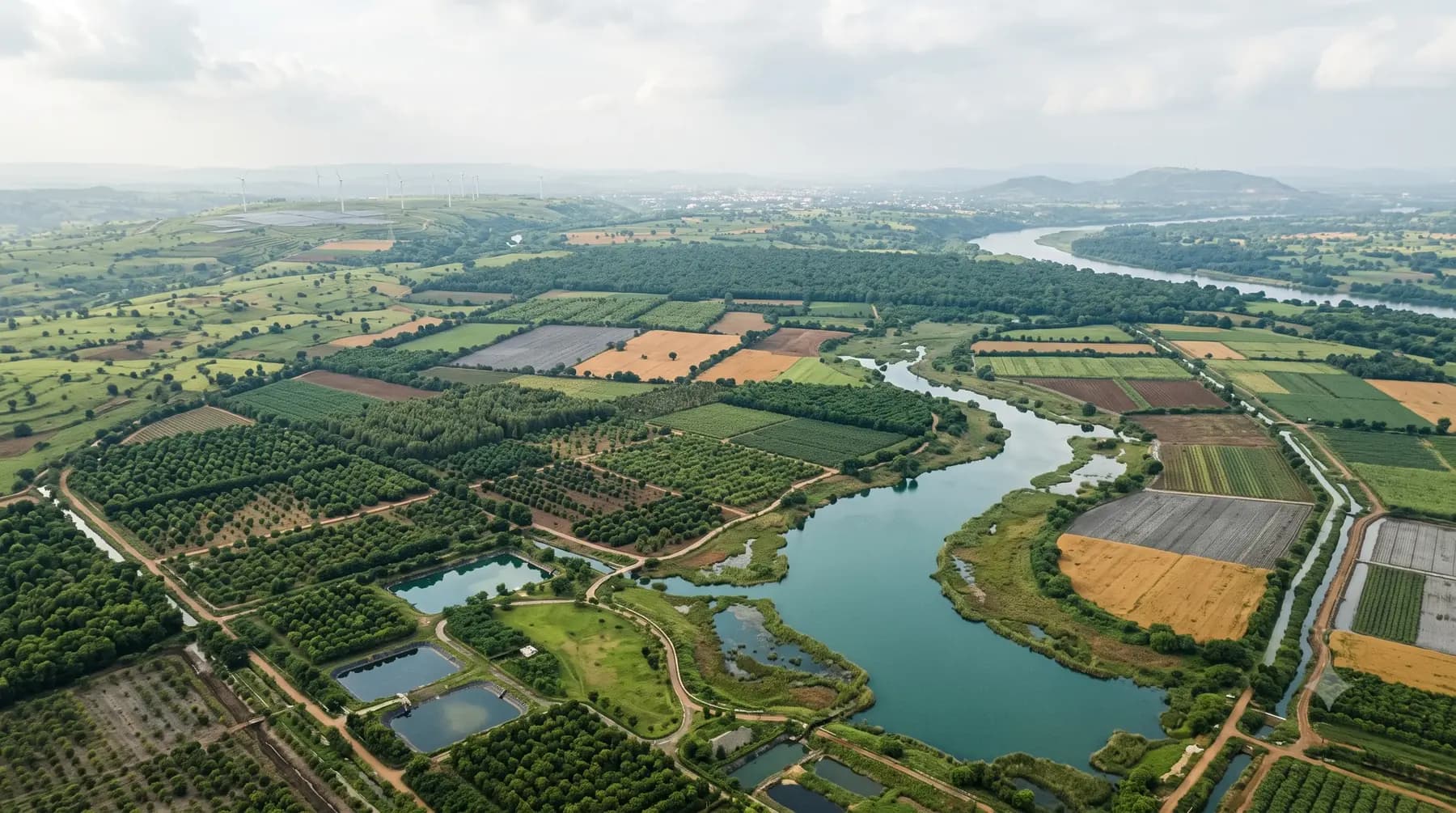
Green Belt Development for Industries · Bhiwandi
The clearance asks for a third of the plot in green. We make that third actually work.
Local demand
What drives green belt development for industries in Bhiwandi.
Warehouse parks are the first driver. Large parks carry green-cover conditions from their clearances and planning permissions, and owners selling to institutional buyers want those conditions visibly met: trees along boundaries, planted setbacks, a green edge to the highway. Occupiers want shade at the docks and around rest areas, where drivers and loaders wait out the afternoon. Where a park was built on a plot that held trees, their felling or transplanting needed permission first, and the compensatory planting still has to be shown alive.
Bhiwandi's warehouse parks have grown up beside villages that once looked out onto fields. Residents now live with truck traffic, floodlights and dust, and their complaints reach the gram panchayat and the pollution board. A well-planted boundary does not remove the trucks, but it cuts dust and glare and gives the park a softer face. Institutional owners also look at green cover during acquisitions, and a thin, patchy belt shows up as a finding in their reports.
How it works
Green Belt Development for Industries, from survey to survival.
- 01/04
Condition & buffer planning
The EC and consent green-cover conditions read, and a buffer plan sized and structured to meet them on the available plot.
- 02/04
Species selection
Pollution- and dust-tolerant native species chosen for attenuation, screening and survival at an industrial boundary.
- 03/04
Planting & establishment
Multi-row planting and the establishment care a buffer needs to close its canopy.
- 04/04
Compliance records
Documentation of the green cover developed and maintained, for the post-EC compliance file.
Every stage, in detail
Proof
Comparable work we've delivered.
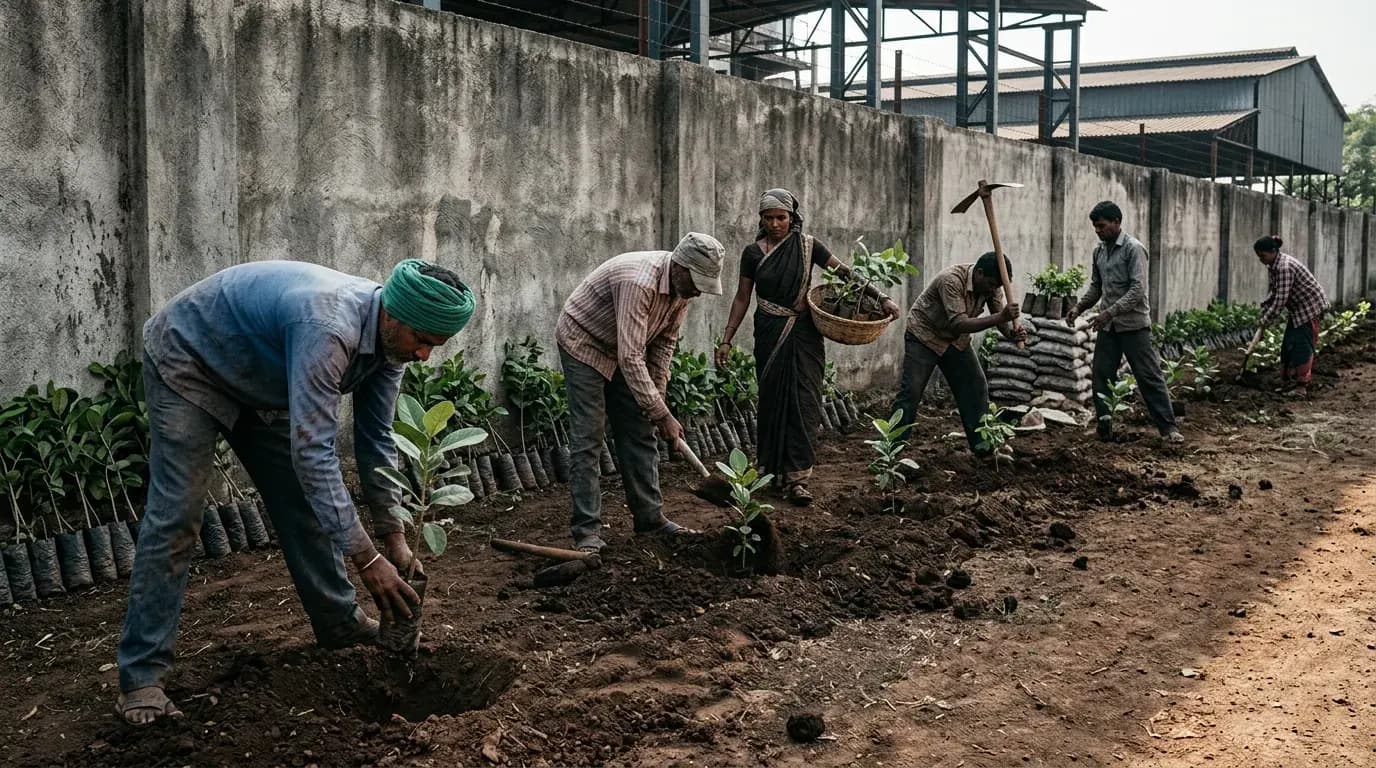
Jamnagar, Gujarat
Miyawaki Plantations at Jamnagar and Junagadh
Land preparation, soil treatment, plantation and irrigation delivered phase-wise in four months.
The record
The work, project by project.
Mandate, method and measured outcome, written end to end for every project on this list.
Environmental compliance audits, Consent to Establish and green certification support across two industrial nodes of the Delhi-Mumbai Industrial Corridor.
Read the case studyOn the ground
Across Bhiwandi, and the belt around it.
Local means the node, not the pin on the map. We carry green belt development for industries across the Bhiwandi nodes and the wider Mumbai Metropolitan Region: where the units, plots and projects actually sit.
Nodes we work across in Bhiwandi
Also across the Mumbai Metropolitan Region
Straight answers
Green Belt Development for Industries in Bhiwandi: common questions.
01Should the green belt on our warehouse park run along the highway frontage?
Often it should, since that is where dust and noise are heaviest. But highway frontages carry road-widening lines, service roads and utility corridors that can later cost the trees. We check the setback against the planning drawings and any widening proposal, and plant inside that line so the belt is not lost to the next project.
02Which trees suit a truck yard and its loading docks?
Native species with deep roots, a wide canopy and tolerance of dust and exhaust, trees that shade without dropping heavy branches or fruit onto vehicles. We keep them clear of turning circles and overhead lines, and protect young trees with guards until they have grown out of reach of reversing trucks.
03How long does green belt development for industries take in Bhiwandi, and who is involved?
BNCMC Tree Authority · BNCMC Garden Department · MMRDA · Maharashtra Forest Department · MPCB Thane are the bodies a Bhiwandi project works with. On timing: planting seasonal; establishment 2–3 years. KIPL sets out a realistic Bhiwandi schedule once the site and the scope have been read, and carries the work through to the outcome, with comparable work on the record such as Miyawaki Plantations at Jamnagar and Junagadh.
By industry
The same filing, read for your sector.
- 01
Townships & Area DevelopmentCore
The layout-level green network committed in the 8(b) EIA is a mapped, measurable obligation carried across a decade of build-out.
Green Belt Development for Industries for Townships & Area Development - 02
Chemical IndustryCore
Clearance conditions typically bind a chemical unit to green belt across roughly a third of its plot area, as an odour and emission buffer.
Green Belt Development for Industries for Chemical Industry - 03
Distilleries & EthanolCore
Odour from spent wash storage makes the green belt a functional buffer with a stated width and species mix, not a landscaping line item.
Green Belt Development for Industries for Distilleries & Ethanol - 04
Sugar IndustryCore
Bagasse handling and boiler particulates make the mandated green belt an actual dust barrier, monitored as an EC condition.
Green Belt Development for Industries for Sugar Industry - 05
Industrial & ManufacturingCore
Consent conditions bind an industrial plot to green belt around roughly a third of its area, with survival evidence expected at renewal.
Green Belt Development for Industries for Industrial & Manufacturing - 06
Industrial Corridors & MIDCCore
Corridor master plans reserve a green belt percentage at node level, and the buffer to surrounding villages is a planning-stage commitment.
Green Belt Development for Industries for Industrial Corridors & MIDC - 07
Data Centres & IT Parks
Green belt is the standard EC answer to DG noise and thermal load at the campus boundary, and its area is a stated condition.
Green Belt Development for Industries for Data Centres & IT Parks - 08
Mining & Minerals
Safety-zone and dump-face plantation is a mine-closure obligation, measured by survival rather than by saplings supplied.
Green Belt Development for Industries for Mining & Minerals
In the press
Covers, features and conversations: the work, talked through.


Keep exploring
Where this connects.
The service
01Green Belt Development for Industries, in full: and the practices that run beside it.
- Green Belt Development for Industries: the full service
- Miyawaki Urban Dense Forestation
- Tree Management
- Public Gardens & Biodiversity Parks
- Sustainable Landscaping
Clients & partners
The work is trusted where the stakes are highest.
Two decades of clearances, treatment plants and green infrastructure delivered for India’s builders, industry and public bodies, and the global engineering firms beside them.





























































Sideways
Green Belt Development for Industries beyond Bhiwandi, and what else we do there.
Also in Bhiwandi
CGWA Groundwater NOCCivil EPCCRZ ClearanceCSR / CER AdvisoryEffluent Treatment PlantsEnvironment ClearanceEnvironment Management & Mitigation PlanEnvironmental AuditsESG Advisory & ReportingExtended Producer ResponsibilityForest ClearanceGreen Building CertificationIntegrated Solid Waste ManagementMiyawaki Urban Dense Forestation
Green Belt Development for Industries in Bhiwandi? Start with the ground you have.
One conversation to walk the site and plan for what survives: not just what gets planted.