










Green buffer planning: designing the vegetated barrier between a plant and its neighbours.
A green buffer is the vegetated band between an emitting activity and what lies beyond it, planned for width, density and species tolerance rather than appearance.
What it is
Buffer planning starts from what the buffer has to do (attenuate dust and particulates, damp noise, screen the plant visually, or all three) and from the prevailing wind direction, the emission sources and the receptors on the other side. Width, planting density and layer structure follow from that, as does species selection, which for a pollution buffer is driven by tolerance rather than ornament.
KIPL plans the buffer against the plant layout and the site's own constraints: setbacks, pipelines and cable routes, firefighting access, security lines of sight and available irrigation. The result is a planting plan that can actually be built and maintained inside a working industrial site, and that stands up when a regulator asks how the buffer was arrived at.
What you get
The deliverables, in hand.
- Authority
- CPCB green belt guidelines · APTI-based species selection
- Typical timeline
- Weeks for planning; planting to the seasonal window
- Buffer requirement assessment: sources, receptors and prevailing wind
- Buffer width, alignment and density plan over the site layout
- Species list selected for pollution tolerance and local suitability
- Multi-tier planting section: ground, shrub and tree layers
- Constraint mapping against utilities, access and setbacks
- Planting drawings, quantities and phased implementation plan
Straight answers
Green Buffer Planning: common questions.
01What is a green buffer, and how is it different from landscaping?
A green buffer is a functional planting band designed to attenuate dust, noise and visual impact between a source and its surroundings. Landscaping is designed for appearance and use. The buffer's width, density, layering and species are all chosen for performance, which usually produces a very different planting from an ornamental scheme.
02How wide does a green belt have to be?
It depends on the project category, the site and, most often, on what the Environment Clearance or consent condition specifies for that unit. CPCB guidance sets expectations on green belt provision around industrial units, and clearance conditions frequently fix a width or an area percentage. The applicable condition governs, so it is read first.
03How are species chosen for a pollution buffer?
By tolerance to the pollutants concerned, alongside local climatic suitability. The Air Pollution Tolerance Index is the common screening tool, it combines leaf biochemical parameters into a comparative tolerance score: and is used together with growth habit, canopy density, foliage persistence and local availability. Ornamental value is secondary.
04What is APTI?
The Air Pollution Tolerance Index is a composite index derived from leaf parameters (ascorbic acid, chlorophyll, leaf extract pH and relative water content) used to rank species by their tolerance to air pollution. It is widely used in India to shortlist species for industrial green belts, generally alongside a suitability assessment for the local site.
05Does a green belt actually reduce pollution?
A dense, correctly layered belt intercepts coarse particulates and dust, attenuates noise, and screens the plant visually: measurable effects at the boundary. It is a mitigation measure at the periphery, not a substitute for source control such as stack treatment or dust suppression, and should be described accordingly.
06Where does irrigation come from in an industrial buffer?
Most industrial sites irrigate the belt from treated effluent or STP-treated water, which also helps meet reuse commitments in the clearance. The water source, quality and delivery system must be settled during planning, because a belt planned without an assured water source rarely survives its first summer.
07Can a buffer be planted in phases?
Yes, and on a live plant it usually has to be: around construction sequencing, utility corridors and area handover. What matters is that the phasing is planned, so the sequence still delivers the committed width and density within the period the clearance condition allows.
Within Green Belt Development for Industries
Part of the whole route, the other components.
Primary sources
Check it at source.
This page describes CPCB green belt guidelines · APTI-based species selection. The regulation and the filing portal are public, these are the official endpoints, not our summary of them.
Relevant proof
Where this stage has already been delivered.
Jamnagar, Gujarat
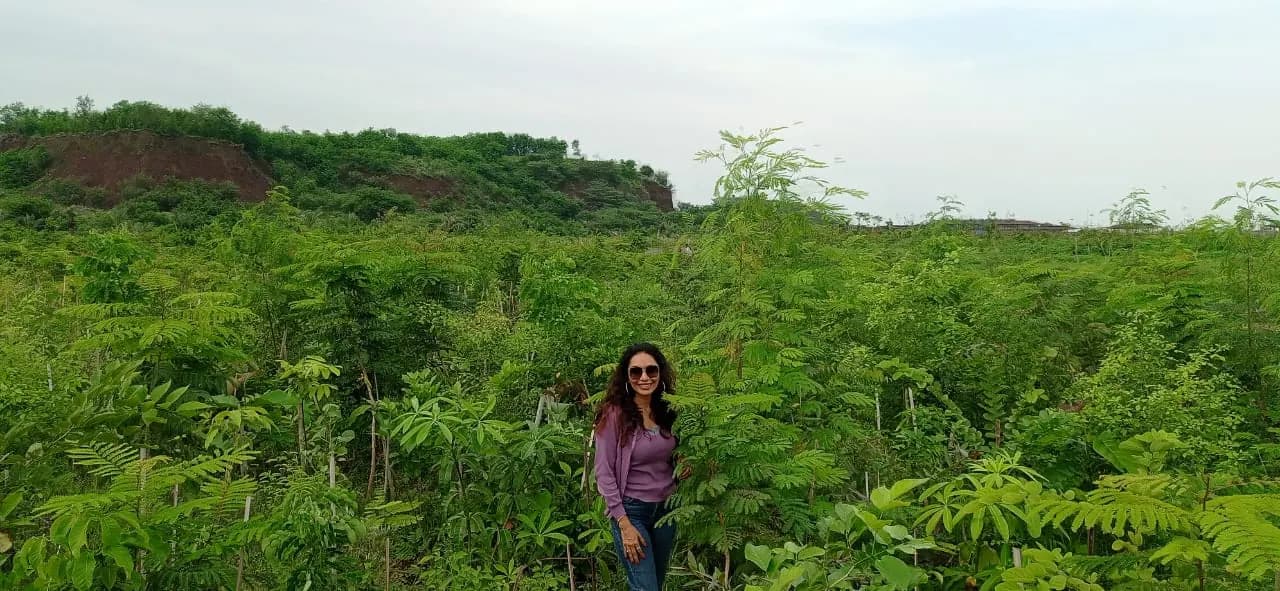
Miyawaki Plantations at Jamnagar and Junagadh
Land preparation, soil treatment, plantation and irrigation delivered phase-wise in four months.
Where we do this
Green Belt Development for Industries on the ground.
The authority, the timeline and the local ground differ by city. These pages set out how green belt development for industries actually runs in each.
Featured projects
Work that carries its own evidence.
Our expertise
One team across the whole environmental brief.
Green Buffer Planning is one stage of one practice. Most projects need several, and the commitments made at clearance are the ones we build and maintain.
Who we do this for
Green Belt Development for Industries reads differently by industry.
- 01
Townships & Area DevelopmentCore
The layout-level green network committed in the 8(b) EIA is a mapped, measurable obligation carried across a decade of build-out.
Green Belt Development for Industries for Townships & Area Development - 02
Chemical IndustryCore
Clearance conditions typically bind a chemical unit to green belt across roughly a third of its plot area, as an odour and emission buffer.
Green Belt Development for Industries for Chemical Industry - 03
Distilleries & EthanolCore
Odour from spent wash storage makes the green belt a functional buffer with a stated width and species mix, not a landscaping line item.
Green Belt Development for Industries for Distilleries & Ethanol - 04
Sugar IndustryCore
Bagasse handling and boiler particulates make the mandated green belt an actual dust barrier, monitored as an EC condition.
Green Belt Development for Industries for Sugar Industry - 05
Industrial & ManufacturingCore
Consent conditions bind an industrial plot to green belt around roughly a third of its area, with survival evidence expected at renewal.
Green Belt Development for Industries for Industrial & Manufacturing - 06
Industrial Corridors & MIDCCore
Corridor master plans reserve a green belt percentage at node level, and the buffer to surrounding villages is a planning-stage commitment.
Green Belt Development for Industries for Industrial Corridors & MIDC - 07
Data Centres & IT Parks
Green belt is the standard EC answer to DG noise and thermal load at the campus boundary, and its area is a stated condition.
Green Belt Development for Industries for Data Centres & IT Parks - 08
Mining & Minerals
Safety-zone and dump-face plantation is a mine-closure obligation, measured by survival rather than by saplings supplied.
Green Belt Development for Industries for Mining & Minerals
Trusted by
The organisations this work is done for.





In the press