










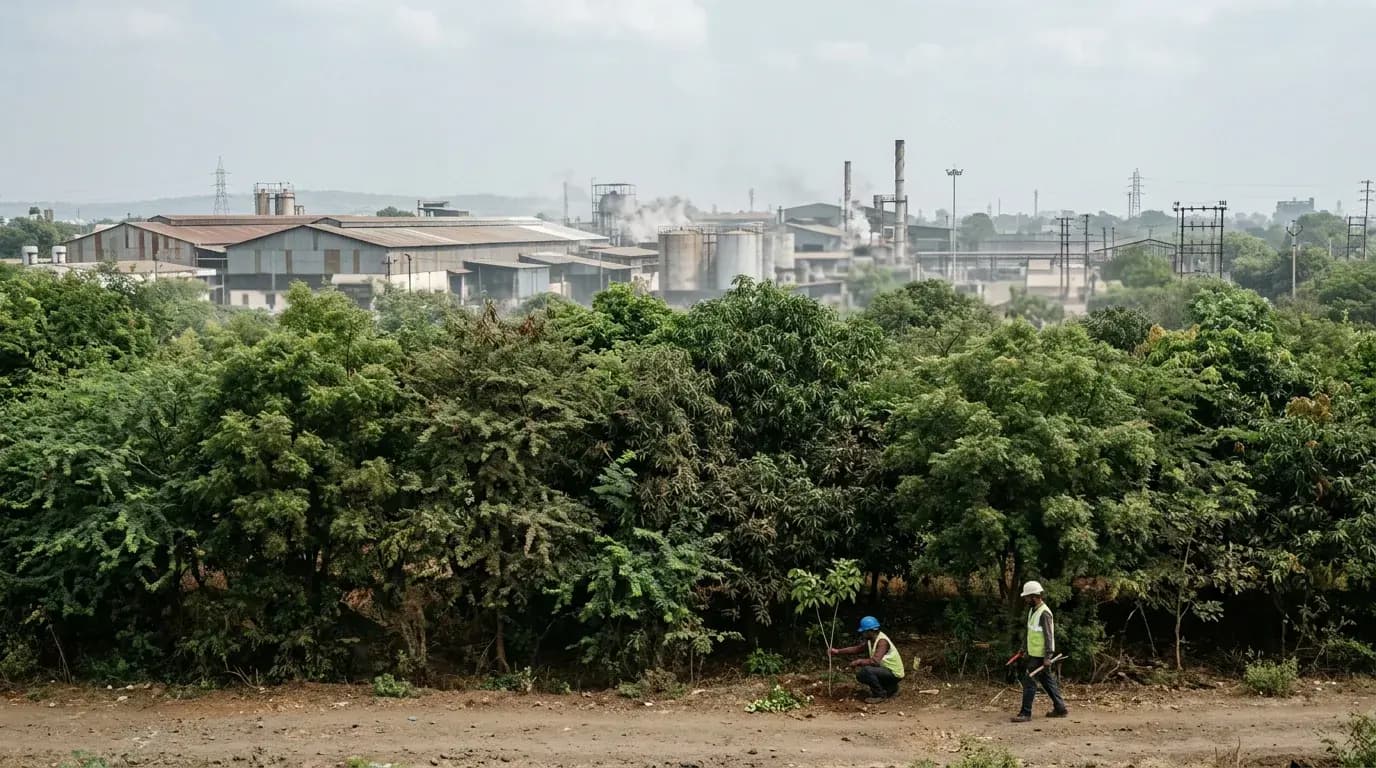
Green Belt Development for Industries consultants in Navi Mumbai.
Green Belt Development for Industries in Navi Mumbai, on the ground where the work actually is, the mangrove edge of Thane Creek, the Parsik and Kharghar hills, and the tree-lined streets and gardens of the CIDCO nodes, with one team on it from the site survey until the survival data says it took.
Why Navi Mumbai
The local ground green belt development for industries sits on.
- Decided with
- NMMC Tree Authority and Garden Department · CIDCO · MIDC · Mangrove Cell, Maharashtra Forest Department
- Local ground
- The CIDCO nodes from Airoli to Belapur, the TTC industrial area, the Parsik hill slopes and the Thane Creek mangrove edge
- Typically for
- Industrial units, estates, MIDC plots, chemical and manufacturing sites
Navi Mumbai was planned with its green in it. CIDCO laid out the nodes with avenue trees, gardens and open spaces, and the city sits between the mangroves of Thane Creek and the Parsik hills. That green is now under steady pressure. Old CIDCO housing is being redeveloped, industrial plots are changing use, and new nodes are rising towards the airport. Each change touches trees, gardens or wetland edges: and each needs planting that survives the heat, the salt air and a heavy monsoon.
Green belts in Navi Mumbai are mostly an industrial question. Chemical, pigment and pharma units at Rabale, Mahape, Turbhe and Taloja carry green-belt conditions in their clearances and MPCB consents. Many of these plots are tight, laid out long before such conditions were written. The buffer has to fit along boundaries, roads and nallahs, often beside housing. Species must take dust, fumes and the salt air off the creek. For the families living across the road, a working belt means cleaner air. The work is carried from our base in the region by named people, start to finish, not passed down a chain.
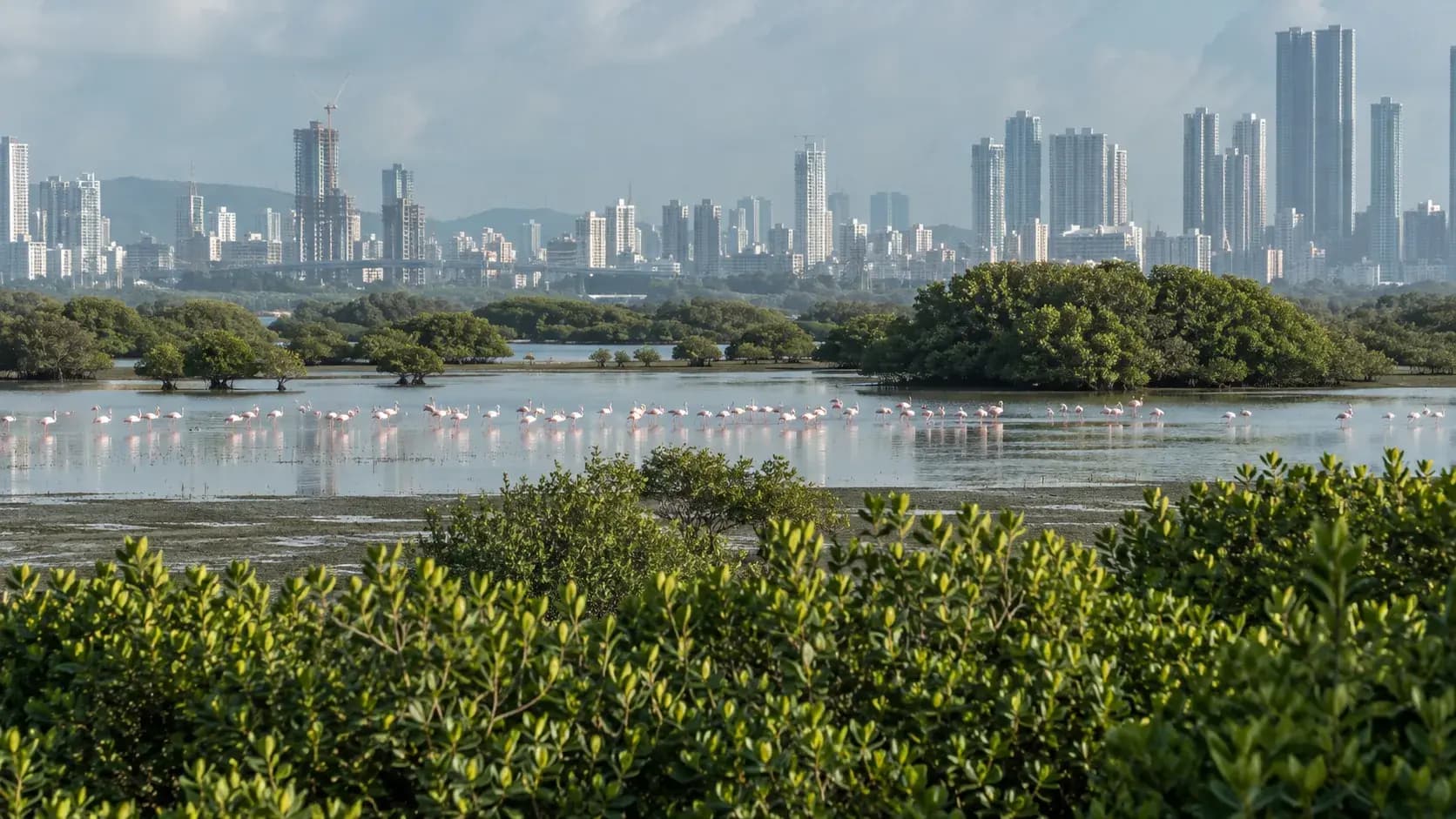
Green Belt Development for Industries · Navi Mumbai
The clearance asks for a third of the plot in green. We make that third actually work.
Local demand
What drives green belt development for industries in Navi Mumbai.
Redevelopment drives much of the demand. Housing societies in Vashi, Nerul and Belapur built by CIDCO decades ago are being rebuilt, and their compounds hold mature trees. Each project needs a tree census and permission from the NMMC Tree Authority before work starts. Most then owe compensatory planting. Road widening and metro works add to the list. The same pressure falls on industry, units in the TTC area and at Taloja carry green-belt conditions in their clearances and consents, and those buffers must be planted and kept alive.
A green belt used to be planted once and forgotten. Now it is checked. MPCB looks at it when consents are renewed, and EC compliance reports must show it has been developed and maintained. New data centres rising on old TTC plots bring green-area conditions of their own. And the housing that now surrounds the industrial area has changed the stakes: residents of Ghansoli and Airoli notice dust and odour from the boundary, and a thin, dying row of trees does little to stop either.
How it works
Green Belt Development for Industries, from survey to survival.
- 01/04
Condition & buffer planning
The EC and consent green-cover conditions read, and a buffer plan sized and structured to meet them on the available plot.
- 02/04
Species selection
Pollution- and dust-tolerant native species chosen for attenuation, screening and survival at an industrial boundary.
- 03/04
Planting & establishment
Multi-row planting and the establishment care a buffer needs to close its canopy.
- 04/04
Compliance records
Documentation of the green cover developed and maintained, for the post-EC compliance file.
Every stage, in detail
Proof
Comparable work we've delivered.
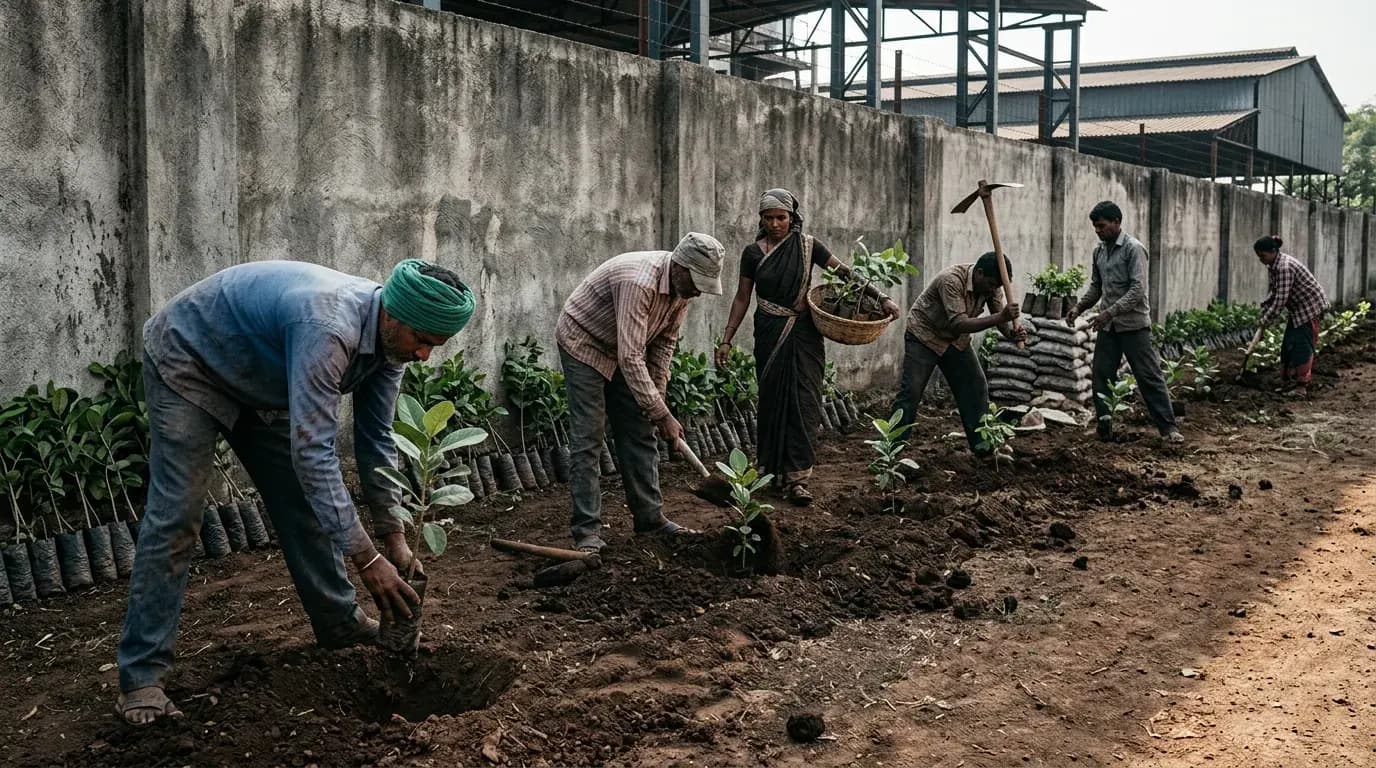
Jamnagar, Gujarat
Miyawaki Plantations at Jamnagar and Junagadh
Land preparation, soil treatment, plantation and irrigation delivered phase-wise in four months.
The record
The work, project by project.
Mandate, method and measured outcome, written end to end for every project on this list.
The Mayor's residence for the Panvel Municipal Corporation, built from concept to completion: columned elevations, terraces, landscape, external works and architectural lighting.
Read the case studyOn the ground
Across Navi Mumbai, and the belt around it.
Local means the node, not the pin on the map. We carry green belt development for industries across the Navi Mumbai nodes and the wider Mumbai Metropolitan Region: where the units, plots and projects actually sit.
Nodes we work across in Navi Mumbai
Also across the Mumbai Metropolitan Region
Straight answers
Green Belt Development for Industries in Navi Mumbai: common questions.
01Our TTC plot has no spare land for the green belt the condition asks for. What can we do?
First read the condition exactly: some ask for a share of the plot, others a number of trees. Then map every usable strip (boundaries, setbacks, around the parking area) and count the healthy trees already there. If the plot still falls short, raise the gap with the regulator rather than hide it. Whether planting elsewhere is accepted is the regulator's decision, not ours.
02Can we plant close to the mangroves along Thane Creek?
Mangrove land and its buffer are protected, and work there is controlled by the Mangrove Cell of the Maharashtra Forest Department, along with coastal regulation. Planting on your own plot near the creek is possible, but species and location need care. Native coastal and salt-tolerant species are the right choice. We check the site's position against the mangrove boundary before any design starts.
03How long does green belt development for industries take in Navi Mumbai, and who is involved?
NMMC Tree Authority and Garden Department · CIDCO · MIDC · Mangrove Cell, Maharashtra Forest Department are the bodies a Navi Mumbai project works with. On timing: planting seasonal; establishment 2–3 years. KIPL sets out a realistic Navi Mumbai schedule once the site and the scope have been read, and carries the work through to the outcome, with comparable work on the record such as Miyawaki Plantations at Jamnagar and Junagadh.
By industry
The same filing, read for your sector.
- 01
Townships & Area DevelopmentCore
The layout-level green network committed in the 8(b) EIA is a mapped, measurable obligation carried across a decade of build-out.
Green Belt Development for Industries for Townships & Area Development - 02
Chemical IndustryCore
Clearance conditions typically bind a chemical unit to green belt across roughly a third of its plot area, as an odour and emission buffer.
Green Belt Development for Industries for Chemical Industry - 03
Distilleries & EthanolCore
Odour from spent wash storage makes the green belt a functional buffer with a stated width and species mix, not a landscaping line item.
Green Belt Development for Industries for Distilleries & Ethanol - 04
Sugar IndustryCore
Bagasse handling and boiler particulates make the mandated green belt an actual dust barrier, monitored as an EC condition.
Green Belt Development for Industries for Sugar Industry - 05
Industrial & ManufacturingCore
Consent conditions bind an industrial plot to green belt around roughly a third of its area, with survival evidence expected at renewal.
Green Belt Development for Industries for Industrial & Manufacturing - 06
Industrial Corridors & MIDCCore
Corridor master plans reserve a green belt percentage at node level, and the buffer to surrounding villages is a planning-stage commitment.
Green Belt Development for Industries for Industrial Corridors & MIDC - 07
Data Centres & IT Parks
Green belt is the standard EC answer to DG noise and thermal load at the campus boundary, and its area is a stated condition.
Green Belt Development for Industries for Data Centres & IT Parks - 08
Mining & Minerals
Safety-zone and dump-face plantation is a mine-closure obligation, measured by survival rather than by saplings supplied.
Green Belt Development for Industries for Mining & Minerals
In the press
Covers, features and conversations: the work, talked through.



Keep exploring
Where this connects.
The service
01Green Belt Development for Industries, in full: and the practices that run beside it.
- Green Belt Development for Industries: the full service
- Miyawaki Urban Dense Forestation
- Tree Management
- Public Gardens & Biodiversity Parks
- Sustainable Landscaping
Clients & partners
The work is trusted where the stakes are highest.
Two decades of clearances, treatment plants and green infrastructure delivered for India’s builders, industry and public bodies, and the global engineering firms beside them.





























































Sideways
Green Belt Development for Industries beyond Navi Mumbai, and what else we do there.
Also in Navi Mumbai
CGWA Groundwater NOCCivil EPCCRZ ClearanceCSR / CER AdvisoryEffluent Treatment PlantsEnvironment ClearanceEnvironment Management & Mitigation PlanEnvironmental AuditsESG Advisory & ReportingExtended Producer ResponsibilityForest ClearanceGreen Building CertificationIntegrated Solid Waste ManagementMiyawaki Urban Dense Forestation
Green Belt Development for Industries in Navi Mumbai? Start with the ground you have.
One conversation to walk the site and plan for what survives: not just what gets planted.