










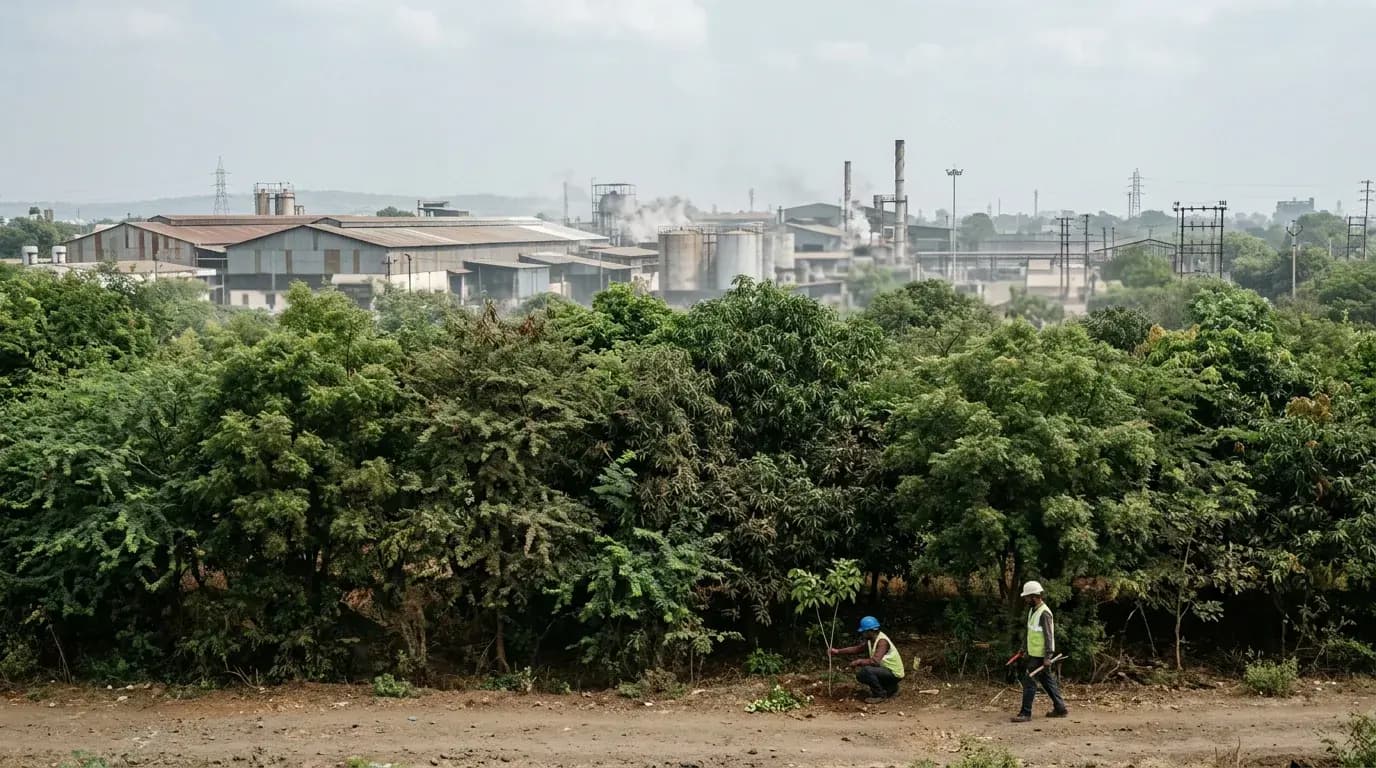
Green Belt Development for Industries consultants in Kharghar.
Green Belt Development for Industries in Kharghar, on the ground where the work actually is, the Kharghar hills and Pandavkada, Central Park and the golf course, and the wetlands along the node's creek edge, with one team on it from the site survey until the survival data says it took.
Why Kharghar
The local ground green belt development for industries sits on.
- Decided with
- Panvel Municipal Corporation Tree Authority and Garden Department · CIDCO · Maharashtra Forest Department · Mangrove Cell, Maharashtra Forest Department
- Local ground
- The Kharghar hill slopes and plateau, the Central Park and golf course belt, the housing sectors and the wetland and mangrove edge of the creek
- Typically for
- Industrial units, estates, MIDC plots, chemical and manufacturing sites
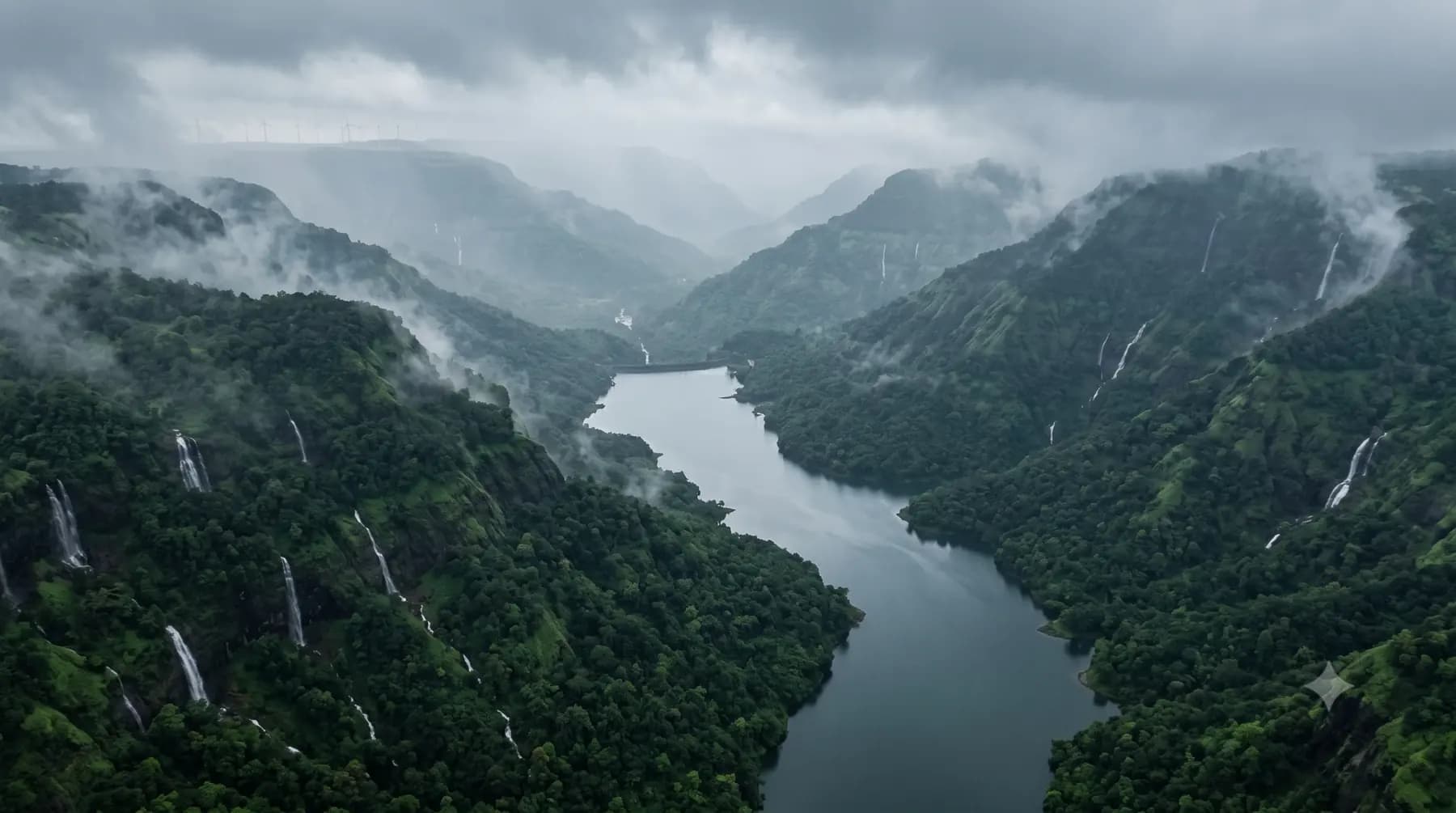
Kharghar is built against a hill. The slopes rise behind the upper sectors to a plateau of grass and scattered trees, and in the monsoon the Pandavkada falls run off them. Below, CIDCO laid out Central Park and a golf course across a wide stretch of the node. On the other side, wetlands and mangroves hold the creek edge. Between them sit dense housing sectors, with gardens and avenue trees planted as the node was built. Green work here means joining these edges: for the people who walk between them every morning.
Green belts around Kharghar are shaped by the Taloja industrial area. Units on its western side look towards housing in Kharghar and the Taloja node, and their green-belt conditions are the only planted buffer between the two. Projects along the Sion–Panvel highway and the node's main roads also carry green-cover conditions that work as screens against traffic dust and noise. We plant layered native rows on the boundary that faces homes, choose species that hold leaf through the dry months, and keep the counts MPCB and the clearance ask for. The work is carried from our base in the region by named people, start to finish, not passed down a chain.
Green Belt Development for Industries · Kharghar
The clearance asks for a third of the plot in green. We make that third actually work.
Local demand
What drives green belt development for industries in Kharghar.
The first driver is the trees the node planted for itself. Kharghar's avenues and society compounds were planted as the sectors filled, and many trees are now full-grown. New towers on the remaining plots, extensions and rebuilding, and metro and road works around the stations all meet them. Each felling or transplant needs a census and permission from the Panvel Municipal Corporation's Tree Authority under the Maharashtra (Urban Areas) Protection and Preservation of Trees Act, 1975. That permission usually carries compensatory planting: and that planting needs land in a node with little of it left.
Air quality at the Kharghar–Taloja boundary has been a public issue for years, with residents' complaints reaching MPCB and the National Green Tribunal. Taloja units that expand or change products face fresh clearance conditions, and their green belts are looked at more closely than they once were. New housing keeps moving closer to the industrial boundary. A dense, maintained belt will not fix emissions, that is the work of controls at the source. But it does screen dust and shows residents that the boundary is being cared for.
How it works
Green Belt Development for Industries, from survey to survival.
- 01/04
Condition & buffer planning
The EC and consent green-cover conditions read, and a buffer plan sized and structured to meet them on the available plot.
- 02/04
Species selection
Pollution- and dust-tolerant native species chosen for attenuation, screening and survival at an industrial boundary.
- 03/04
Planting & establishment
Multi-row planting and the establishment care a buffer needs to close its canopy.
- 04/04
Compliance records
Documentation of the green cover developed and maintained, for the post-EC compliance file.
Every stage, in detail
Proof
Comparable work we've delivered.
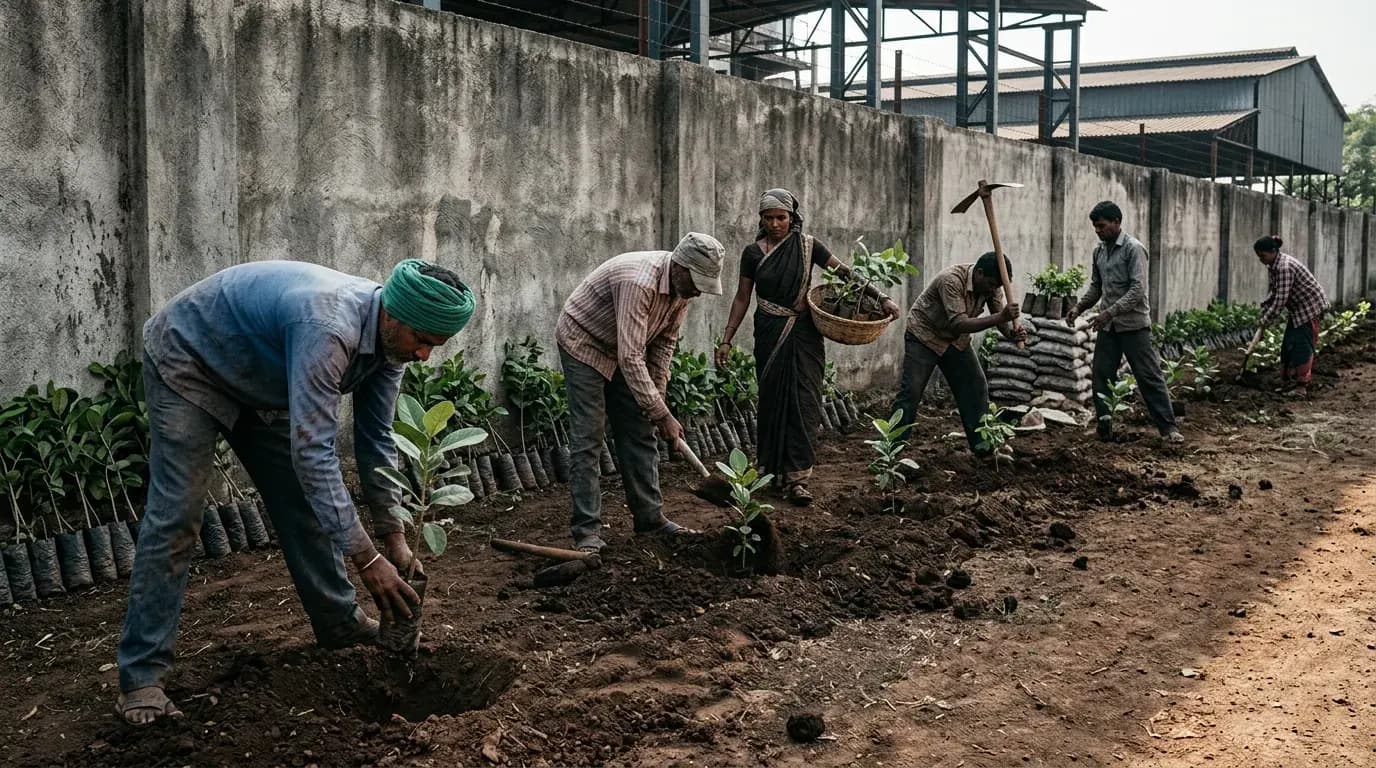
Jamnagar, Gujarat
Miyawaki Plantations at Jamnagar and Junagadh
Land preparation, soil treatment, plantation and irrigation delivered phase-wise in four months.
The record
The work, project by project.
Mandate, method and measured outcome, written end to end for every project on this list.
Green zone development and maintenance across multiple client sites at Jamnagar, covering 120 acres. The wider Jamnagar portfolio also included Miyawaki plantation and maintenance of approximately 80,000 plants across 24,000 sq m.
Read the case studyOn the ground
Across Kharghar, and the belt around it.
Local means the node, not the pin on the map. We carry green belt development for industries across the Kharghar nodes and the wider Mumbai Metropolitan Region: where the units, plots and projects actually sit.
Nodes we work across in Kharghar
Also across the Mumbai Metropolitan Region
Straight answers
Green Belt Development for Industries in Kharghar: common questions.
01Our Taloja unit faces housing on the Kharghar side. Which species work in that belt?
Tall evergreen natives with dense crowns in the back rows, medium trees and shrubs in front, so the screen reaches from the ground up. Neem, bakul, jamun, karanj and undi hold their leaves through the dry season. We avoid species that shed heavily in March or break in monsoon wind, and set the rows back from the wall so they have room to grow.
02Our project is near the Kharghar wetlands. Can we landscape close to them?
Carefully, and only after the edge is fixed. Mangroves and wetlands along the creek carry protection under coastal and wetland rules and Bombay High Court orders, and the status of some patches here has been disputed. We check the site against the official maps first. Near that edge, native salt-tolerant planting and low lighting keep the birds that use it undisturbed.
03How long does green belt development for industries take in Kharghar, and who is involved?
Panvel Municipal Corporation Tree Authority and Garden Department · CIDCO · Maharashtra Forest Department · Mangrove Cell, Maharashtra Forest Department are the bodies a Kharghar project works with. On timing: planting seasonal; establishment 2–3 years. KIPL sets out a realistic Kharghar schedule once the site and the scope have been read, and carries the work through to the outcome, with comparable work on the record such as Miyawaki Plantations at Jamnagar and Junagadh.
By industry
The same filing, read for your sector.
- 01
Townships & Area DevelopmentCore
The layout-level green network committed in the 8(b) EIA is a mapped, measurable obligation carried across a decade of build-out.
Green Belt Development for Industries for Townships & Area Development - 02
Chemical IndustryCore
Clearance conditions typically bind a chemical unit to green belt across roughly a third of its plot area, as an odour and emission buffer.
Green Belt Development for Industries for Chemical Industry - 03
Distilleries & EthanolCore
Odour from spent wash storage makes the green belt a functional buffer with a stated width and species mix, not a landscaping line item.
Green Belt Development for Industries for Distilleries & Ethanol - 04
Sugar IndustryCore
Bagasse handling and boiler particulates make the mandated green belt an actual dust barrier, monitored as an EC condition.
Green Belt Development for Industries for Sugar Industry - 05
Industrial & ManufacturingCore
Consent conditions bind an industrial plot to green belt around roughly a third of its area, with survival evidence expected at renewal.
Green Belt Development for Industries for Industrial & Manufacturing - 06
Industrial Corridors & MIDCCore
Corridor master plans reserve a green belt percentage at node level, and the buffer to surrounding villages is a planning-stage commitment.
Green Belt Development for Industries for Industrial Corridors & MIDC - 07
Data Centres & IT Parks
Green belt is the standard EC answer to DG noise and thermal load at the campus boundary, and its area is a stated condition.
Green Belt Development for Industries for Data Centres & IT Parks - 08
Mining & Minerals
Safety-zone and dump-face plantation is a mine-closure obligation, measured by survival rather than by saplings supplied.
Green Belt Development for Industries for Mining & Minerals
In the press
Covers, features and conversations: the work, talked through.



Keep exploring
Where this connects.
The service
01Green Belt Development for Industries, in full: and the practices that run beside it.
- Green Belt Development for Industries: the full service
- Miyawaki Urban Dense Forestation
- Tree Management
- Public Gardens & Biodiversity Parks
- Sustainable Landscaping
Clients & partners
The work is trusted where the stakes are highest.
Two decades of clearances, treatment plants and green infrastructure delivered for India’s builders, industry and public bodies, and the global engineering firms beside them.





























































Sideways
Green Belt Development for Industries beyond Kharghar, and what else we do there.
Also in Kharghar
CGWA Groundwater NOCCivil EPCCRZ ClearanceCSR / CER AdvisoryEffluent Treatment PlantsEnvironment ClearanceEnvironment Management & Mitigation PlanEnvironmental AuditsESG Advisory & ReportingExtended Producer ResponsibilityForest ClearanceGreen Building CertificationIntegrated Solid Waste ManagementMiyawaki Urban Dense Forestation
Green Belt Development for Industries in Kharghar? Start with the ground you have.
One conversation to walk the site and plan for what survives: not just what gets planted.