










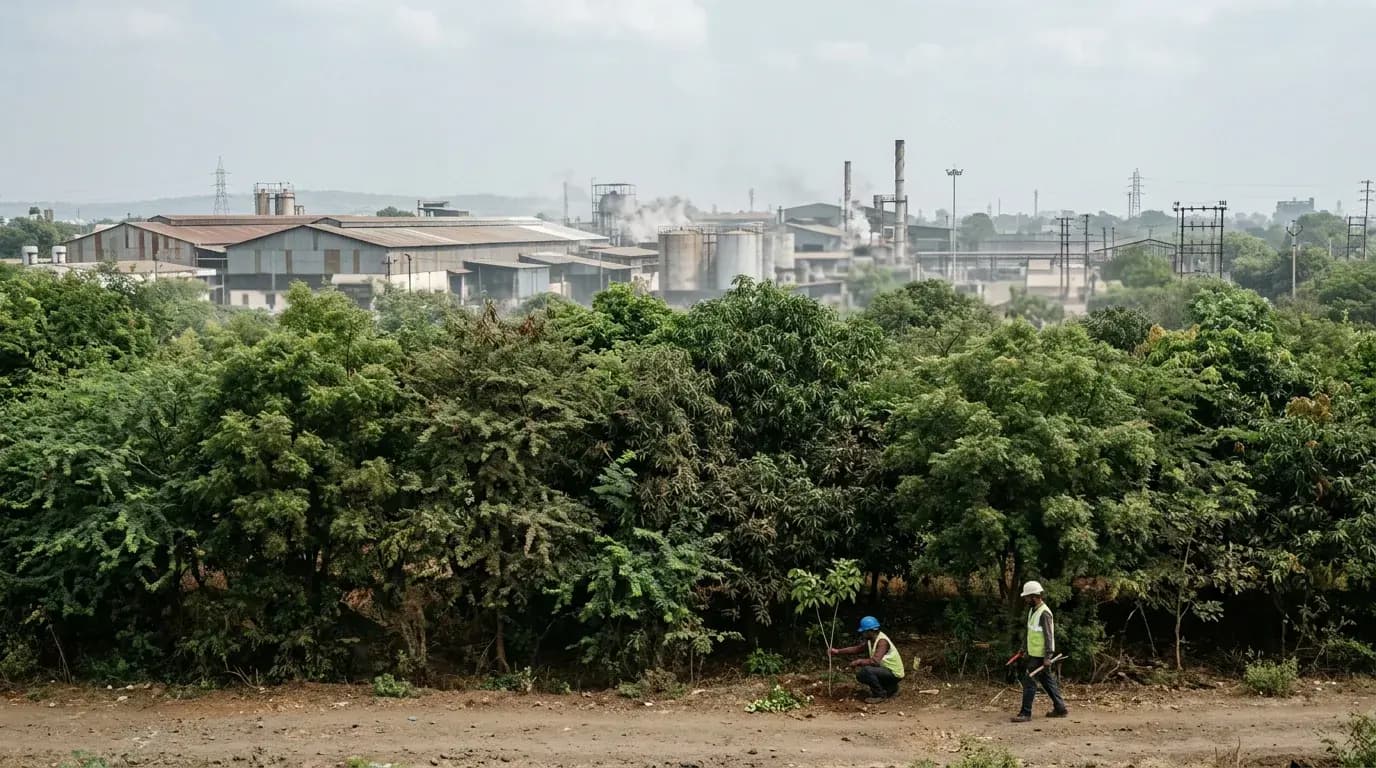
Green Belt Development for Industries in Val, Bhiwandi.
Green Belt Development for Industries for Val: read against this area's own ground, not the city's average.
Why Val
The ground this work sits on here.
- Area
- Val, Bhiwandi
- Practice
- Urban Ecology and Green Infrastructure Services
- Typically for
- Industrial units, estates, MIDC plots, chemical and manufacturing sites
Conditions on Val's parks usually fix a proportion of each plot for planting, most often along the boundary. The ground there is typically compacted fill, and the yards beside it are hot, dusty and exposed. We rework the soil in the planting strips before anything goes in, choose native trees that take heat and poor ground, and place the denser belts where the park faces village houses, so the planting screens dust and noise as well as meeting the count.
Val is one of the villages near the Mumbai–Nashik highway that has been absorbed into Bhiwandi's warehousing belt. Where there were once paddy fields, grazing land and low hills, there are now logistics parks of long, high sheds with wide truck yards and rows of loading docks, many let to online retailers, consumer brands and third-party logistics firms. Most parks went up in stages over roughly the past fifteen years, and new ones are still under construction. Village houses, temples and small farm plots survive in the gaps between them, and heavy vehicles use the approach roads at every hour.
How it works
Green Belt Development for Industries, from survey to survival.
- 01/04
Condition & buffer planning
The EC and consent green-cover conditions read, and a buffer plan sized and structured to meet them on the available plot.
- 02/04
Species selection
Pollution- and dust-tolerant native species chosen for attenuation, screening and survival at an industrial boundary.
- 03/04
Planting & establishment
Multi-row planting and the establishment care a buffer needs to close its canopy.
- 04/04
Compliance records
Documentation of the green cover developed and maintained, for the post-EC compliance file.
Proof
Comparable work we've delivered.
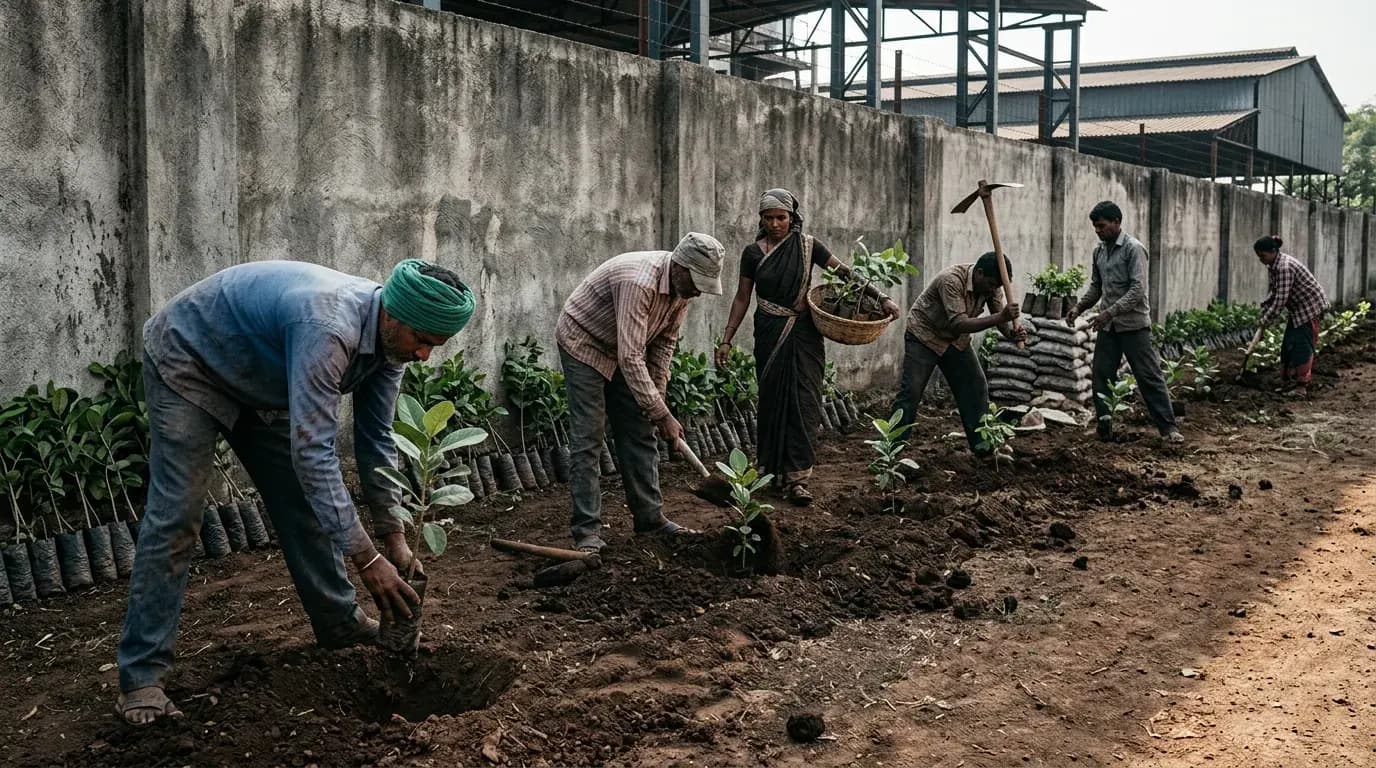
· Jamnagar, Gujarat
Miyawaki Plantations at Jamnagar and Junagadh
Land preparation, soil treatment, plantation and irrigation delivered phase-wise in four months.
See the full case →The record
The work, project by project.
Mandate, method and measured outcome, written end to end for every project on this list.
ESDD reports for Panvelkar and Tridhatu Group developments under the last-mile funding window for stalled affordable and mid-income projects.
Read the case studyStraight answers
Green Belt Development for Industries in Val: common questions.
01How much of our park must be planted?
The share is fixed by your clearance or consent conditions, and planning rules may add a requirement too. Having read each document, we work out the area and tree count required and plan the planting on ground that can actually sustain trees, with a record of survival that the next inspection or buyer can check.
02How long does green belt development for industries take in Val?
On timing: planting seasonal; establishment 2–3 years. A realistic Val schedule is set once the site and the scope have been read, and the work is carried through to the outcome by the same named people.
In the press
Covers, features and conversations: the work, talked through.



Keep exploring
Where this connects.
Also in Val
Other work written for Val's own ground.
- Environment Clearance
- Post-EC Compliance
- MPCB Consent
- Sewage Treatment Plants
- Statutory Compliance Management
- Environment Management & Mitigation Plan
Green Belt Development for Industries nearby
The same work, elsewhere across Bhiwandi.
Green Belt Development for Industries: the full serviceClients & partners
The work is trusted where the stakes are highest.
Two decades of clearances, treatment plants and green infrastructure delivered for India’s builders, industry and public bodies, and the global engineering firms beside them.





























































Green Belt Development for Industries in Val? Start with the ground you have.
One conversation to walk the site and plan for what survives: not just what gets planted.