









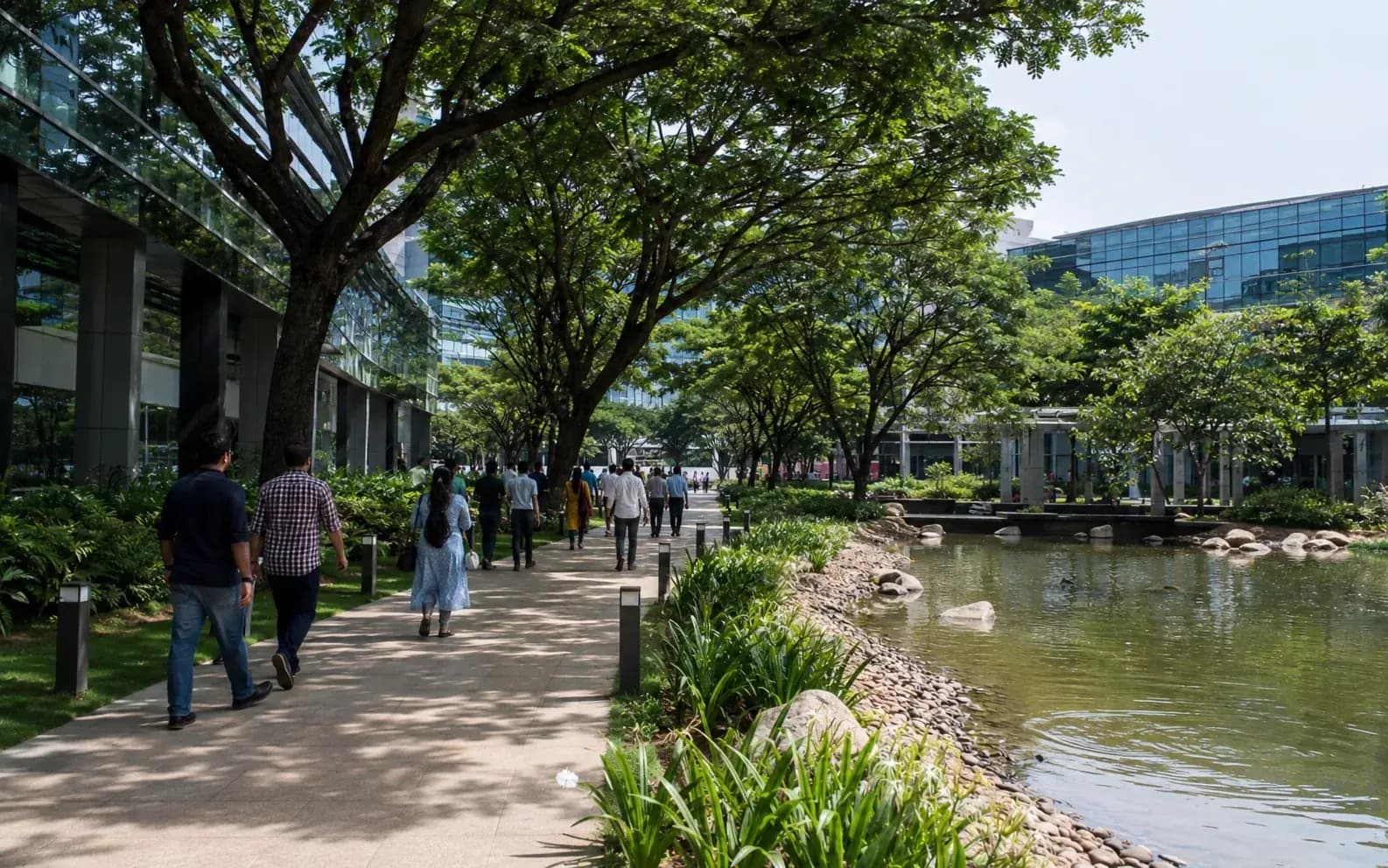
Tree Management · Corporate Campuses
Tree Management & Tree Authority NOC for Campuses
A campus expanding into its own grounds still needs tree enumeration, transplantation assessment and Tree Authority permission before ground is broken, because ownership of the land does not carry ownership of the trees on it.
Screening view on your project, with the category and route named. No obligation.
What this means for corporate campuses
Estate teams are regularly surprised by this. A company that owns its campus outright assumes it may clear a corner of its own lawn for a new block, and finds that felling or transplanting trees requires permission from the local Tree Authority, in Maharashtra under the Maharashtra (Urban Areas) Protection and Preservation of Trees Act 1975: supported by an enumeration of the affected trees, a case for why each has to be removed, and a compensatory planting commitment. Mature campus trees are often the oldest and largest in their locality, which raises both the compensatory requirement and the reputational stakes if they are removed without process.
How KIPL runs it
KIPL handles enumeration and the application, but the more useful work happens earlier: assessing which trees can be retained by adjusting the building footprint, which can realistically be transplanted given species, girth and season, and which genuinely have to go. Transplantation is where campuses lose credibility, because trees are moved in the wrong season with inadequate root ball preparation, reported as transplanted, and are dead within two years, a fact that becomes visible in the aftercare record if anyone looks. We assess feasibility honestly before it is committed to in an application, and we treat the aftercare period as part of the scope rather than as a handover.
- Trees Act 1975
Permission is required on owned land
Felling or transplanting trees in urban areas of Maharashtra requires Tree Authority permission under the Maharashtra (Urban Areas) Protection and Preservation of Trees Act 1975, irrespective of land ownership.
Compensatory planting is a condition
Permission is granted with compensatory planting and aftercare obligations that the campus must have the land and the maintenance arrangement to honour.
Clearance conditions and green cover commitments
Where the campus operates under an Environment Clearance, its green cover and plantation commitments interact directly with any tree removal on site.
What you receive
Written for corporate campuses, not adapted from a template.
- 01Tree enumeration with species, girth, height, health and geo-referenced position
- 02Retention assessment against the proposed footprint, identifying trees savable by design adjustment
- 03Transplantation feasibility by species, girth and season, stated honestly rather than optimistically
- 04Tree Authority application with justification and the compensatory planting proposal
- 05Transplantation execution with root ball preparation, pit preparation and post-move care
- 06Aftercare and survival monitoring record for the period the permission requires
Questions from corporate campuses
What corporate campuses ask before appointing us.
Answered against the regulation as it stands, not as a sales pitch. If your situation is not here, ask us directly.
Ask a question →Do we need permission to cut a tree on land we own?
In urban areas of Maharashtra, yes. The Maharashtra (Urban Areas) Protection and Preservation of Trees Act 1975 requires permission from the local Tree Authority to fell trees, and ownership of the land does not exempt the occupier. Other states have their own equivalent legislation, so the position should be confirmed for the campus's location.
What does the application need?
An enumeration of the affected trees with species, girth and condition, the reason each tree must be removed or moved, and a compensatory planting proposal. Applications are commonly returned for a weak enumeration or for a compensatory proposal the site cannot actually accommodate.
Is transplantation always possible?
No. Feasibility depends on species, girth, root habit, the season and the receiving site. Large mature specimens of some species transplant poorly whatever the care taken. Committing to transplant a tree that will not survive produces a worse outcome than an honest case for removal with proper compensatory planting.
Why do transplanted campus trees die?
Usually because they were moved in the wrong season, with an inadequate root ball, into an unprepared pit, and then not watered through the establishment period. Each of those is a decision made before the move, which is why the aftercare regime should be agreed at the same time as the transplant.
How does this interact with our Environment Clearance?
Where the campus holds a clearance, its conditions typically include green cover and plantation commitments, and removing trees affects compliance against them. Tree removal and compensatory planting should therefore be reflected in the campus's compliance reporting, not handled as a separate municipal matter.
How long does Tree Authority permission take?
It follows the authority's own process and meeting cycle, which varies by local body. The controllable part is the quality of the enumeration and the compensatory proposal, since incomplete applications are the usual cause of delay. Building programmes should allow for the permission before mobilisation rather than during it.
Stage by stage
How tree management actually runs, step by step.
Also for corporate campuses
The rest of the environmental brief for this sector.

Relevant proof
MCGM GARDEN DEVELOPMENT- MIYAWAKI PLANTATION
Miyawaki dense forestation across 27 locations in 7 wards using native species, delivered under the municipal greening programme.
- Area
- ~74,000 m²
- Trees
- ≈1,10,000
- CO₂ (est.)
- 2,052 t
Where we do this
Tree Management for corporate campuses, city by city.
Other sectors
Who else we run tree management for.
Next step
Tell us the project, and we will tell you the category and the route.
Screening is the cheapest stage to get right and the most expensive to get wrong. We will say plainly what tree management your corporate campuses project needs, and what it does not.





























































Start the conversation