










Green Belt Development for Industries · Corporate Campuses
Green Belt Development for Corporate Campus Perimeters
The perimeter green belt is both the campus's acoustic and visual screen and, where the campus holds an Environment Clearance, a stated condition of it that is checked in compliance reporting.
Screening view on your project, with the category and route named. No obligation.
What this means for corporate campuses
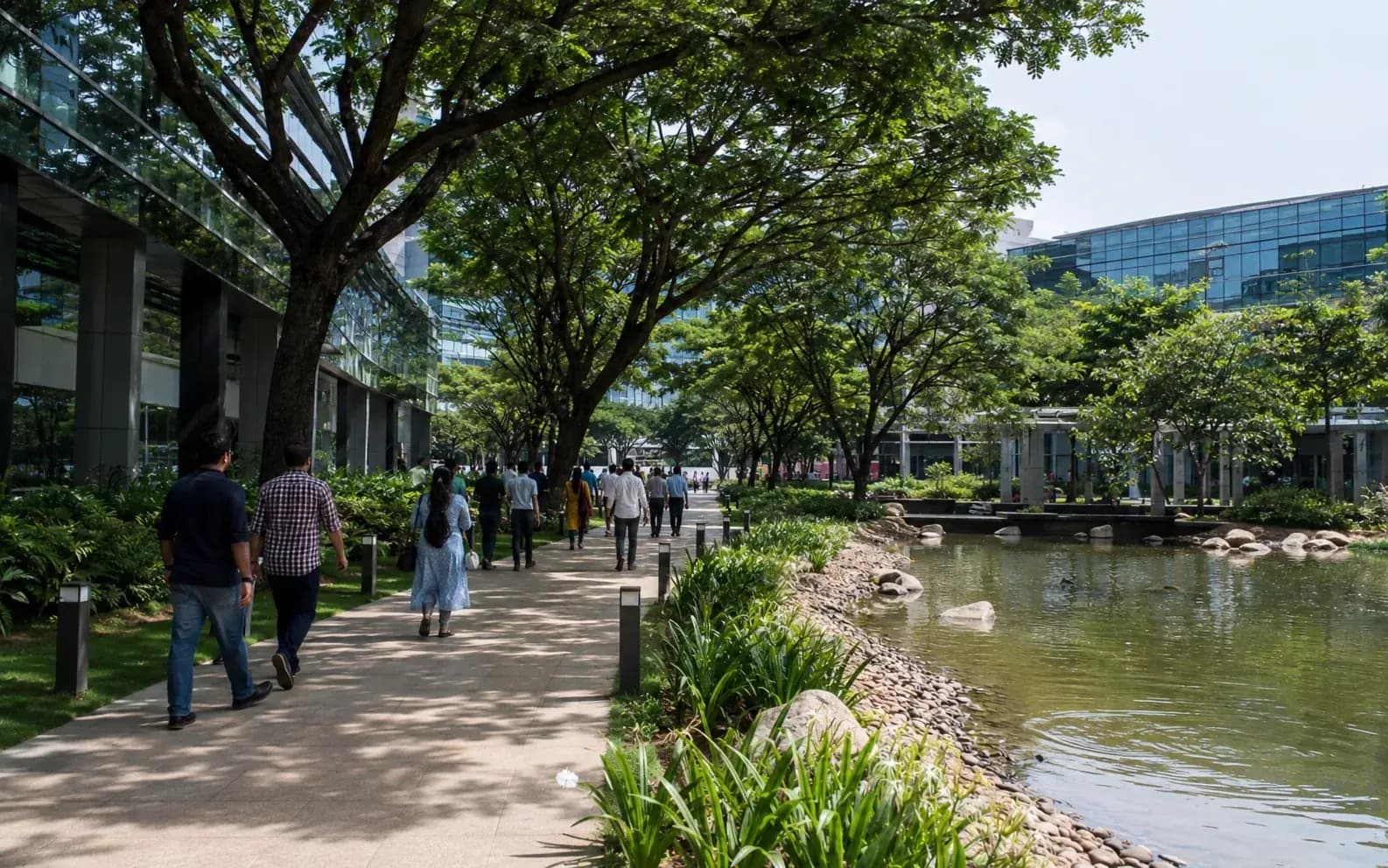
Green belt has a dual character on a corporate campus, and estate teams tend to see only one of them. Functionally it is a buffer: it screens the campus from the road and the neighbours, intercepts dust, attenuates traffic and plant noise at the boundary, and separates operational areas such as the generator yard, the sewage treatment plant and the waste room from occupied space and from the neighbours who complain about them. Regulatorily, where the campus was built under an Environment Clearance, the green belt area and species were committed in the application and appear as clearance conditions, and the half-yearly compliance report has to state what has actually been achieved against them.
How KIPL runs it
KIPL designs the belt to do the functional job (layered planting with the density and height needed for the specific screening or attenuation task, species that tolerate the boundary conditions of dust, reflected heat and restricted root run) and then reconciles it against whatever was committed in the clearance file. That reconciliation is where campuses find problems: an area commitment that a later building encroached on, a species list from the original application that bears no relation to what is growing, or a percentage of plot area that was never achieved and has been reported as achieved for years. Correcting that position is more straightforward when it is found by the campus than when it is found at an inspection.
- EC condition
Green belt is a clearance commitment
Where a campus was built under an Environment Clearance, the green belt area and planting were committed in the application and are conditions reported against half-yearly.
Buffering operational areas from neighbours
Generator yards, treatment plants and waste handling areas sit at the campus edge, and the belt is what separates their noise, odour and appearance from adjoining occupiers.
Boundary conditions are hostile to planting
Perimeter strips carry dust, reflected heat, restricted root run and service corridors, so a belt planted with an inland campus palette performs poorly.
What you receive
Written for corporate campuses, not adapted from a template.
- 01Reconciliation of existing green belt against the area, width and species committed in the clearance file
- 02Function-wise design brief by boundary segment: visual screening, noise attenuation, dust interception
- 03Layered planting specification with species selected for boundary conditions and target height
- 04Root run, service corridor and access constraints resolved before planting layout is fixed
- 05Planting execution and establishment maintenance through the period required for the belt to perform
- 06Compliance evidence pack (area achieved, species, survival) for half-yearly clearance reporting
Questions from corporate campuses
What corporate campuses ask before appointing us.
Answered against the regulation as it stands, not as a sales pitch. If your situation is not here, ask us directly.
Ask a question →Is our green belt a legal requirement or just good practice?
If the campus holds an Environment Clearance, the green belt committed in the application is a condition of that clearance and is reported against in the half-yearly compliance report. Where no clearance applies, the belt is a functional and planning matter rather than a clearance condition, though local development control rules may still prescribe open space and planting.
What if our actual green belt is smaller than what was committed?
It is a compliance gap and should be addressed deliberately. The options are to restore the area where land permits, or to place the position on record with the authority alongside what the campus has done instead. Continuing to report an area that does not exist is the outcome to avoid, because it converts a shortfall into a misstatement.
Does a green belt actually reduce noise?
Vegetation alone provides limited attenuation compared with a solid barrier, and its main contributions are perceptual screening and, where the belt is deep and densely layered, some measurable reduction. Where a specific noise target exists at the boundary, the belt should be designed alongside a physical barrier rather than expected to achieve it by itself.
What species work on a campus perimeter?
Species that tolerate dust loading, reflected heat from paving and boundary walls, restricted root run and often poor made ground. This is a different palette from the campus interior, and using the interior palette at the boundary is a common reason perimeter planting looks thin while the core landscape thrives.
How is the green belt reported in compliance?
By area achieved, species planted and survival, with photographic and survey evidence. Compliance reports that state a percentage without evidence behind it are exactly what an inspection tests, so the evidence pack should be assembled as the belt develops rather than reconstructed before a submission.
Can the green belt double as habitat or amenity?
It can, and layered native planting for screening supports habitat well. Amenity use is more constrained, since a belt in recreational use loses the understorey that gives it screening and buffering value. Where both are wanted, they are better allocated to different segments of the boundary.
Stage by stage
How green belt development for industries actually runs, step by step.
Also for corporate campuses
The rest of the environmental brief for this sector.
Primary sources
Verify any of this at the source.
Relevant proof
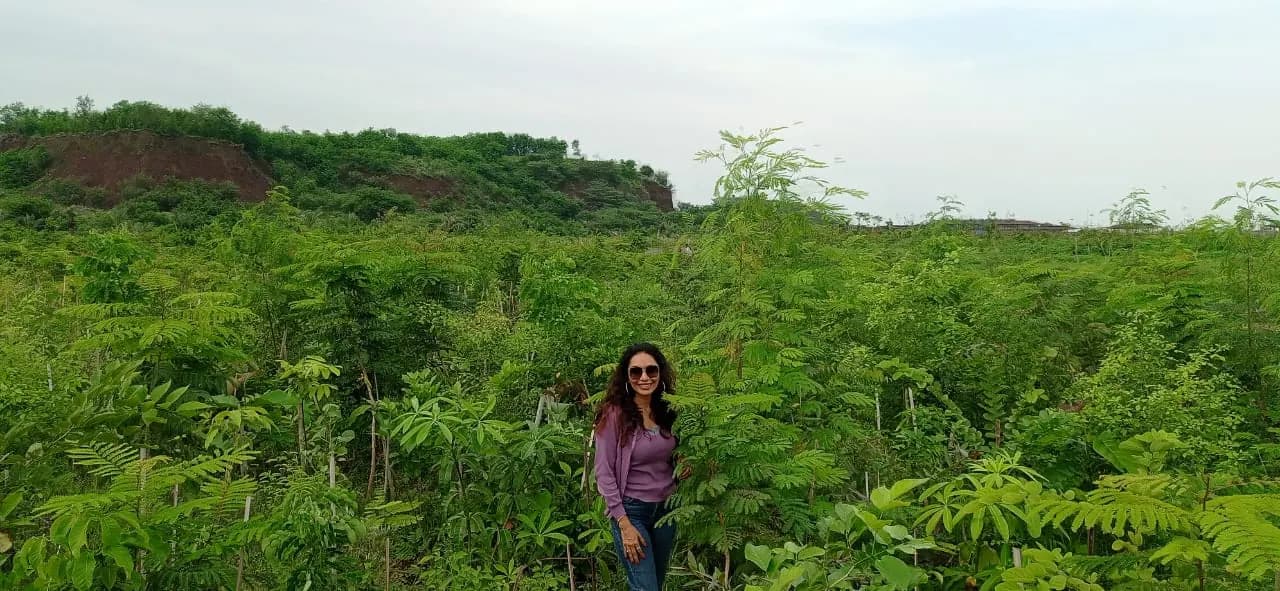
Miyawaki Plantations at Jamnagar and Junagadh
Land preparation, soil treatment, plantation and irrigation delivered phase-wise in four months.
- Area
- 24,000 m²
- Native plants
- 82,000
Where we do this
Green Belt Development for Industries for corporate campuses, city by city.
Other sectors
Who else we run green belt development for industries for.
Next step
Tell us the project, and we will tell you the category and the route.
Screening is the cheapest stage to get right and the most expensive to get wrong. We will say plainly what green belt development for industries your corporate campuses project needs, and what it does not.





























































Start the conversation