










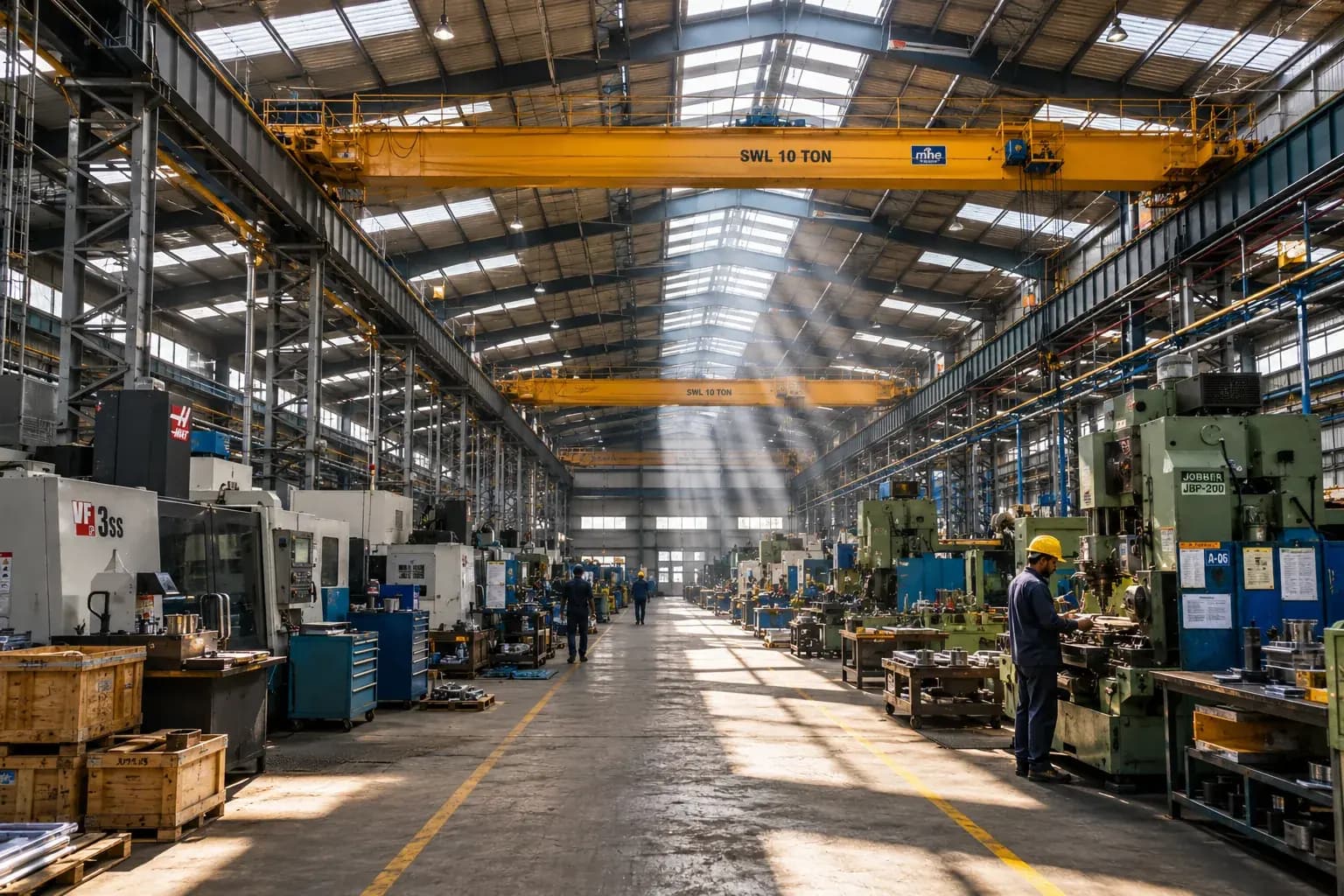
Environment Management & Mitigation Plan · Industrial & Manufacturing
Environment Management and Mitigation Plan for Manufacturing Units
An Environment Management Plan is only useful to a manufacturing unit when it is written against the actual process steps (this line, this stack, this rinse tank, this waste stream), rather than as a general EHS document that production has never read.
Screening view on your project, with the category and route named. No obligation.
What this means for industrial & manufacturing
The EMP converts identified impacts into named controls with frequencies, budgets and owners, and where a clearance exists it is the document the EC conditions are drawn from. In manufacturing the difference between a working EMP and a shelf document is where the controls attach. A plan that says fume extraction shall be maintained is unenforceable; a plan that names the extraction system on a specific line, states the airflow to be verified, the frequency, the person responsible and the record kept, becomes part of how the line is run. The same is true of effluent segregation at a pickling or plating station, of DG set operation and its emission and noise position, of hazardous waste at the point it is generated rather than at the storage yard, and of the interface with worker safety: because in practice the same solvent, dust or fume that is an emission is also an occupational exposure, and the controls overlap even though the statutes do not.
How KIPL runs it
KIPL builds the EMP from a process walk rather than from a template: each unit operation examined for what it emits, discharges and generates, the control assigned at that point, and the record that proves it. Monitoring is specified where it is diagnostic rather than everywhere it is possible. Budgets are separated into capital and recurring so they can be approved and then defended in year three. Ownership is assigned to production and maintenance roles alongside EHS, because a control that only EHS owns is a control that stops during a production push. Where the unit holds an EC, we keep the EMP and the condition register aligned so the plan is not committing to one thing while the clearance requires another. The failure mode of a generic EMP is not inaccuracy; it is irrelevance: a document nobody on the shop floor has seen, producing compliance reports that describe controls the plant does not actually operate.
The EMP becomes the conditions
Where a clearance exists, appraisal draws EC conditions from the management plan submitted, so an over-committed EMP creates obligations the plant is measured against for years.
- HOWM 2016
Waste control starts at generation
Hazardous waste obligations under the 2016 Rules are far easier to meet when segregation, labelling and record-keeping are designed at the point of generation rather than at the storage yard.
The safety interface is real
Fume, dust and solvent controls serve both emission compliance and occupational exposure. An EMP written in isolation from plant safety duplicates effort and leaves gaps between the two.
What you receive
Written for industrial & manufacturing, not adapted from a template.
- 01Process-step impact matrix: each unit operation mapped to its emissions, effluent streams and waste, with the control assigned at that point
- 02Air management plan covering process stacks, fume and dust extraction, and DG sets, with verification frequency and records
- 03Effluent segregation and treatment plan tied to the specific stations that generate each stream
- 04Hazardous waste plan from point of generation: segregation, labelling, storage duration, manifest and authorised disposal route
- 05Capital and recurring EMP budget with ownership assigned across production, maintenance and EHS, not EHS alone
- 06Monitoring schedule that serves the consent, the EC conditions where they exist, and Form-V from one dataset
Questions from industrial & manufacturing
What industrial & manufacturing ask before appointing us.
Answered against the regulation as it stands, not as a sales pitch. If your situation is not here, ask us directly.
Ask a question →What makes an EMP actually get used on the shop floor?
Controls written against named equipment and named process steps, with a frequency and an owner who works on that line. A plan that generalises across the plant is read once by EHS and never again. The test is whether a supervisor can look up what they are responsible for on their line and find a specific answer.
Should the EMP be integrated with our ISO 14001 system?
It should share the same registers and records rather than run in parallel. ISO 14001 gives you the aspect-impact discipline and the document control; the EMP carries the regulatory commitments made in your clearance or consent. Keeping them on one set of records avoids the common situation where the certified system says one thing and the compliance report says another.
How does the EMP relate to worker safety obligations?
They are separate statutory regimes with overlapping physical controls. Extraction at a welding or plating station reduces both stack-relevant emissions and worker exposure; solvent handling controls serve both. The EMP should acknowledge the interface so the two functions specify equipment once, rather than each buying its own solution for the same hazard.
How detailed should the EMP budget be?
Capital and recurring stated separately, with the recurring figure realistic for a full year of operation. Appraisal committees read an unfunded EMP as a commitment that will not be met, and inside the plant an unbudgeted control is the first thing dropped when the line is under pressure. A budget that survived approval is what makes the plan durable.
When should the EMP be revised?
Whenever the process changes: a new line, a new product, a modernisation, a change of solvent or process chemical, a new DG set. Between those, review it against the last two compliance reports, because a control repeatedly reported as partially implemented is telling you the plan is unrealistic rather than that the crew is failing.
Do we need an EMP if we have no Environment Clearance?
You are not filing one for appraisal, but the underlying discipline is the same and your consent conditions still require controls to be operated and recorded. A unit running on consent alone benefits from the same process-step matrix, because that is what makes an inspection or an audit straightforward to answer and what makes any future clearance file much faster to prepare.
Stage by stage
How environment management & mitigation plan actually runs, step by step.
Also for industrial & manufacturing
The rest of the environmental brief for this sector.

Relevant proof
EIA for Synthetic Organic Chemical Industry
CTE/CTO application, ToR application, baseline data collection, EIA report and appraisal before the EAC: Category 5(f), the sector KIPL holds Category A accreditation in.
- Capacity
- 20 → 140 TPM
- 5(f) accredited
- Cat A
Where we do this
Environment Management & Mitigation Plan for industrial & manufacturing, city by city.
Other sectors
Who else we run environment management & mitigation plan for.
Next step
Tell us the project, and we will tell you the category and the route.
Screening is the cheapest stage to get right and the most expensive to get wrong. We will say plainly what environment management & mitigation plan your industrial & manufacturing project needs, and what it does not.





























































Start the conversation