










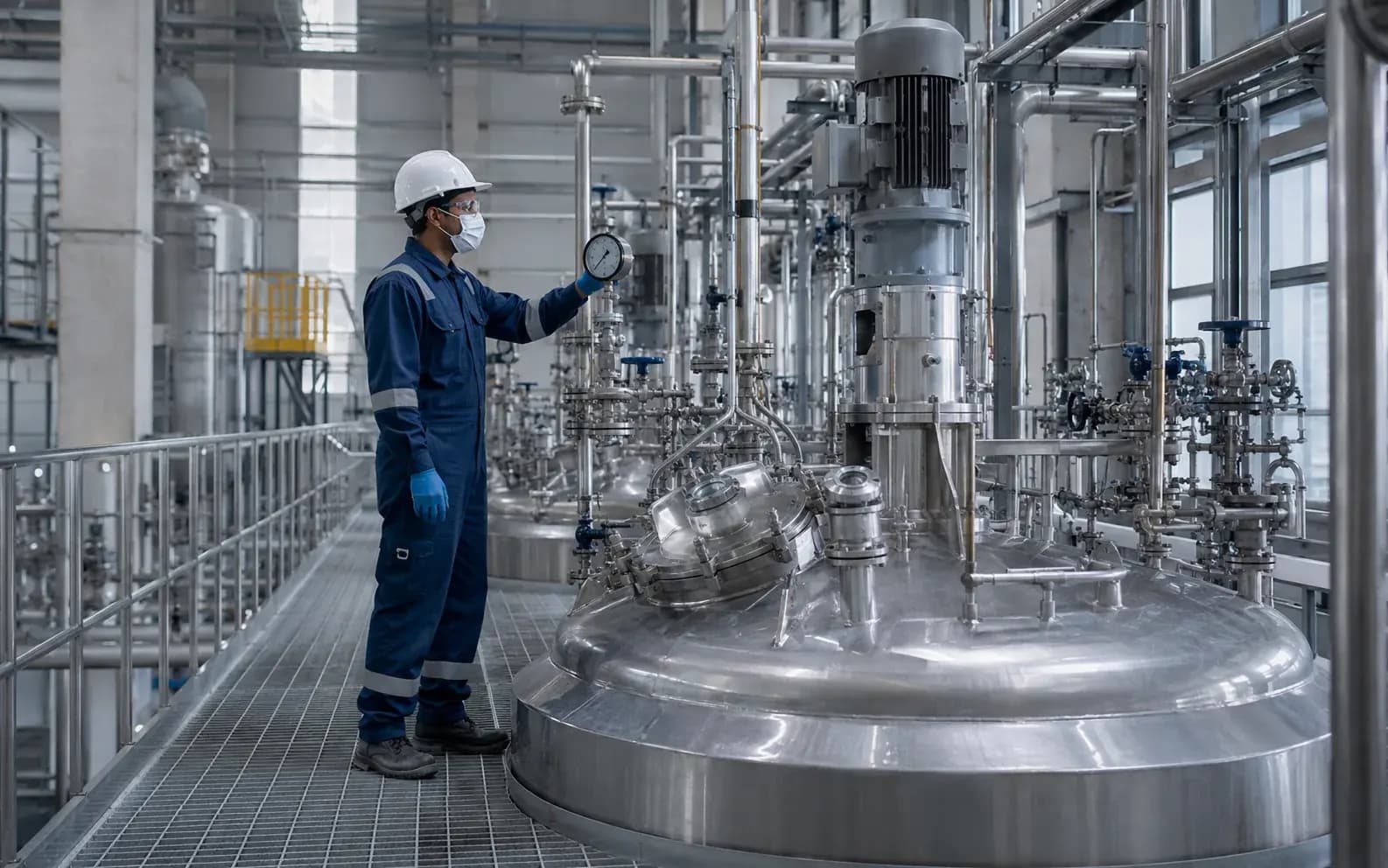
Environment Management & Mitigation Plan · Chemical Industry
Environment Management and Mitigation Plan for Chemical Plants
In a chemical plant the Environment Management Plan is the operating document that governs solvent recovery, fugitive emissions, hazardous-waste handling and emergency response: not an appendix to the EIA.
Screening view on your project, with the category and route named. No obligation.
What this means for chemical industry
For most industries an EMP describes mitigation. For a synthetic organic chemical unit it describes how the plant runs. Solvent recovery is simultaneously a process economics decision, an air emission control and a hazardous-waste reduction measure; fugitive VOC losses from pumps, flanges, sampling points and tank vents are the emissions that ambient monitoring will actually detect; the hazardous-waste storage shed's floor, slope, roof and segregation rules determine whether an inspection finds a compliant plant. And because these units hold flammable and toxic inventories, the EMP has to carry through to risk assessment and emergency preparedness: where the MSIHC Rules 1989 set threshold quantities that, once crossed, bring a safety report, an on-site emergency plan and mock-drill obligations with them.
How KIPL runs it
KIPL writes the EMP so that each commitment has a number, an owner and a record behind it: leak detection and repair on identified sources rather than a general undertaking to control fugitives, scrubber media and blowdown schedules rather than a note that scrubbers exist, secondary containment volumes at the tank farm, segregation rules by waste compatibility in the storage shed, and consequence-modelled scenarios that match the actual inventory. What goes wrong otherwise is an EMP that survives appraisal and then cannot be implemented: mitigation described in terms too general to audit, budgets that do not correspond to any equipment, and an emergency plan written for a generic plant rather than for the one that was built. That gap surfaces in the first half-yearly compliance report, and again at the first inspection.
- MSIHC 1989
Threshold quantities trigger obligations
Where the inventory of hazardous chemicals crosses the threshold quantities in the MSIHC Rules, the site becomes a major accident hazard installation with safety report, on-site emergency plan and mock-drill duties.
- EC conditions
The EMP becomes enforceable
Mitigation committed in the EMP is written into the clearance and the consent, so it is audited half-yearly: vague commitments become unmeetable ones.
- VOC
Fugitive emissions are the real air issue
For a solvent-handling plant the dominant air impact is not the stack but the diffuse loss from seals, vents and transfers, and the EMP has to address it source by source.
What you receive
Written for chemical industry, not adapted from a template.
- 01Solvent balance and recovery plan: consumption, recovery, losses to air and residue to hazardous waste
- 02Fugitive VOC control programme with identified sources, leak detection and repair frequency and closed-transfer measures
- 03Hazardous-waste management plan: category-wise segregation, compliant storage design, manifest discipline and disposal route
- 04Air emission control specification: scrubbers, media, blowdown handling and stack monitoring against consent parameters
- 05Risk assessment with consequence modelling, on-site emergency plan inputs and mock-drill schedule against MSIHC obligations
- 06Monitoring programme, budget and responsibility matrix in the form the half-yearly compliance report will draw from
Questions from chemical industry
What chemical industry ask before appointing us.
Answered against the regulation as it stands, not as a sales pitch. If your situation is not here, ask us directly.
Ask a question →Why is risk assessment part of a chemical EMP rather than a separate safety exercise?
Because the environmental consequence of a chemical plant's worst day is larger than its consequence on a normal one. Consequence modelling of the actual inventory, containment design and the on-site emergency plan belong with the mitigation measures, and the appraisal committee reads them together.
What is a major accident hazard installation?
A site holding hazardous chemicals above the threshold quantities set in the schedules to the MSIHC Rules 1989. Crossing that threshold brings obligations including a safety report, an on-site emergency plan, notification to the authorities and periodic mock drills, and it makes the district authority responsible for an off-site plan.
How specific does the EMP need to be about solvent recovery?
Specific enough to audit. A solvent balance should state consumption, recovered quantity, losses to air and residue reporting to hazardous waste, because those figures reappear in the compliance report and in the hazardous-waste return. A general statement that solvents are recovered cannot be checked and will be questioned.
Does the EMP have to carry a budget?
Yes, both capital and recurring, and it should correspond to identifiable equipment and activities. Budgets that cannot be tied to a scrubber, an analyser, a monitoring contract or a storage structure are the ones that fail scrutiny when compliance is assessed against expenditure.
Who implements the EMP after clearance?
The plant does, through named responsibilities. The reason to write it with an owner against each measure is that the half-yearly compliance report is assembled from those records (monitoring results, maintenance logs, manifest copies, drill reports) and a plan without owners produces no records to assemble.
Can an existing EMP be strengthened without reopening the clearance?
Improving mitigation beyond what was committed does not require reopening the clearance; committing to less does. Where an EMP has proved unimplementable as written, the practical route is to document the equivalent or better measure actually adopted and report it, rather than to leave the original commitment unmet in the record.
Stage by stage
How environment management & mitigation plan actually runs, step by step.
Also for chemical industry
The rest of the environmental brief for this sector.

Relevant proof
EIA for Synthetic Organic Chemical Industry
CTE/CTO application, ToR application, baseline data collection, EIA report and appraisal before the EAC: Category 5(f), the sector KIPL holds Category A accreditation in.
- Capacity
- 20 → 140 TPM
- 5(f) accredited
- Cat A
Where we do this
Environment Management & Mitigation Plan for chemical industry, city by city.
Other sectors
Who else we run environment management & mitigation plan for.
Next step
Tell us the project, and we will tell you the category and the route.
Screening is the cheapest stage to get right and the most expensive to get wrong. We will say plainly what environment management & mitigation plan your chemical industry project needs, and what it does not.





























































Start the conversation