









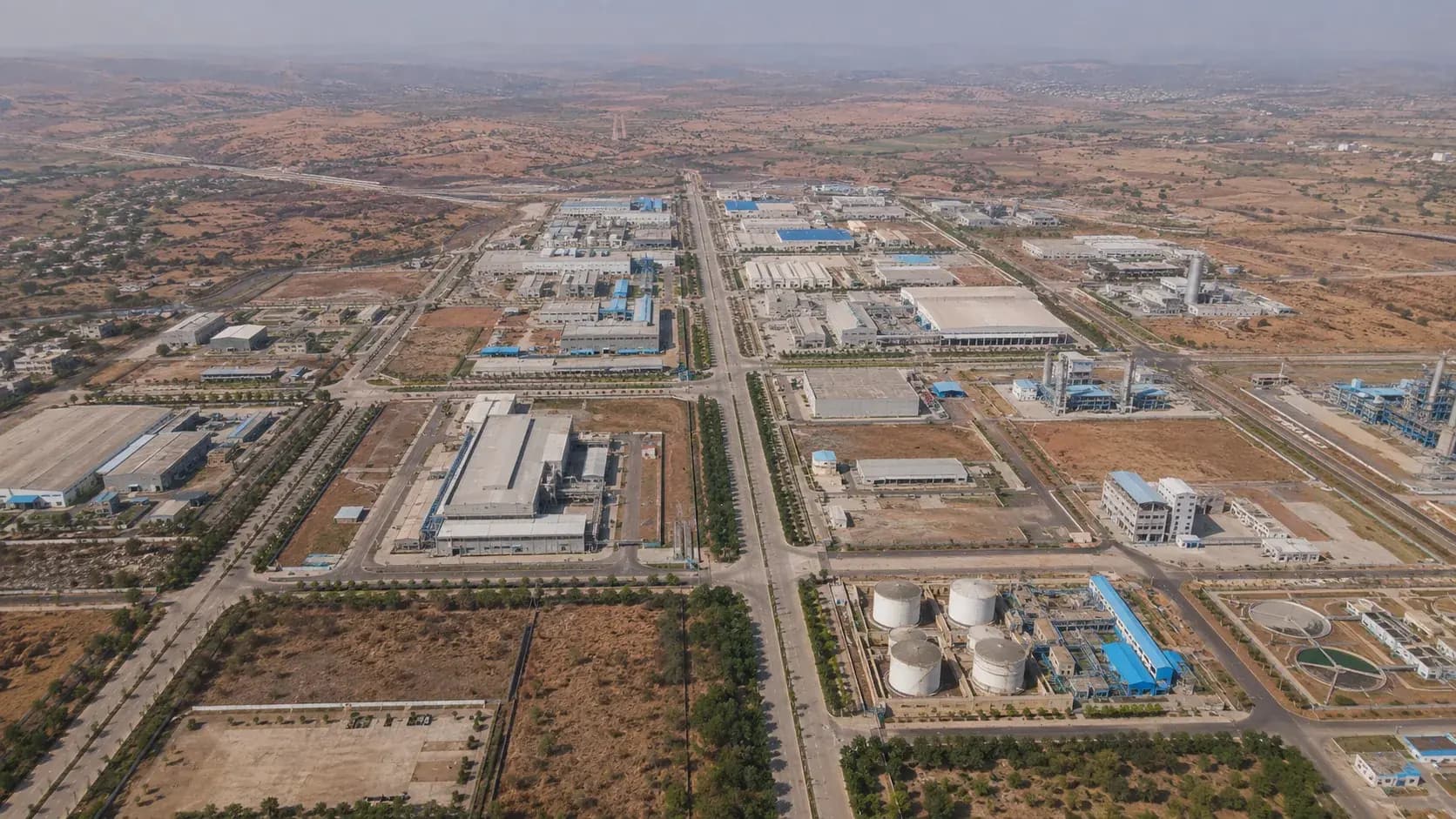
Miyawaki Urban Dense Forestation · Industrial Corridors & MIDC
Miyawaki Dense Forestation for Industrial Corridors and MIDC Nodes
Dense native forestation gives a corridor node its buffer canopy years earlier than conventional avenue planting, which matters when green belt area and progress are reported against the node's clearance every six months.
Screening view on your project, with the category and route named. No obligation.
What this means for industrial corridors & midc
A node's green belt commitment is made at master-plan and clearance stage and is then reported on for years while the estate is still being built. Conventional plantation on stripped, compacted greenfield land establishes slowly and shows little for a long time, which is awkward when the commitment is to a buffer between the estate and its neighbouring villages. Dense forestation compresses that: it delivers canopy structure on defined parcels within a few seasons, which is what makes it useful on the segments of buffer where the node is under most scrutiny.
How KIPL runs it
KIPL delivers dense plantation at industrial scale: including on an operating industrial estate at Jamnagar and Junagadh, covering 24,000 square metres and 82,000 native plants delivered phase-wise. At a greenfield corridor node the determining factor is ground condition: earthwork strips topsoil and compacts the subsoil, and planting into that without profile restoration produces uniform failure whatever the method. We assess and specify soil and assured water first, then plant, then record survival by parcel, because the compliance report asks for area and survival, not for a photograph.
- EIA Notification 2006
Green belt is a reported clearance condition
Area planted against area committed appears in the node's half-yearly compliance reporting throughout development, so early, verifiable progress on the buffer has a regulatory value.
Buffer to neighbouring settlements
The band between the estate and surrounding villages is the commitment those communities can see. Canopy that establishes in a few seasons rather than a decade changes what the authority can show.
Land is available in phases
A node has parcels awaiting development that can carry dense plantation now, letting the authority build canopy on the schedule of the land rather than of the tenants.
What you receive
Written for industrial corridors & midc, not adapted from a template.
- 01Parcel selection across the node against the approved green belt and buffer layout
- 02Soil assessment and profile restoration specification for stripped and compacted greenfield ground
- 03Native species matrix drawn from the local floristic region, layered for structure
- 04Assured irrigation for the establishment period, using treated water from the node where available
- 05Phase-wise planting programme aligned with land availability and development sequence
- 06Parcel-wise area and survival records formatted for the half-yearly compliance report
Questions from industrial corridors & midc
What industrial corridors & midc ask before appointing us.
Answered against the regulation as it stands, not as a sales pitch. If your situation is not here, ask us directly.
Ask a question →Does dense plantation count towards the node's green belt commitment?
It counts as green belt area on the parcels where it is planted, and the compliance report is stated in area and location against the approved layout. What it changes is how quickly that area develops canopy structure. The parcels still have to be the ones the layout designates as green belt or buffer, not convenient spare land elsewhere.
Why does plantation fail on greenfield corridor land?
Because earthwork removes topsoil and compacts what remains, leaving ground with no structure, poor infiltration and no biological activity. Planting into it fails regardless of species or method. Stripped topsoil should be stockpiled during the earthwork contract and reused, which is a decision taken before the earthwork is tendered rather than after.
Where should a node plant first?
On the buffer segments facing settlements and on the boundaries of the phases under active development, because that is where canopy has the most effect and where the authority is most observed. Planting a uniform thin band around the whole node at once spreads the water and maintenance effort so thin that little of it establishes.
What water does dense plantation need at a greenfield site?
Assured irrigation through the establishment period, after which it becomes largely self-sustaining. At a water-scarce node the practical source is treated water from the node's own sewage infrastructure, distributed to the planted parcels. Planting without a secured water arrangement for those first seasons is the second most common cause of failure after soil.
How is survival reported for compliance?
Parcel by parcel, with area, planting date, count and survival at each monitoring round, geo-referenced. A single programme-wide figure conceals the parcels that failed, which is exactly what an audit walking the boundary will find. Parcel-level records let the authority state and defend its position without a fresh survey.
Can allottees be required to do this within their plots?
Plot-level green area obligations belong in the allotment terms, and dense plantation is one way an allottee can meet them on a constrained plot. The authority can specify the area and the outcome, and should verify it as part of plot-level compliance, since plot green area also contributes to what the node reports.
Stage by stage
How miyawaki urban dense forestation actually runs, step by step.
Also for industrial corridors & midc
The rest of the environmental brief for this sector.

Relevant proof
MCGM GARDEN DEVELOPMENT- MIYAWAKI PLANTATION
Miyawaki dense forestation across 27 locations in 7 wards using native species, delivered under the municipal greening programme.
- Area
- ~74,000 m²
- Trees
- ≈1,10,000
- CO₂ (est.)
- 2,052 t
Where we do this
Miyawaki Urban Dense Forestation for industrial corridors & midc, city by city.
Other sectors
Who else we run miyawaki urban dense forestation for.
Next step
Tell us the project, and we will tell you the category and the route.
Screening is the cheapest stage to get right and the most expensive to get wrong. We will say plainly what miyawaki urban dense forestation your industrial corridors & midc project needs, and what it does not.





























































Start the conversation