









Miyawaki Urban Dense Forestation · Hospitality, Healthcare & Education
Miyawaki Urban Dense Forestation for Hospital, Hotel and Education Campuses
The Miyawaki method establishes dense native vegetation in a small footprint, which suits a hospital, hotel or education campus with a plantation obligation, very little spare land, and, for an education client: an interest in what the planting can teach.
Screening view on your project, with the category and route named. No obligation.
What this means for hospitality, healthcare & education
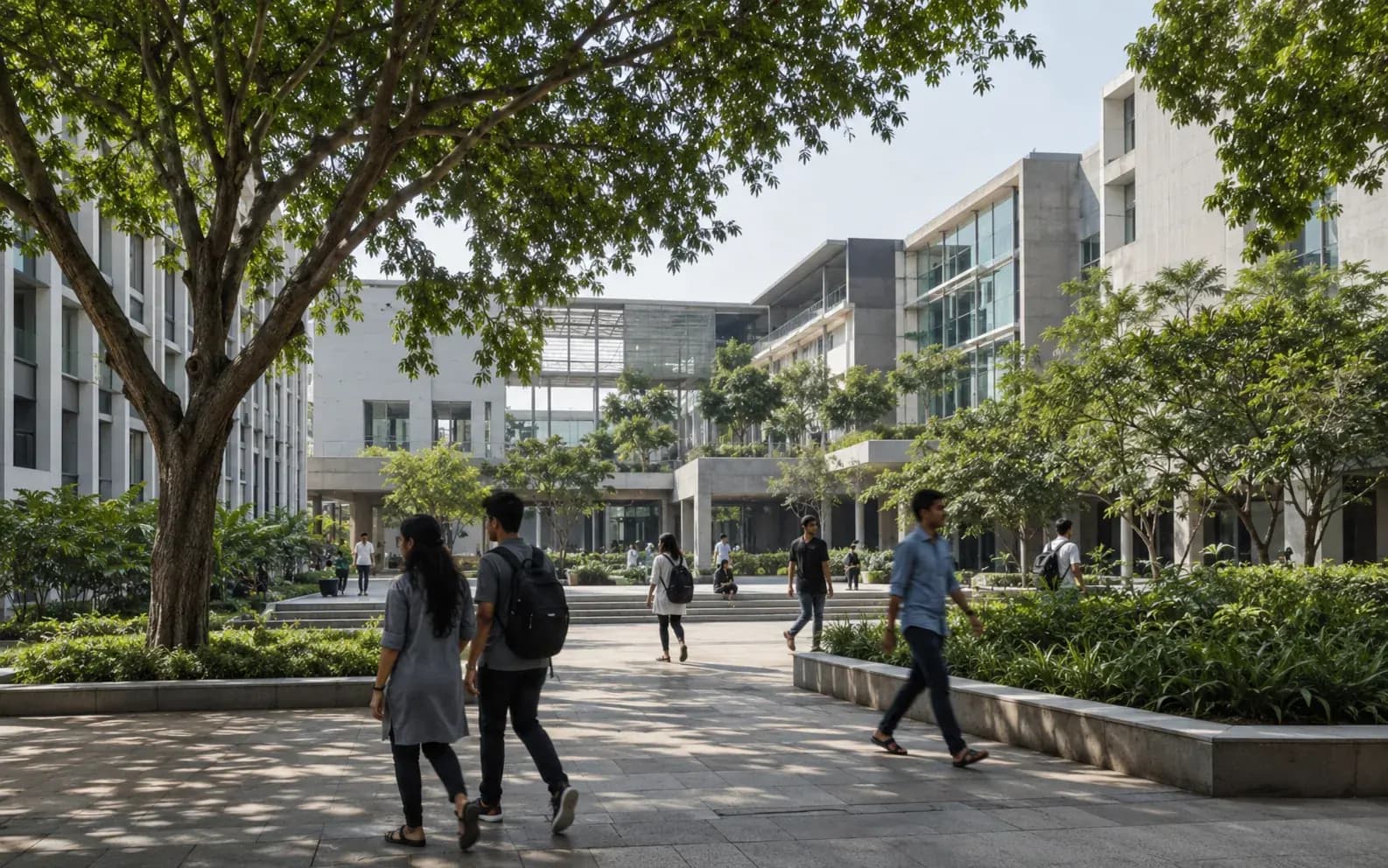
Miyawaki planting works by preparing the soil deeply, planting multi-layered native species at high density, mulching heavily and maintaining intensively for the first two to three years, after which the stand becomes largely self-sustaining. On a campus of this type the attraction is arithmetic: a clearance may require a plantation density expressed as trees per unit of plot area, and an urban hospital or hotel usually has parking, service yards, ambulance routes and setbacks consuming most of the open ground. A dense pocket on a marginal strip (beside a boundary wall, along a service edge, on land unsuitable for amenity use) can carry a meaningful share of that obligation while also providing screening, dust interception and a cooler edge. On a school or college campus the same pocket doubles as a teaching resource with a visible succession from planting to canopy over a few years.
How KIPL runs it
KIPL plans these plantings on what the site can actually sustain. Soil on an established campus is usually compacted and often contains construction debris, so the excavation, amendment and drainage work is the greater part of the effort and the part most often skipped. Species are selected as natives of the local ecology rather than from a generic list, and the location is chosen so the stand is not placed where it will conflict with campus operations: away from air intakes and ventilated waiting areas in a hospital, clear of ambulance and emergency routes, and where the intensive early watering can actually be delivered. Maintenance is contracted for the establishment years because that is what decides survival, and survival is what the compliance report records. We do not claim outcomes that depend on the site; growth and canopy performance vary with soil, water and species, and are reported as measured rather than as promised.
- EC plantation condition
Density obligations on a constrained plot
Clearances fix plantation numbers that a built-up urban campus struggles to place, and a dense pocket delivers a meaningful share of them in a small footprint.
- Screening and dust
Boundaries that need a buffer
Service yards, generator areas and road-facing edges on these campuses benefit from a dense multi-layered screen more than from scattered specimen trees.
A teaching asset on an education campus
A dense native pocket with visible succession, labelled species and a measurable growth record gives an institution something its students can use rather than only look at.
What you receive
Written for hospitality, healthcare & education, not adapted from a template.
- 01Site selection against campus operations: ambulance routes, air intakes, service access and future expansion
- 02Soil investigation and rehabilitation, including removal of construction debris and drainage correction
- 03Native species matrix with canopy, sub-canopy, shrub and ground layers for the local ecology
- 04Planting, mulching and irrigation provision for the intensive establishment period
- 05Maintenance contract for the establishment years with defined watering, weeding and replacement duties
- 06Survival and growth monitoring records suitable for EC compliance reporting, and species labelling for education campuses
Questions from hospitality, healthcare & education
What hospitality, healthcare & education ask before appointing us.
Answered against the regulation as it stands, not as a sales pitch. If your situation is not here, ask us directly.
Ask a question →How much space does a Miyawaki plot need?
It works on small footprints, which is the main reason it suits constrained campuses, and a modest strip along a boundary or beside a service yard can carry a stand. What matters more than area is depth of soil preparation and the ability to water intensively for the first two to three years. A plot placed where a hose cannot reach will not establish regardless of its size.
Can it count towards our clearance plantation requirement?
Generally the plantation condition is expressed in numbers of trees and area, and a dense native stand contributes to both, but the position should be checked against the wording of the specific clearance and reported transparently: number of saplings planted, species and survival. Reporting a dense pocket honestly is straightforward; presenting it as equivalent to something the condition did not contemplate is not.
Is it suitable next to a hospital building?
With placement judgement. Keep dense planting away from air intakes and ventilated waiting areas where pollen and litter matter, clear of ambulance and emergency access, and away from areas where dense vegetation would affect security sightlines. Placed on a service edge or boundary, it provides screening and a cooler edge without those conflicts.
How long before it looks like anything?
The method relies on high density and intensive early care to accelerate establishment, and visible change generally comes within the first few growing seasons, but growth rates depend on soil, water availability, species and climate at the specific site. We report measured growth and survival rather than offering a fixed timeline, because the variables that drive it are site-specific.
What maintenance does it need?
Intensive attention for the first two to three years (regular watering, weeding, mulch replenishment and replacement of failures) after which the stand is largely self-sustaining. That establishment period is where projects succeed or fail, so it is contracted with defined duties rather than left to the general grounds routine.
Why would a school or college want one?
Because it is a living system on the campus with a measurable record: labelled native species, layered structure, visible succession, and growth and survival data students can collect. It converts a plantation obligation into curriculum material, which is a use an ornamental lawn or a row of boundary trees does not offer.
Stage by stage
How miyawaki urban dense forestation actually runs, step by step.
Also for hospitality, healthcare & education
The rest of the environmental brief for this sector.

Relevant proof
MCGM GARDEN DEVELOPMENT- MIYAWAKI PLANTATION
Miyawaki dense forestation across 27 locations in 7 wards using native species, delivered under the municipal greening programme.
- Area
- ~74,000 m²
- Trees
- ≈1,10,000
- CO₂ (est.)
- 2,052 t
Where we do this
Miyawaki Urban Dense Forestation for hospitality, healthcare & education, city by city.
Other sectors
Who else we run miyawaki urban dense forestation for.
Next step
Tell us the project, and we will tell you the category and the route.
Screening is the cheapest stage to get right and the most expensive to get wrong. We will say plainly what miyawaki urban dense forestation your hospitality, healthcare & education project needs, and what it does not.





























































Start the conversation