










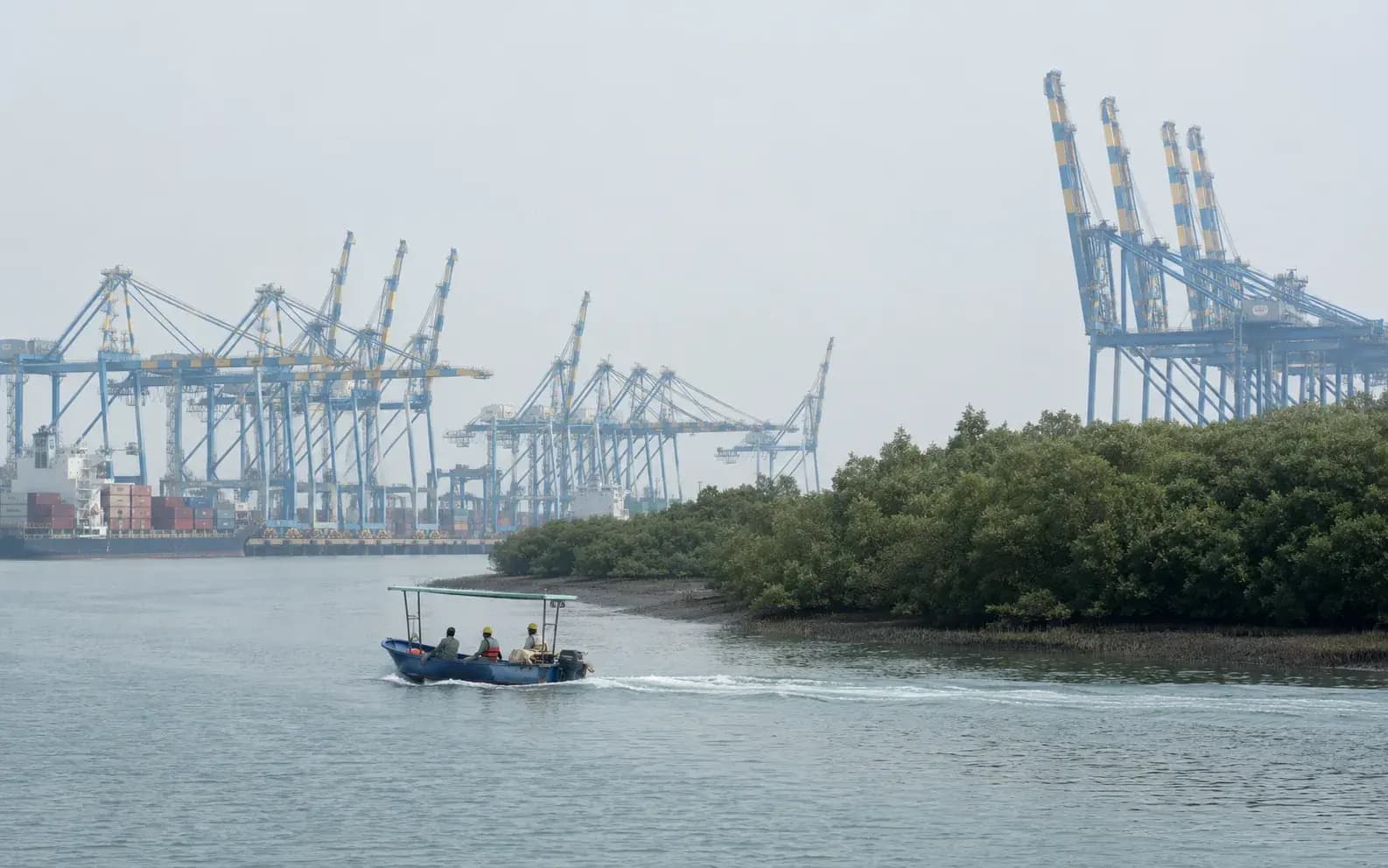
Environment Management & Mitigation Plan · Logistics & Ports
Environment Management Plan for Ports & Logistics Operations
For a port or logistics operation the Environment Management Plan has to be written as procedure (who does what, at what trigger, with what equipment) because oil spill response, dredge material handling and stormwater control fail as report clauses and only work as operating instructions.
Screening view on your project, with the category and route named. No obligation.
What this means for logistics & ports
The environmental risks of a cargo facility are event-driven rather than continuous, and that changes what an EMP has to be. A spill happens in minutes; a dredging campaign runs for weeks with a turbidity threshold that must trigger a decision by somebody on shift; the first heavy rain of the monsoon flushes months of accumulated cargo residue and oil off a very large paved surface in under an hour. None of that is managed by a mitigation table. The oil spill contingency plan has to be tiered and tied into the national response arrangements coordinated by the Coast Guard, with equipment held on site, a call-out list, and drills that are actually run and recorded. The dredge material management plan has to characterise the material before the works, fix the disposal location, specify silt curtains where they are needed, and set the turbidity trigger with a named person empowered to stop work. Stormwater has to be designed for first flush, with interception at the fuel and workshop areas and settling for a dry bulk yard, rather than a drain that discharges whatever crosses it. Cargo dust control for dry bulk means enclosure, covered conveyors, fogging, wind screens, stockpile height limits and wheel washing at the gate. Vessel-side, oily bilge and sludge have to go through reception and authorised handling rather than over the side.
How KIPL runs it
KIPL writes logistics and port EMPs as documents the terminal can actually run on: each procedure with a trigger, an owner, an equipment list and a record it produces, and each record mapped to the compliance report it will eventually feed. Marine works get a construction-phase EMP of their own, because the piling, dredging and reclamation period carries most of the risk and almost none of the operational systems are in place yet. Where the site adjoins mangroves or a creek, the protection protocol for the works (buffer marking, no storage or spoil placement, silt containment) is written into the method statement rather than left in the EIA, since the people who need it are the ones on the barge. This is home-coast work for a Navi Mumbai firm, with mandates including Allcargo Logistics on the land-side and the Chowgule Lavgan shiprepair facility on the waterfront. The failure is familiar: a well-drafted EMP in the clearance file, no spill kit that anyone can find, and no one on shift with the authority to stop a dredger.
Oil spill response has to exist before it is needed
A tiered contingency plan tied into the national response arrangements, with equipment on site, a call-out list and recorded drills. A plan without equipment and drills is not a plan.
Dredge material needs a decision chain
Characterisation before works, a fixed disposal location, silt containment where required, and a turbidity trigger with a named person empowered to stop the dredger on shift.
First flush carries the yard
Stormwater across a large paved platform mobilises cargo residue, oil and rubber in the first heavy rain. Interception and settling are design decisions, not housekeeping.
What you receive
Written for logistics & ports, not adapted from a template.
- 01Tiered oil spill contingency plan with equipment schedule, call-out list and drill record format
- 02Dredge material management plan: characterisation, disposal location, silt curtains, turbidity triggers and stop-work authority
- 03Stormwater management scheme with first-flush interception, oil separation and settling for the yard
- 04Cargo dust control regime for dry bulk: enclosure, fogging, wind screens, stockpile limits, wheel wash
- 05Bilge, sludge and waste reception and handling procedure with authorised disposal chain
- 06Construction-phase EMP for marine works, including the mangrove and creek protection protocol
Questions from logistics & ports
What logistics & ports ask before appointing us.
Answered against the regulation as it stands, not as a sales pitch. If your situation is not here, ask us directly.
Ask a question →What makes a port EMP different from an industrial one?
The risks are event-driven rather than continuous. An industrial EMP manages steady-state emissions and effluent; a port EMP has to manage a spill that happens in minutes, a dredging campaign with a stop-work threshold, and a first-flush event once a year. That means it must be written as procedures with triggers and named owners, not as a table of mitigation measures.
What does a tiered oil spill contingency plan mean in practice?
It means the facility handles small spills itself with its own equipment and trained crew, escalates larger incidents to the port and regional resources, and connects into the national response arrangements coordinated by the Coast Guard for anything beyond that. The tiering only works if the first tier is real: booms, absorbents and skimmers on site, people who have used them in a drill, and a call-out list that is current.
How is dredging turbidity actually managed?
By setting a monitored threshold at defined points, measuring against it while the dredger is working, deploying silt curtains where the receiving environment warrants them, and giving a named person on shift the authority to stop the work when the threshold is crossed. Without that authority the threshold is decorative, because nobody wants to stop a dredger on a day rate.
Why does stormwater matter so much on a logistics platform?
Because the platform is almost entirely impervious and very large, so runoff volumes are high and fast, and the surface carries cargo residue, oil, rubber and sediment. The first flush after a dry period is the most contaminated. Interception at the fuel and workshop areas, oil separation and a settling arrangement before discharge are design elements that have to be built in, not managed by sweeping.
Does the EMP cover the construction phase separately?
It should. Piling, dredging, reclamation and bunding carry the highest environmental risk of the whole project and happen before any operational system exists, so a construction-phase EMP with its own procedures, its own monitoring and its own protection protocol for mangroves and the creek edge belongs in the contractor's method statement, not only in the EIA.
How is bilge and sludge from vessels handled?
Through reception and authorised handling: collection into dedicated storage, treatment or transfer to an authorised disposal chain, with records. It is oily waste and it is regulated as such, so the handling arrangement, its capacity and the disposal route all belong in the EMP and in the facility's hazardous waste authorisation rather than being treated as a shipping matter.
Stage by stage
How environment management & mitigation plan actually runs, step by step.
Also for logistics & ports
The rest of the environmental brief for this sector.

Relevant proof
EIA for Synthetic Organic Chemical Industry
CTE/CTO application, ToR application, baseline data collection, EIA report and appraisal before the EAC: Category 5(f), the sector KIPL holds Category A accreditation in.
- Capacity
- 20 → 140 TPM
- 5(f) accredited
- Cat A
Where we do this
Environment Management & Mitigation Plan for logistics & ports, city by city.
Other sectors
Who else we run environment management & mitigation plan for.
Next step
Tell us the project, and we will tell you the category and the route.
Screening is the cheapest stage to get right and the most expensive to get wrong. We will say plainly what environment management & mitigation plan your logistics & ports project needs, and what it does not.





























































Start the conversation