









CRZ Clearance · Logistics & Ports
CRZ Clearance for Ports, Jetties & Waterfront Logistics
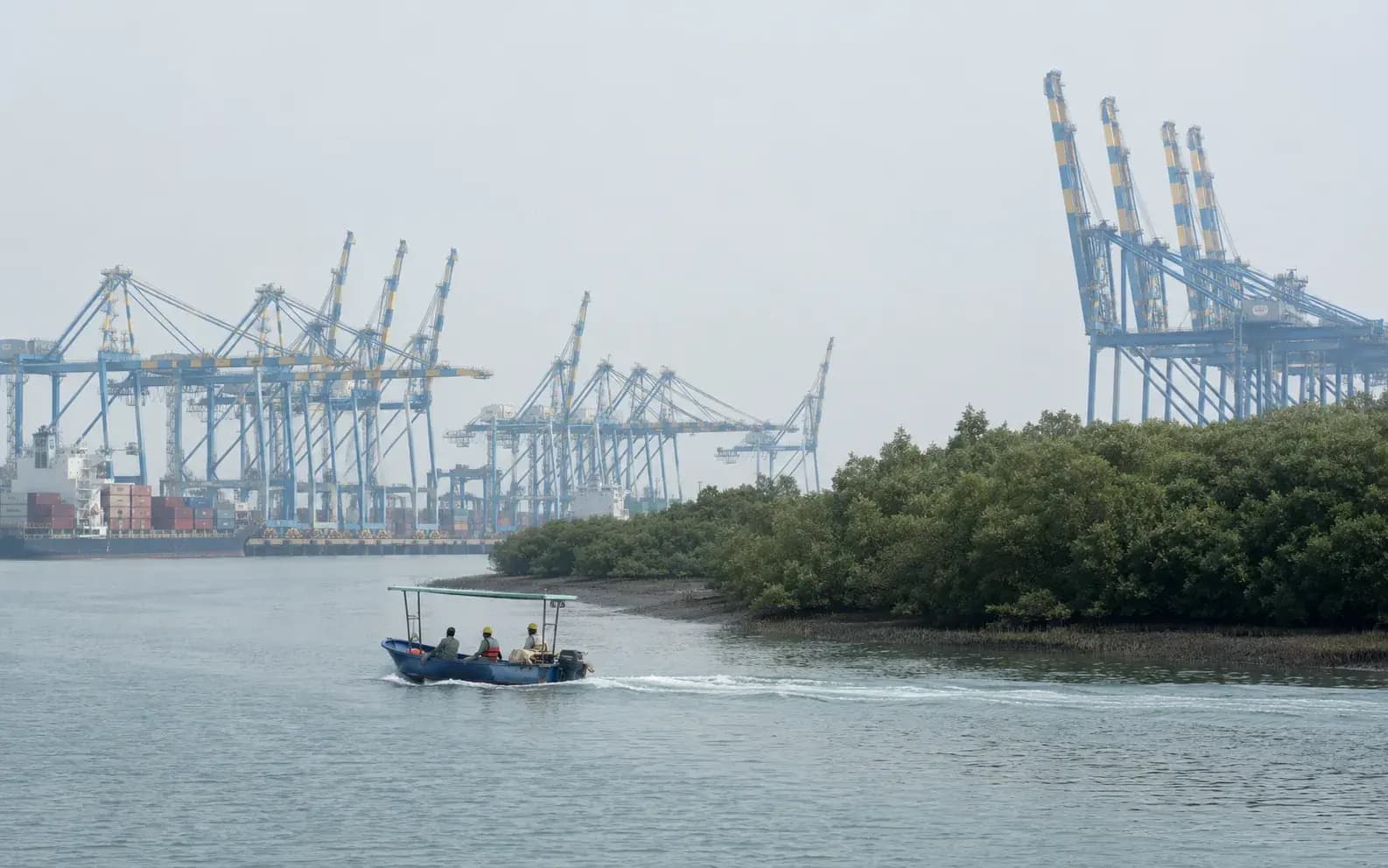
Any jetty, berth, shipyard or waterfront logistics facility sits inside the Coastal Regulation Zone, and the 1:4000 demarcation of the High and Low Tide Lines is what decides the category, the route and in many cases whether the layout works at all.
Screening view on your project, with the category and route named. No obligation.
What this means for logistics & ports
The CRZ Notification 2019 divides the coast into four zones, and which one a structure falls in changes almost everything about its approval. CRZ-I(A) covers ecologically sensitive features (mangrove patches with their buffer, corals, turtle nesting grounds, salt marshes) where development is most tightly restricted; CRZ-I(B) is the intertidal area; CRZ-II is the developed, built-up shoreline; CRZ-III is the undeveloped rural coast with its no-development band measured landward of the High Tide Line; and CRZ-IV is the water area itself. Ports, jetties, berths and shipyards belong to the small class of activities that require waterfront and foreshore facilities, which is the basis on which they can be permitted in zones where general development cannot. The route follows the category: projects in CRZ-I and CRZ-IV are dealt with at the level of the Ministry of Environment, Forest and Climate Change, while CRZ-II and CRZ-III proposals are recommended by the State coastal zone management authority and cleared at the State level. Everything rests on the demarcation, the tide lines mapped at 1:4000 by an authorised agency against the approved Coastal Zone Management Plan, with the mangrove, dune and sensitive-feature overlays. A line drawn wrongly does not produce a small error; it produces the wrong category, the wrong authority and, once discovered, a restart.
How KIPL runs it
KIPL does the demarcation before the design is frozen, because a jetty head, a bund alignment, a stockyard edge or a pipeline corridor moved by twenty metres at concept stage is a drawing revision, while the same movement after clearance is a fresh application. The submission then carries what a coastal authority actually interrogates: the justification that the facility requires the waterfront, the reclamation area with its rationale, the dredging volume with its disposal location, the shoreline change and sediment transport assessment, and the mangrove and intertidal position stated against the mapped features rather than around them. On this coast the work is home ground, KIPL's coastal mandates include the Chowgule Lavgan shiprepair facility at Jaigad, where a jetty and a ship repair expansion were assessed under both the CRZ framework and the EIA Notification. The recurring failure is a project designed on a revenue-survey map and demarcated afterwards, at which point a berth turns out to sit in CRZ-I and a stockyard inside the no-development zone.
- CRZ 2019
The category decides the route
CRZ-I and CRZ-IV proposals are dealt with centrally at the Ministry; CRZ-II and CRZ-III are recommended by the State coastal authority and cleared at State level. The zone is not a formality.
- HTL/LTL
Demarcation at 1:4000 by an authorised agency
Tide lines mapped against the approved Coastal Zone Management Plan set every distance in the file. An error in the line misclassifies the site and invalidates the application built on it.
- Foreshore facility
Waterfront requirement is the permitting basis
Ports, jetties and shipyards are permitted where they are because they need the foreshore. The justification for why the activity cannot sit landward is examined, not assumed.
What you receive
Written for logistics & ports, not adapted from a template.
- 01HTL and LTL demarcation at 1:4000 by an authorised agency, on the approved CZMP base
- 02CRZ category mapping of the full site with mangrove, dune and sensitive-feature overlays
- 03Layout review against the no-development zone and CRZ-I features, before design freeze
- 04Waterfront-requirement justification and reclamation rationale
- 05Dredging volume, disposal location and shoreline change assessment
- 06CZMA submission and follow-through to the CRZ clearance, with EC co-ordination
Questions from logistics & ports
What logistics & ports ask before appointing us.
Answered against the regulation as it stands, not as a sales pitch. If your situation is not here, ask us directly.
Ask a question →Does every logistics facility near the sea need CRZ clearance?
Only those falling within the notified Coastal Regulation Zone. A jetty, berth, shipyard or any structure on the intertidal area or the water is squarely inside it; a warehouse or container yard landward of the CRZ boundary is not, and needs Environment Clearance and consents but no CRZ approval. The demarcation is what answers the question, and on a large waterfront site parts of the plot are frequently inside and parts outside.
Why is the tide-line demarcation done at 1:4000?
Because that is the scale at which the approved Coastal Zone Management Plan is prepared and against which distances are measured, and because coastal distances are decided in metres. At a coarser scale a berth or a stockyard boundary cannot be placed reliably in one zone or another, and the entire application (category, authority, permissibility) hangs off that placement.
Who grants CRZ clearance, the State or the Ministry?
It depends on the category. Proposals in CRZ-I and CRZ-IV are dealt with at the Ministry of Environment, Forest and Climate Change, while CRZ-II and CRZ-III proposals are recommended by the State coastal zone management authority (in Maharashtra, the MCZMA) and cleared at State level. A project that straddles categories is governed by the more restrictive one, which is why the mapping matters before the filing.
Can dredged material be disposed of anywhere?
No. The disposal location is part of the approval (whether the material goes to reclamation within the project, to a designated offshore ground, or to beach nourishment) and it is assessed on the character of the material and the receiving environment. Disposal outside the approved location is a condition breach, and monitoring of the disposal operation is normally a clearance condition in its own right.
What do mangroves do to a waterfront project?
They constrain it heavily. Mangrove areas above the notified extent are CRZ-I(A) with a buffer landward of them in which development is not permitted, and in Maharashtra mangroves also carry protection through the forest route and judicial orders. In practice this means the mangrove edge is mapped first and the layout designed around it (approach roads, pipeline corridors and bunds included), rather than assessed after the alignment is fixed.
Do CRZ clearance and Environment Clearance run separately?
They are separate approvals under separate instruments, but for a port, jetty or coastal logistics project they are prepared as one file and appraised together in practice, on the same project description, the same dredging figures and the same marine baseline. Running them apart is how proponents end up with two documents that describe different projects, which is a query in both.
Stage by stage
How crz clearance actually runs, step by step.
Also for logistics & ports
The rest of the environmental brief for this sector.

Relevant proof
NAMAMI GANGE PROGRAMME
Environmental & Social Impact Assessment and EHS reporting for existing and proposed sewage treatment plants on the Ganga.
- Largest existing STP
- 130 MLD
- Assessed
- 5 plants
Where we do this
CRZ Clearance for logistics & ports, city by city.
Other sectors
Who else we run crz clearance for.
Next step
Tell us the project, and we will tell you the category and the route.
Screening is the cheapest stage to get right and the most expensive to get wrong. We will say plainly what crz clearance your logistics & ports project needs, and what it does not.





























































Start the conversation