










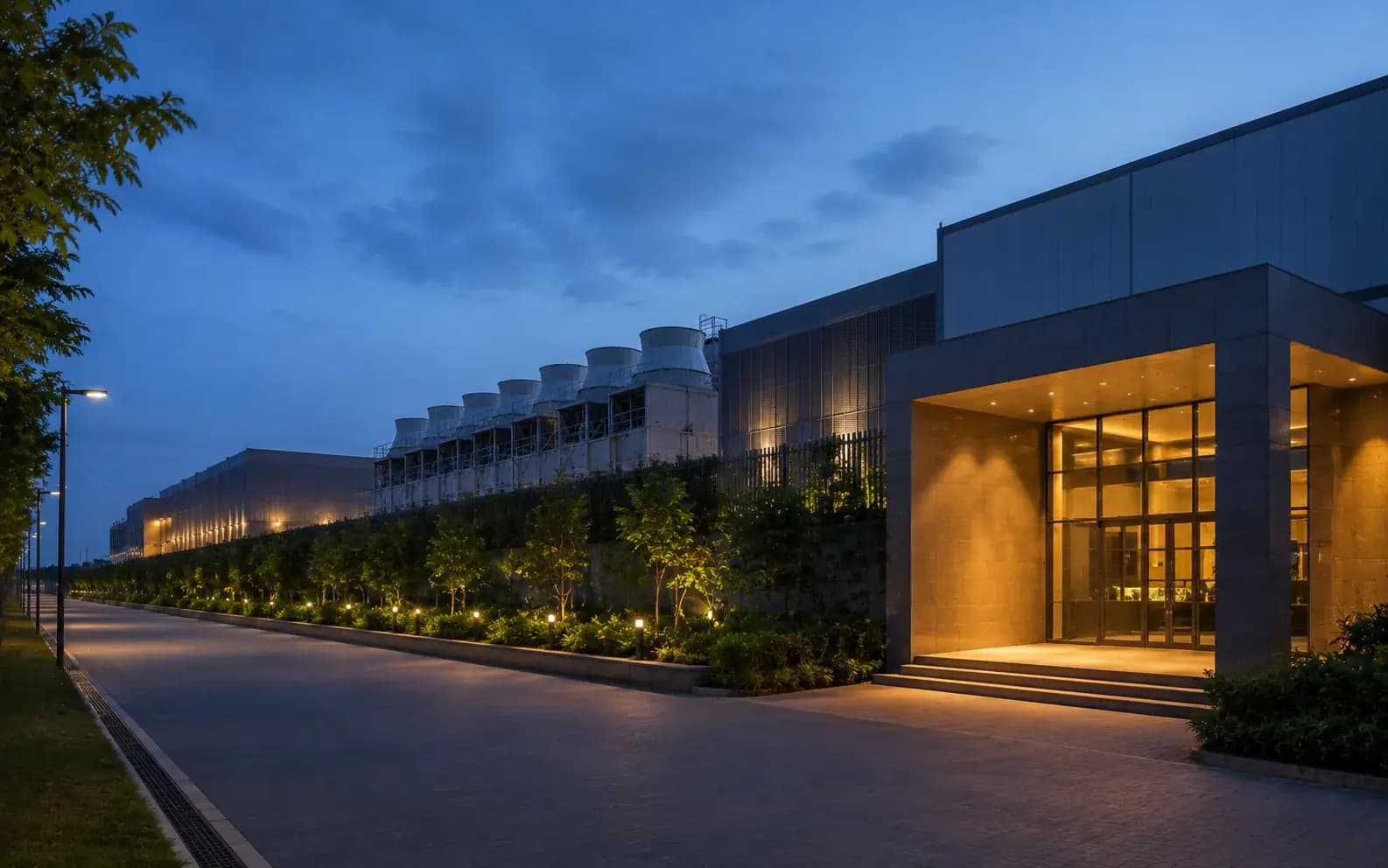
Environment Management & Mitigation Plan · Data Centres & IT Parks
Environment Management and Mitigation Plan for Data Centres and IT Parks
For a data centre or IT park the Environment Management Plan is the document that turns clearance conditions on fuel storage, DG noise and eco-sensitive zone mitigation into daily procedures a lean facilities team can actually execute.
Screening view on your project, with the category and route named. No obligation.
What this means for data centres & it parks
The EMP accompanies the Environment Clearance and states, condition by condition, how impacts will be avoided, mitigated and monitored: with responsibilities, frequencies and budgets attached. In this sector the plan has to cover a specific and unusual set: bulk high-speed diesel storage with spill containment and transfer procedures, DG banks whose weekly testing is the campus's loudest and dirtiest event, cooling towers with their blowdown chemistry and drift, e-waste and battery streams from equipment refresh, and, on creek-side sites, mitigation carried over from the wildlife clearance covering lighting spill, drainage and boundary vegetation. Construction phase adds its own layer, because these campuses are built fast and continuously, often adjacent to sensitive habitat.
How KIPL runs it
KIPL writes the EMP for the people who will operate it. That means DG test schedules tied to permitted hours rather than to convenience, fuel transfer and spill response written as a procedure with named responsibility, monitoring locations fixed on a drawing so the same points are sampled each cycle, and e-waste and used-oil handling described as a route to an authorised recycler with the paperwork identified. Budgets are stated because an unbudgeted mitigation is one that does not happen. The failure this prevents is familiar: an EMP written as a chapter of the EIA, never read again, and a facilities team improvising against conditions it discovers only when a monitoring visit is announced.
- EC condition
The EMP is what the conditions are drawn from
Commitments made in the EMP become clearance conditions and are then reported half-yearly, so an unrealistic plan creates obligations the campus cannot meet.
- HSD storage
Fuel is the highest-consequence risk on site
Bulk diesel storage and transfer demands containment, spill response and handling procedures that sit alongside the PESO licence conditions.
Lean teams, high uptime obligations
A data hall runs with a small on-site team that cannot pause operations for compliance activity, so mitigation has to be designed around uninterrupted running.
What you receive
Written for data centres & it parks, not adapted from a template.
- 01Construction-phase EMP for a fast-track build adjoining sensitive habitat: silt, dust, noise and debris
- 02DG operation and testing protocol with permitted hours, stack monitoring and boundary noise checks
- 03HSD storage, transfer and spill-response procedure with containment and named responsibilities
- 04Cooling tower water treatment, blowdown management and drift control regime
- 05E-waste, used oil and spent battery handling routes with authorised recycler documentation
- 06ESZ mitigation (lighting spill, drainage, boundary vegetation) with monitoring locations fixed on drawing, and a schedule, budget and responsibility matrix the facilities team can run
Questions from data centres & it parks
What data centres & it parks ask before appointing us.
Answered against the regulation as it stands, not as a sales pitch. If your situation is not here, ask us directly.
Ask a question →How is an EMP for a data centre different from one for an office building?
The impact set is different. An office EMP is dominated by sewage, solid waste and parking; a data centre EMP is dominated by backup generation, bulk fuel storage, cooling water chemistry and equipment waste streams, with a very small population. The mitigation effort concentrates in the utility yard rather than in the occupied space.
Does the EMP cover DG testing?
It should, explicitly. Routine testing is when the campus produces its highest emissions and noise, and it is the activity most likely to breach a boundary noise condition or an eco-sensitive zone restriction. Setting the testing window, the monitoring associated with it and the escalation if limits are approached is one of the more useful things the plan does.
What does the EMP say about e-waste?
It sets out the route rather than the rule: how retired servers, storage and network equipment are stored securely, who transports them, which registered recycler receives them, and what documentation is retained. The legal obligation arises under the E-Waste (Management) Rules 2022, but the EMP is where it becomes a working procedure for the facilities team.
Who owns the EMP once the campus is operating?
The facilities or engineering lead, with the clearance holder accountable. If a third-party operator runs the site, the EMP has to be part of the handover pack and reflected in their scope of work, because the plan's monitoring frequencies and budgets are worthless if the contract does not fund them.
How does the EMP relate to the half-yearly compliance report?
The compliance report is essentially evidence that the EMP was executed. Monitoring results, waste manifests, green belt records and mitigation actions all originate from EMP activities, so a plan with clear frequencies and record formats makes the report a compilation exercise rather than a reconstruction.
Can the EMP be updated as the campus expands?
It should be. Adding halls, DG banks or cooling capacity changes the mitigation requirement, and where the expansion needs an EC amendment the revised EMP forms part of that application. Keeping the plan current also avoids the awkward position of reporting against a document that no longer describes the site.
Stage by stage
How environment management & mitigation plan actually runs, step by step.
Also for data centres & it parks
The rest of the environmental brief for this sector.

Relevant proof
EIA for Synthetic Organic Chemical Industry
CTE/CTO application, ToR application, baseline data collection, EIA report and appraisal before the EAC: Category 5(f), the sector KIPL holds Category A accreditation in.
- Capacity
- 20 → 140 TPM
- 5(f) accredited
- Cat A
Where we do this
Environment Management & Mitigation Plan for data centres & it parks, city by city.
Other sectors
Who else we run environment management & mitigation plan for.
Next step
Tell us the project, and we will tell you the category and the route.
Screening is the cheapest stage to get right and the most expensive to get wrong. We will say plainly what environment management & mitigation plan your data centres & it parks project needs, and what it does not.





























































Start the conversation