










MPCB Consent · Data Centres & IT Parks
MPCB Consent for Data Centres and IT Parks
A data centre or IT park needs Consent to Establish and Consent to Operate from the Maharashtra Pollution Control Board under the Water Act 1974 and the Air Act 1981, and it is DG capacity, diesel storage and cooling-tower blowdown, not the servers: that set the category and the conditions.
Screening view on your project, with the category and route named. No obligation.
What this means for data centres & it parks
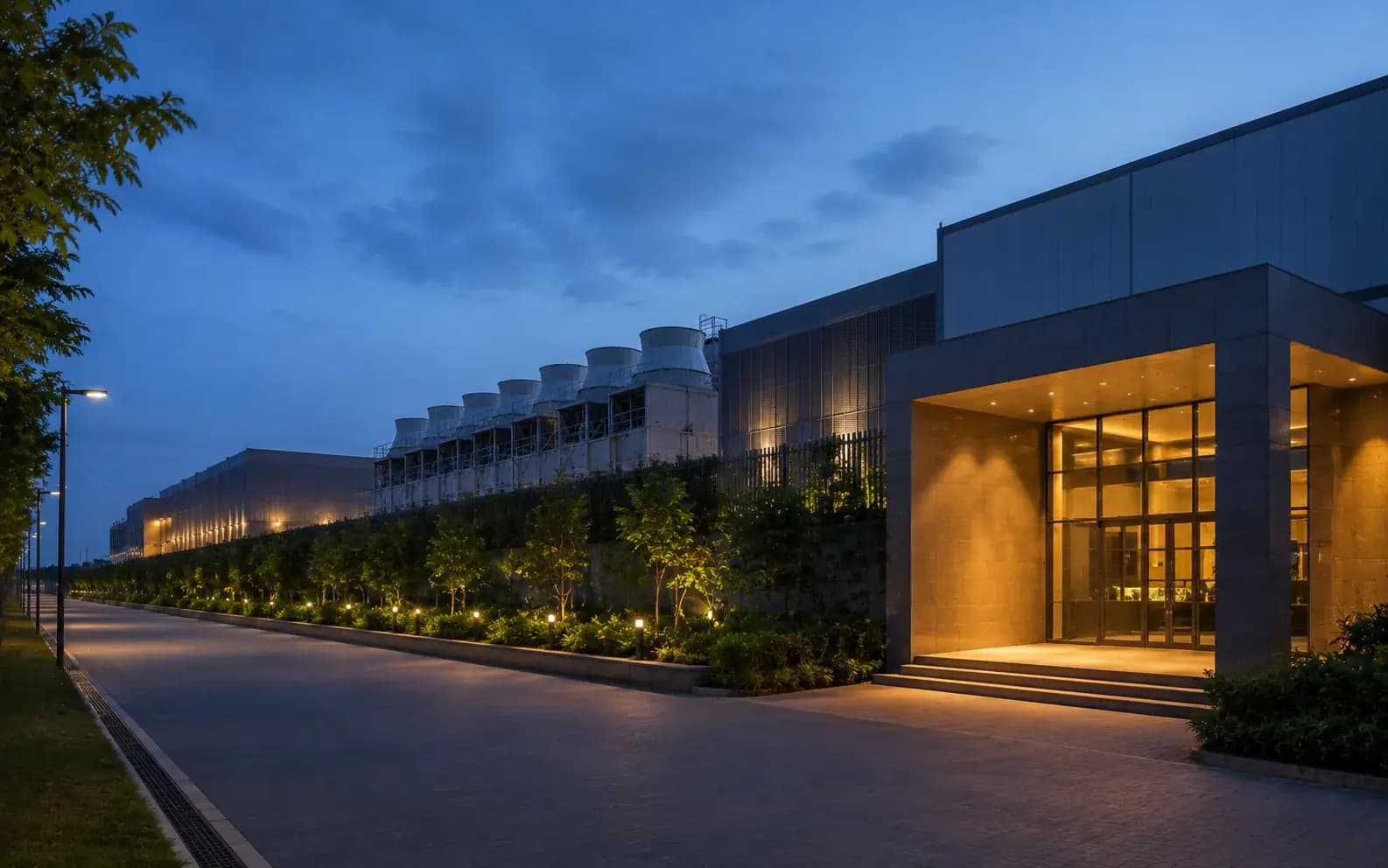
Consent to Establish is required before construction and Consent to Operate before the facility runs, issued under section 25 of the Water (Prevention and Control of Pollution) Act 1974 and section 21 of the Air (Prevention and Control of Pollution) Act 1981. The Board's view of a data centre is shaped by its utility yard: the installed DG capacity in kVA and the stacks that serve it, the high-speed diesel stored on site, the cooling towers with their evaporative losses and blowdown, and the used oil, spent batteries and e-waste generated in operation. Those factors drive the categorisation and consent fee, and they generate the conditions the facility will be inspected against: stack height and monitoring, acoustic enclosure and boundary noise limits, effluent quality and destination, and authorised handling of hazardous and e-waste streams.
How KIPL runs it
KIPL prepares the consent application on the plant that will actually be installed at end-state rather than on a first-phase schedule, because DG banks and chiller trains added later against a consent written for fewer units is one of the most common non-compliances found at inspection in this sector. We reconcile the DG stack heights and acoustic enclosure specification with the applicable norms, set out the blowdown route and the treated-sewage reuse that supports a no-discharge position, and align the declared water figures with the EC and any groundwater NOC. Where the campus phases capacity, we plan the amendment and renewal sequence in advance so that energisation of a new hall is never waiting on a consent variation.
- Air Act 1981
DG banks are the air-emission source
Installed DG capacity determines stack height, emission norms and the acoustic enclosure specification, and the total kVA on site drives the consent category.
- Water Act 1974
Blowdown and sewage, not process effluent
Cooling-tower blowdown with its dissolved solids, plus campus sewage, are the discharge streams the Board conditions and samples.
- HSD storage
Fuel on site changes the file
Bulk high-speed diesel for backup runtime brings storage, handling and spill containment into the consent alongside the PESO licence.
What you receive
Written for data centres & it parks, not adapted from a template.
- 01Consent to Establish application with end-state DG kVA, cooling capacity and HSD storage declared
- 02DG stack height, emission monitoring and acoustic enclosure basis against the applicable norms
- 03Water balance and blowdown management supporting the no-discharge position taken in the EC
- 04Hazardous waste authorisation for used oil and spent batteries, integrated with the consent
- 05Consent to Operate on commissioning, with the compliance conditions transcribed for the facilities team
- 06Amendment and renewal plan matched to the campus capacity phasing
Questions from data centres & it parks
What data centres & it parks ask before appointing us.
Answered against the regulation as it stands, not as a sales pitch. If your situation is not here, ask us directly.
Ask a question →What decides the consent category for a data centre?
Not the IT load but the pollution-generating plant: installed DG capacity, diesel storage, cooling-tower operation and the waste streams. A campus with a large backup generation bank and bulk fuel storage is treated very differently from an office of the same built-up area, and that categorisation drives both the consent fee and the inspection regime.
Can we energise a new hall under the existing consent?
Only if the consent covers the added DG capacity, cooling capacity and water demand. Commissioning plant beyond what the Consent to Operate describes is a non-compliance that inspections find readily, since installed kVA is easy to verify against the consent. The amendment should be filed to land before the hall is ready, not after.
What are the noise obligations for DG sets?
DG sets are required to be provided with acoustic enclosures meeting the prescribed insertion loss and noise limit measured at the specified distance, and the campus must in addition hold ambient noise within the limits for its zone under the Noise Pollution (Regulation and Control) Rules 2000. For a campus adjoining a residential area or an eco-sensitive zone, the boundary figure, not the enclosure rating: is what will be tested.
Where can cooling-tower blowdown go?
It has to have a lawful and declared destination: treatment and reuse on site, or discharge to an authorised sewer or common facility to the quality the consent specifies. Blowdown carries elevated dissolved solids from cycles of concentration, so it cannot simply be added to the stormwater system, and for creek-side campuses discharge towards the creek will not be accepted.
Does the consent cover e-waste from server refresh?
The consent conditions will require lawful handling, but the substantive obligation sits under the E-Waste (Management) Rules 2022, which govern how a bulk consumer channels retired IT equipment to registered recyclers and files returns. In practice the consent and the e-waste obligations are inspected together, so they are managed as one compliance stream.
How often is consent renewed?
Consent to Operate is issued for a period stated in the consent itself, which varies with the category and the Board's practice, and must be renewed before expiry. For a phased campus the renewal cycle should be synchronised with the capacity additions so that a single filing carries both, instead of a renewal and an amendment being pursued in parallel.
Stage by stage
How mpcb consent actually runs, step by step.
Also for data centres & it parks
The rest of the environmental brief for this sector.
Primary sources
Verify any of this at the source.

Relevant proof
EIA for Synthetic Organic Chemical Industry
CTE/CTO application, ToR application, baseline data collection, EIA report and appraisal before the EAC: Category 5(f), the sector KIPL holds Category A accreditation in.
- Capacity
- 20 → 140 TPM
- 5(f) accredited
- Cat A
Where we do this
MPCB Consent for data centres & it parks, city by city.
Other sectors
Who else we run mpcb consent for.
Next step
Tell us the project, and we will tell you the category and the route.
Screening is the cheapest stage to get right and the most expensive to get wrong. We will say plainly what mpcb consent your data centres & it parks project needs, and what it does not.





























































Start the conversation