










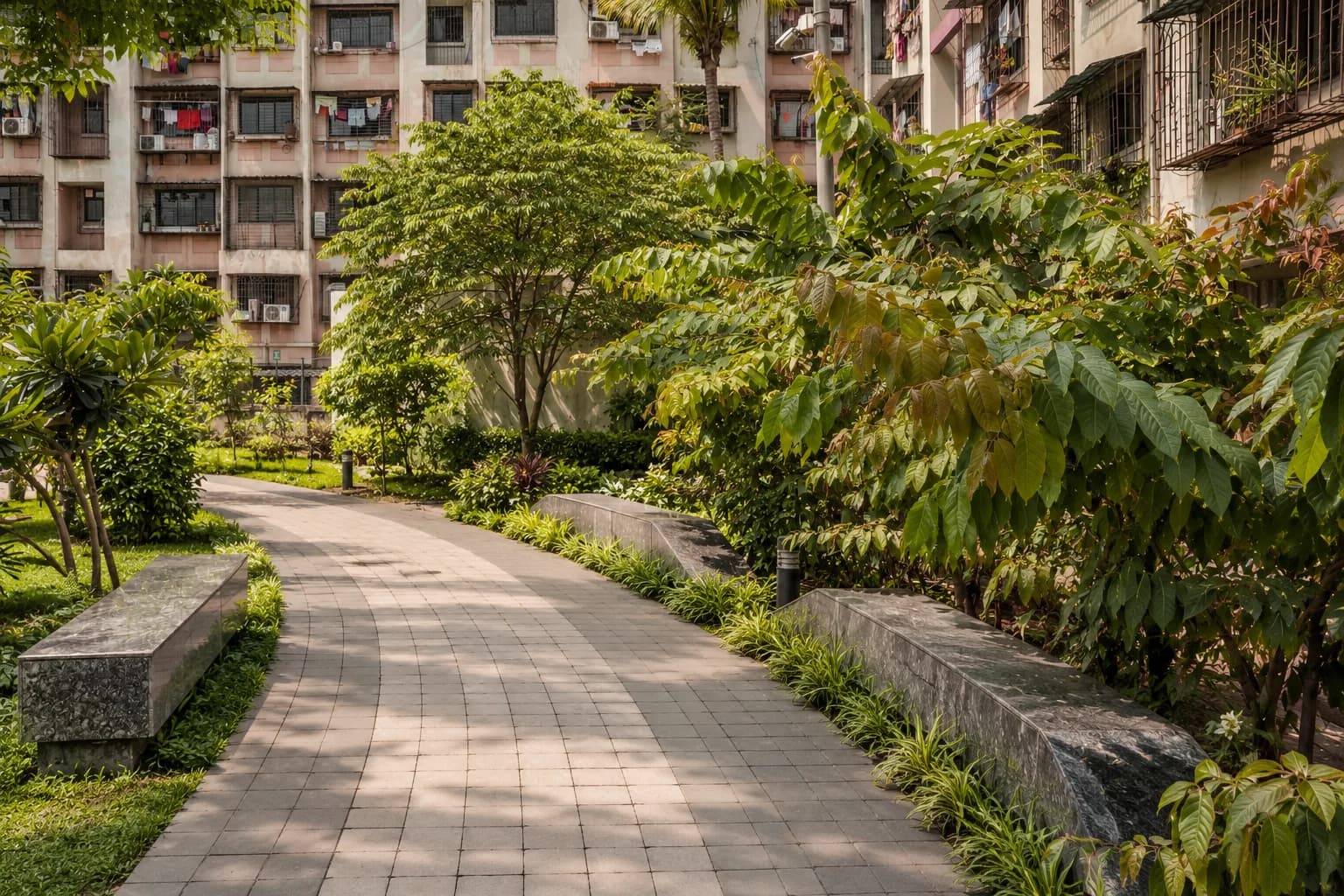
Vertical gardens and green walls: planting a facade, and committing to its irrigation.
A green wall is a planted vertical system with a permanent dependence on irrigation: which makes the system engineering, not the plant list, the decision that determines whether it survives.
What it is
Green walls come in two broad forms: modular or felt-pocket systems mounted on a frame with automated drip or recirculating irrigation, and green facades where climbers rooted at grade or in planters are trained on a support structure. The first delivers immediate density and needs continuous irrigation and nutrient dosing; the second is far lower risk and lower cost but takes time to cover.
KIPL specifies vertical greening from the constraints that actually govern it: structural load including saturated weight, waterproofing and drainage behind the panel, an assured water supply with power backup, light levels at each part of the wall, and safe access for maintenance. Species are then selected for those light levels. A green wall installed without maintenance access or backup water is a facade failure waiting to happen.
What you get
The deliverables, in hand.
- Authority
- System-led design · structural, waterproofing and irrigation constraints
- Typical timeline
- Weeks to install; maintenance is continuous
- Feasibility assessment: structure, orientation, light, water and access
- System selection: modular green wall or trained green facade
- Structural framing, waterproofing and drainage detailing
- Automated irrigation with dosing, timers and backup provision
- Species selection and planting by light zone across the wall
- Maintenance regime with access arrangements
Straight answers
Vertical & Green Walls: common questions.
01What is the difference between a green wall and a green facade?
A green wall carries plants in a mounted system of modules or pockets across the wall surface, with irrigation delivered to each plant. A green facade grows climbers from the ground or planters up a support structure. The facade is slower to cover but far cheaper, lighter and much more forgiving in maintenance.
02What is the biggest risk with a green wall?
Irrigation failure. Plants on a vertical system have almost no root volume and no soil reservoir, so a stopped pump, a blocked emitter or a power cut is measured in days before visible damage. Assured water, power backup and prompt fault response are the difference between a green wall and a brown one.
03How much maintenance does a green wall need?
Continuous and skilled: irrigation and dosing checks, emitter cleaning, pruning, replacement of failed plants, and periodic system servicing, usually at a defined frequency with proper access equipment. A green wall is best treated as a serviced installation with an annual budget, not as a one-time landscape item.
04How are species selected for a vertical garden?
Primarily by light, the wall's orientation and the shading pattern across it produce quite different conditions at different points, and species are zoned accordingly. Beyond light, plants are chosen for compact root systems, tolerance of a confined medium, and modest growth so the wall does not need constant cutting back.
05Does the building structure need checking?
Yes, always, and for saturated weight rather than dry weight. Modular systems carry growing medium, plants and retained water, and the load is applied to the facade continuously. Waterproofing and a drainage route behind the panel are equally essential, since a leak behind a green wall is discovered late and repaired expensively.
06Are green walls worth it environmentally?
They provide localised cooling, some particulate capture, acoustic softening and visual amenity, particularly where there is no ground area available. They are not an efficient substitute for ground-level planting on a per-square-metre or per-rupee basis, and are best justified where horizontal space genuinely does not exist.
Within Sustainable Landscaping
Part of the whole route, the other components.
Relevant proof
Where this stage has already been delivered.
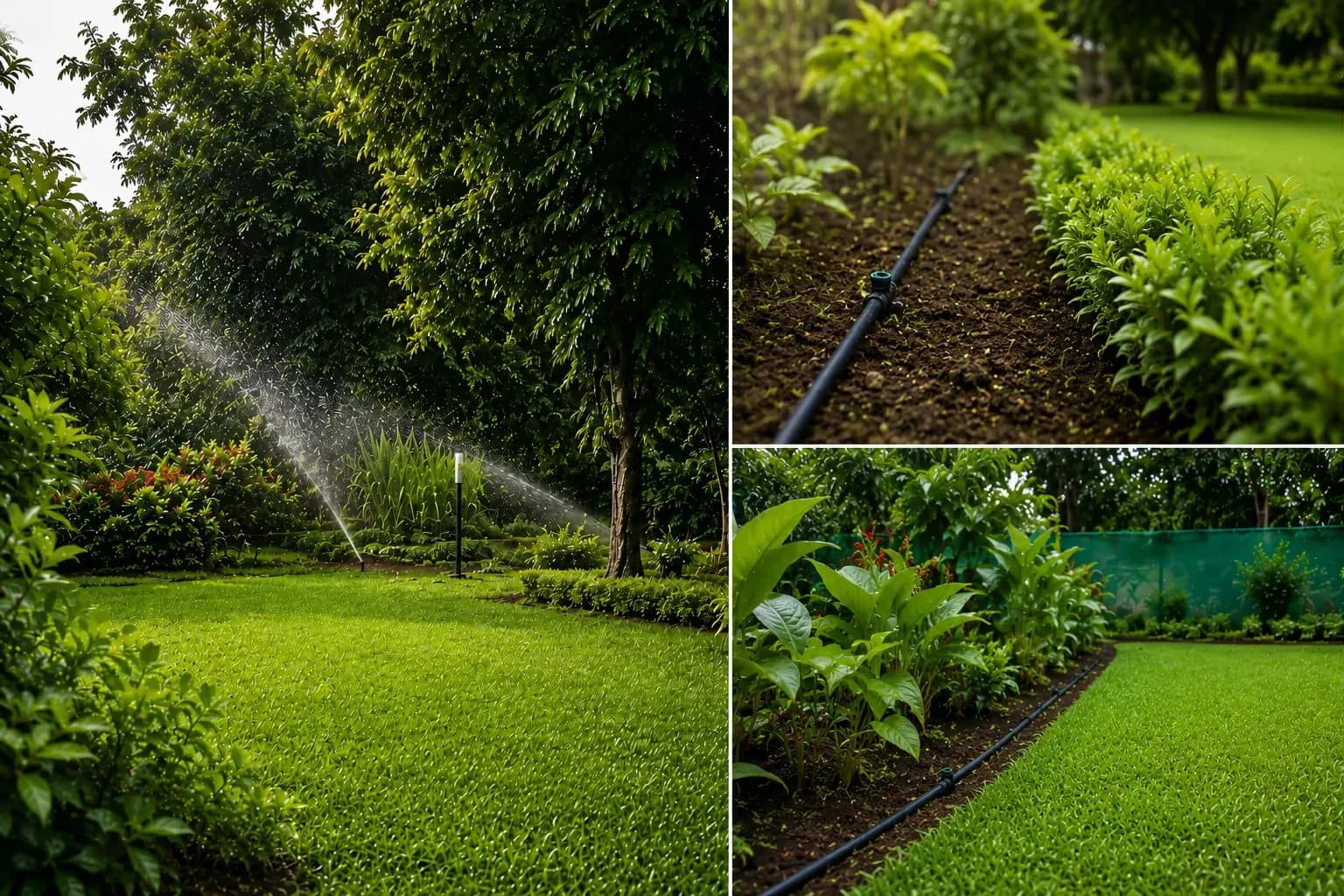
TCS, Banyan Park · Mumbai
IRRIGATION WORK AT TCS BANYAN PARK
Design and execution of an efficient drip-irrigation network across ~10,000 m² of landscape and plantation zones: pipeline, network and testing, completed in 45 days.
Where we do this
Sustainable Landscaping on the ground.
The authority, the timeline and the local ground differ by city. These pages set out how sustainable landscaping actually runs in each.
Featured projects
Work that carries its own evidence.
Our expertise
One team across the whole environmental brief.
Vertical & Green Walls is one stage of one practice. Most projects need several, and the commitments made at clearance are the ones we build and maintain.
Who we do this for
Sustainable Landscaping reads differently by industry.
- 01
Corporate CampusesCore
Campus softscape, hardscape and irrigation are the brand made physical, and are expected to run on treated water rather than fresh.
Sustainable Landscaping for Corporate Campuses - 02
Real Estate & Construction
Podium and open-space landscaping carries the plantation and pervious-area commitments made in the EIA, not just the amenity brief.
Sustainable Landscaping for Real Estate & Construction - 03
Townships & Area Development
Softscape, irrigation and water-sensitive hardscape are how the township's treated-water reuse and runoff commitments are actually realised.
Sustainable Landscaping for Townships & Area Development - 04
Hospitality, Healthcare & Education
Campus landscape is both the amenity the guest or patient experiences and the pervious-area and plantation commitment in the clearance.
Sustainable Landscaping for Hospitality, Healthcare & Education - 05
Municipal Corporations
Public realm landscaping has to survive footfall, water scarcity and a maintenance budget set years before, which drives species choice.
Sustainable Landscaping for Municipal Corporations
Trusted by
The organisations this work is done for.





In the press