










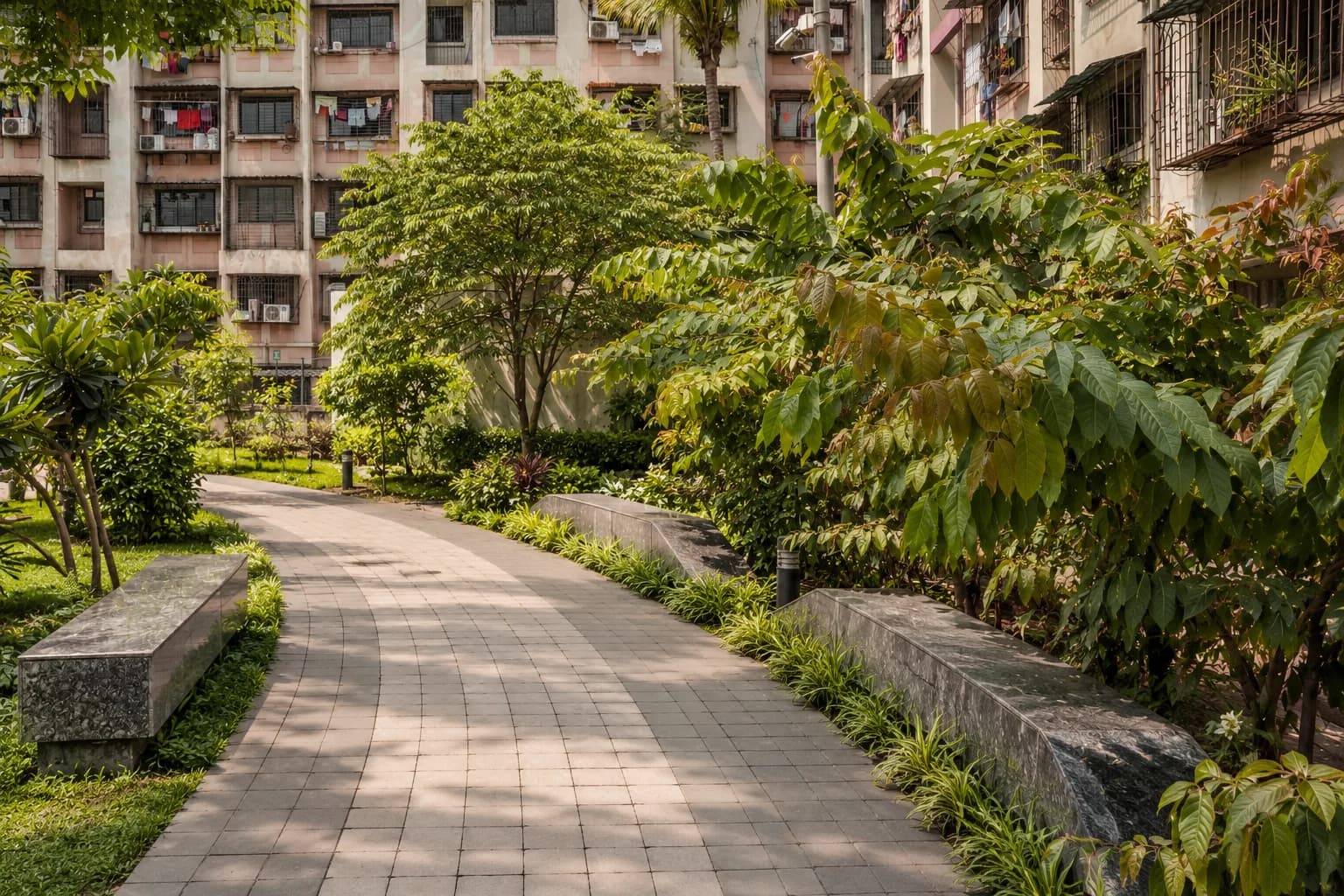
Hardscape: the built structure that carries a landscape and its drainage.
Hardscape is the built half of a landscape (paving, paths, steps, walls, edging, seating and structures) and it is where drainage and levels are either solved or created as problems.
What it is
Hardscape carries movement and defines space, but its more consequential job is water. Levels, falls, kerb lines, drainage inlets and the choice between sealed and permeable surfaces determine where rainfall goes, whether planting beds waterlog, and whether paving lifts and settles. That is decided in the subgrade and the levels, long before any surface material is chosen.
KIPL designs and builds hardscape from the base upward (compacted subgrade, correct bedding, adequate falls, expansion and edge restraint) and treats permeable paving, infiltration and rainwater routing as design decisions rather than optional additions. Material selection then balances appearance against slip resistance, heat, durability under the expected use, and how easily a section can be lifted and reinstated for services.
What you get
The deliverables, in hand.
- Authority
- Level and drainage-led design · subgrade and bedding control
- Typical timeline
- Weeks to months by area; independent of planting season
- Level and grading plan with drainage falls and inlet positions
- Paving, path and kerb layouts with material specification
- Steps, ramps, retaining walls and edge details
- Seating, pergolas, planters and landscape structures
- Permeable surfacing and rainwater routing where adopted
- Execution with subgrade, bedding and edge-restraint control
Straight answers
Hardscape Development: common questions.
01What counts as hardscape?
The built, non-living elements of a landscape: paving and paths, kerbs and edging, steps and ramps, retaining walls, seating, pergolas, planters, water-feature structures and surfacing. It is normally executed before planting because it involves excavation, machinery and levels.
02Why do landscape paths crack and settle?
Almost always because of what is underneath: inadequately compacted subgrade, poor bedding, no edge restraint, or water trapped below the surface. Surface material is rarely the cause. Getting the base right is unglamorous, invisible in photographs, and the difference between paving that lasts and paving that is relaid.
03What is permeable paving and when is it worth using?
Paving that lets rainfall infiltrate rather than run off: through porous blocks, open-jointed units or gravel systems on a draining base. It reduces runoff, recharges groundwater and eases stormwater load, which makes it worth using on parking areas, paths and low-traffic surfaces on most Indian sites.
04How are hardscape materials chosen?
By durability under the expected loading, slip resistance when wet, surface temperature under sun, appearance, local availability and cost, and how easily the surface can be lifted and reinstated when buried services need attention. In hot climates the heat a surface holds is a real comfort consideration, not a detail.
05Should hardscape be built before planting?
Yes, in nearly all cases. Hardscape involves excavation, compaction, machinery movement and levels, all of which damage finished planting. Buried services should also be laid and tested before surfacing, so that finished paving is not opened again within months.
06How much of a landscape should be hard surface?
Only as much as the circulation and use require. Excess paving increases runoff, raises local surface temperature and reduces the planted area doing the environmental work. Where large paved areas are unavoidable, permeable systems and shade planting mitigate part of the effect.
Within Sustainable Landscaping
Part of the whole route, the other components.
Relevant proof
Where this stage has already been delivered.
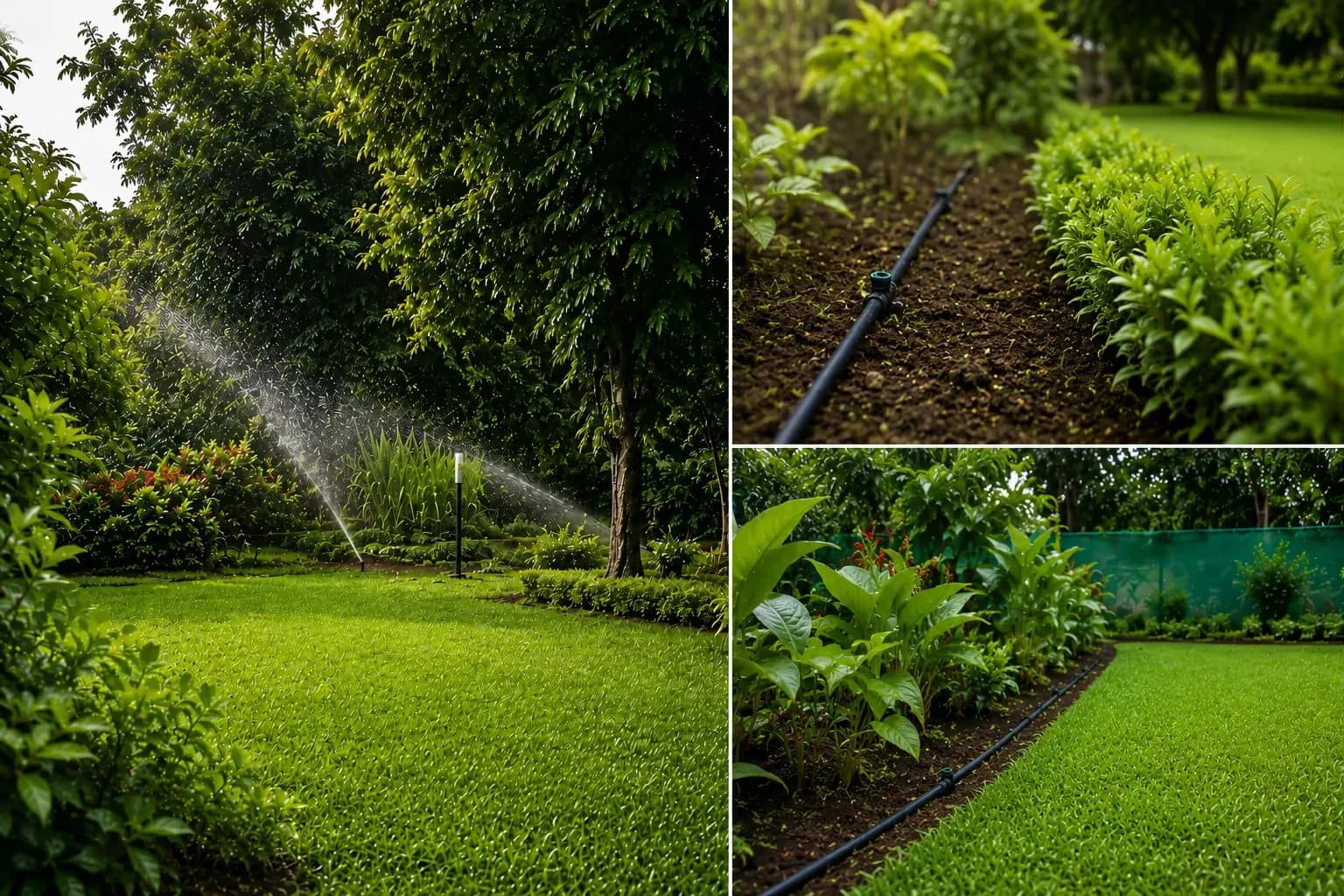
TCS, Banyan Park · Mumbai
IRRIGATION WORK AT TCS BANYAN PARK
Design and execution of an efficient drip-irrigation network across ~10,000 m² of landscape and plantation zones: pipeline, network and testing, completed in 45 days.
Where we do this
Sustainable Landscaping on the ground.
The authority, the timeline and the local ground differ by city. These pages set out how sustainable landscaping actually runs in each.
Featured projects
Work that carries its own evidence.
Our expertise
One team across the whole environmental brief.
Hardscape Development is one stage of one practice. Most projects need several, and the commitments made at clearance are the ones we build and maintain.
Who we do this for
Sustainable Landscaping reads differently by industry.
- 01
Corporate CampusesCore
Campus softscape, hardscape and irrigation are the brand made physical, and are expected to run on treated water rather than fresh.
Sustainable Landscaping for Corporate Campuses - 02
Real Estate & Construction
Podium and open-space landscaping carries the plantation and pervious-area commitments made in the EIA, not just the amenity brief.
Sustainable Landscaping for Real Estate & Construction - 03
Townships & Area Development
Softscape, irrigation and water-sensitive hardscape are how the township's treated-water reuse and runoff commitments are actually realised.
Sustainable Landscaping for Townships & Area Development - 04
Hospitality, Healthcare & Education
Campus landscape is both the amenity the guest or patient experiences and the pervious-area and plantation commitment in the clearance.
Sustainable Landscaping for Hospitality, Healthcare & Education - 05
Municipal Corporations
Public realm landscaping has to survive footfall, water scarcity and a maintenance budget set years before, which drives species choice.
Sustainable Landscaping for Municipal Corporations
Trusted by
The organisations this work is done for.





In the press