









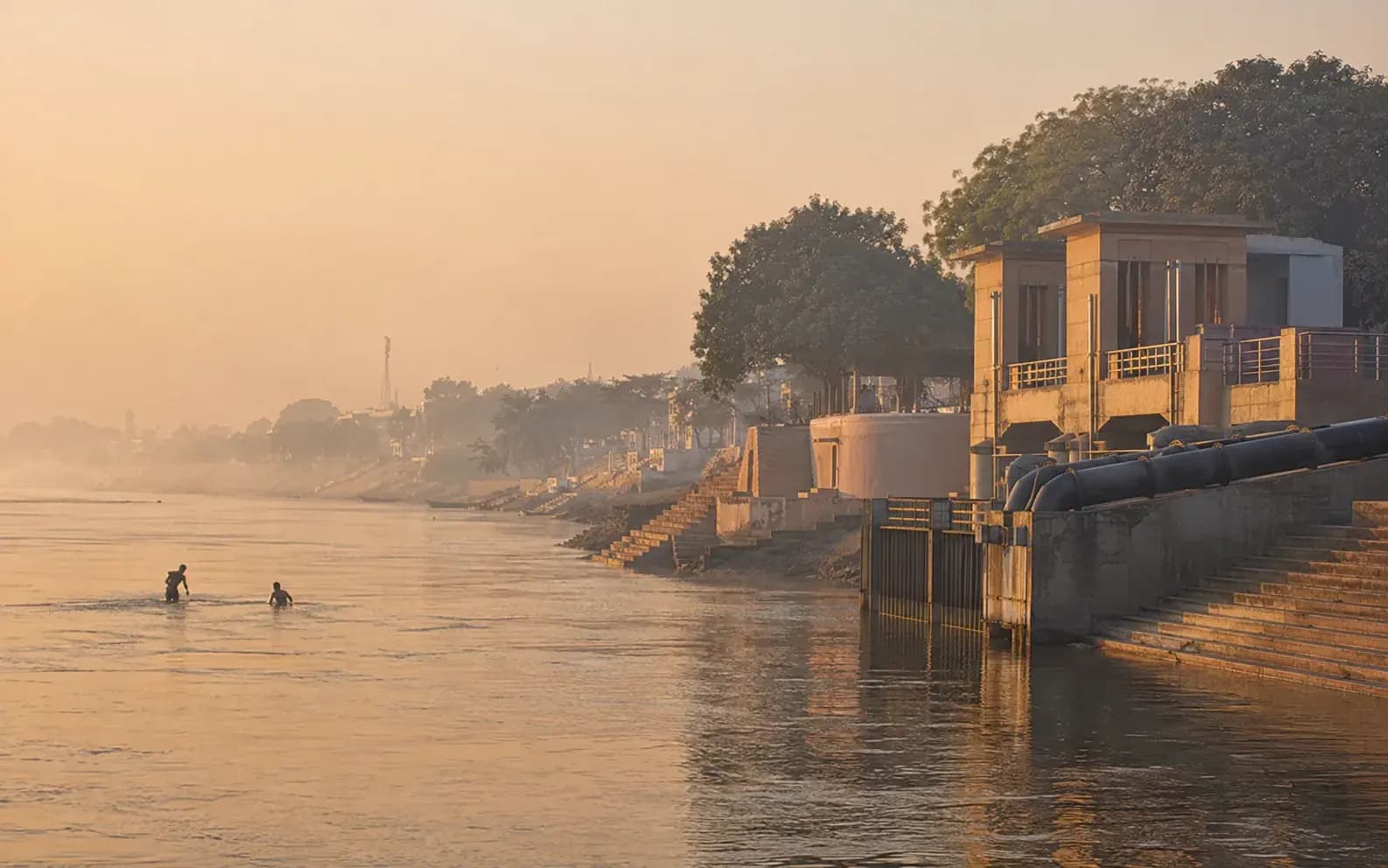
Miyawaki Urban Dense Forestation · River & Water Missions
Miyawaki Riparian Forestation for River & Water Missions
Riparian buffer planting stabilises banks and intercepts diffuse runoff before it reaches the channel, and dense native forestation is the method that delivers a functioning buffer inside a mission's timeline rather than a decade after it.
Screening view on your project, with the category and route named. No obligation.
What this means for river & water missions
For a river programme, planting on the bank is not landscaping. A riparian buffer performs three measurable functions: it holds the bank against erosion that otherwise loads the channel with silt, it intercepts diffuse runoff carrying nutrients and solids from the land behind it, and it re-establishes the habitat edge that a channelised reach has lost. A mission is usually asked to show ecological outcome alongside water quality, and the buffer is the intervention that produces it. The constraint is time: a programme working on a defined term cannot wait for conventional avenue planting to close canopy.
How KIPL runs it
KIPL uses dense native planting on prepared soil to close canopy quickly, with species selected for the flood regime the strip actually experiences: a bank that submerges annually needs species that tolerate it, and a strip planted with the wrong palette dies in the first monsoon and is reported as a failed intervention. The other constraint specific to river work is land: the riparian strip is frequently encroached or in active informal use, so a planting programme that has not settled land status will find its plots occupied. We survey the strip, fix species to the inundation profile, and set survival monitoring as the reported metric rather than saplings planted.
Bank erosion loads the channel
An unstabilised bank contributes silt directly to the reach and undermines the structures a mission has built on it.
Diffuse runoff is not addressed by interception
Sheet flow carrying nutrients and solids from land behind the bank bypasses drain interception entirely and is intercepted only by a vegetated buffer.
Ecological outcome is a reported result
Missions are increasingly asked to demonstrate habitat and green cover outcomes alongside water quality, and riparian planting is the measurable intervention behind that.
What you receive
Written for river & water missions, not adapted from a template.
- 01Riparian strip survey with land status, encroachment and available planting width established
- 02Species palette matched to the inundation profile of each stretch of the bank
- 03Soil preparation and amendment specification for filled, silted or degraded bank soils
- 04Dense native planting execution with density and layer composition stated
- 05Maintenance regime through the establishment period, including monsoon recovery
- 06Survival and canopy monitoring reported as the programme metric rather than saplings planted
Questions from river & water missions
What river & water missions ask before appointing us.
Answered against the regulation as it stands, not as a sales pitch. If your situation is not here, ask us directly.
Ask a question →Why dense native planting rather than conventional avenue planting on a riverbank?
Because a buffer only performs once it has closed canopy and developed a root mass, and dense multi-layer native planting reaches that condition far sooner than spaced avenue planting. On a programme with a defined term, that difference decides whether the intervention delivers within the mission or after it.
How are species chosen for a riverbank?
By the inundation profile of the specific strip. A bank that submerges every monsoon needs flood-tolerant native species; a higher terrace can carry a wider palette. Using a standard urban palette on a bank is the commonest cause of first-monsoon failure.
What about encroachment on the riparian strip?
It has to be resolved before planting, not during. Programmes that plant on land in active informal use lose the plantation and generate a social grievance at the same time. Land status is the first item in our survey for exactly this reason.
Does riparian planting improve water quality measurably?
It reduces the diffuse load, silt from bank erosion and runoff-borne nutrients and solids, which drain interception does not address. It is not a substitute for treating point sources, and a programme should not report it as one. Its contribution is best shown at the bank and in bank stability, alongside the reach monitoring.
What is the maintenance obligation?
Watering and weeding through the establishment period, and recovery works after the first monsoons, which on a riverbank can remove young stock. This obligation has to be contracted; plantations handed over without a maintenance term are the most common failed intervention on green packages.
How is success reported?
By survival percentage and canopy development against the planted stock at defined intervals, and by the condition of the bank. Number of saplings planted is an input, not an outcome, and monitoring committees increasingly ask for the survival figure instead.
Stage by stage
How miyawaki urban dense forestation actually runs, step by step.
Also for river & water missions
The rest of the environmental brief for this sector.

Relevant proof
MCGM GARDEN DEVELOPMENT- MIYAWAKI PLANTATION
Miyawaki dense forestation across 27 locations in 7 wards using native species, delivered under the municipal greening programme.
- Area
- ~74,000 m²
- Trees
- ≈1,10,000
- CO₂ (est.)
- 2,052 t
Where we do this
Miyawaki Urban Dense Forestation for river & water missions, city by city.
Other sectors
Who else we run miyawaki urban dense forestation for.
Next step
Tell us the project, and we will tell you the category and the route.
Screening is the cheapest stage to get right and the most expensive to get wrong. We will say plainly what miyawaki urban dense forestation your river & water missions project needs, and what it does not.





























































Start the conversation