









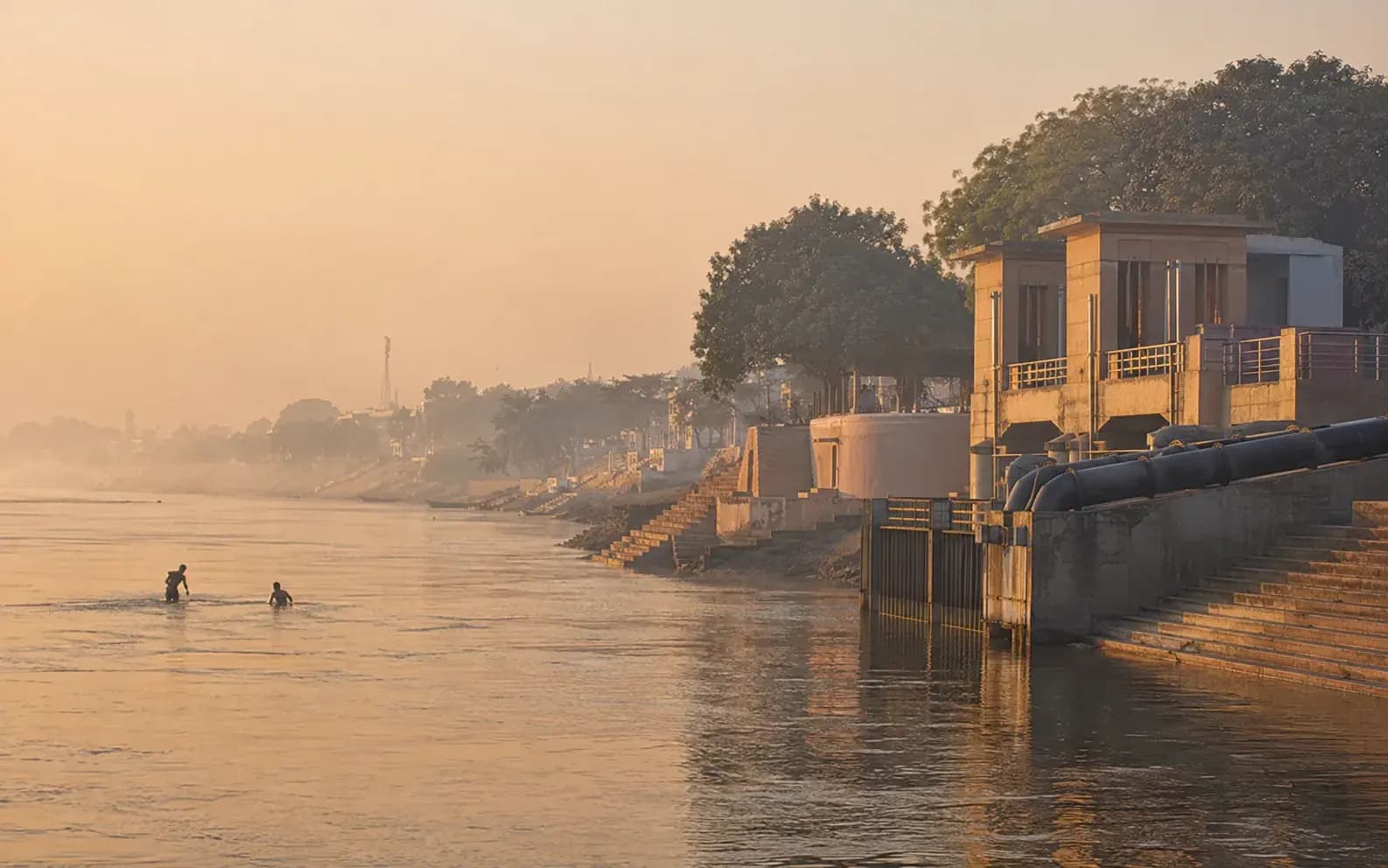
Water Body Remediation · River & Water Missions
Water Body Remediation for River & Water Missions
On a river or water mission, water body remediation is not a supporting activity but the deliverable itself: the drains are intercepted, the stretch is treated, and the programme is measured on the river's water quality, not on works completed.
Screening view on your project, with the category and route named. No obligation.
What this means for river & water missions
A mission is funded to change a number. The Central Pollution Control Board classifies river stretches by the extent to which they fail the designated best-use criteria, and a stretch stays on that list until dissolved oxygen, BOD and coliform readings say otherwise. For the programme unit, that reframes remediation: every untapped nalah discharging into the reach is a source that has to be inventoried, characterised and either intercepted to a treatment facility or treated in situ where laying an interceptor sewer is not feasible in the time the programme has. Works that look complete on a progress report but leave three drains flowing do not move the classification.
How KIPL runs it
KIPL approaches a stretch by first establishing what is actually entering it, drain-by-drain flow and load characterisation across dry and wet weather. And then matching each source to the intervention that will hold: interception and conveyance where a treatment plant exists or is being built, in-situ or decentralised treatment where it does not, and bank and riparian works where the load is diffuse. Programmes fail here for a predictable reason: in-situ units are commissioned against a design flow that no one verified, monsoon flows bypass them, and post-monsoon sampling shows the stretch unchanged. We size against measured flow, write the sampling protocol that will be used to judge the work, and hand over an O&M regime the operator can actually run for the contract period.
- CPCB
The stretch is on a published list
River stretches are classified by CPCB against designated best-use criteria, and the programme's success is read off that classification rather than off works certified.
- NGT
Monitoring committee scrutiny
River rejuvenation on identified polluted stretches is monitored under National Green Tribunal directions, with periodic reporting by the state and the pollution control board.
Untapped drains defeat treatment capacity
Sewage treatment capacity created upstream delivers nothing if drains downstream of the interception point continue to discharge directly into the reach.
What you receive
Written for river & water missions, not adapted from a template.
- 01Drain-wise inventory of outfalls into the stretch, with dry and wet weather flow and load characterisation
- 02Intervention matrix mapping each outfall to interception, decentralised treatment or in-situ treatment
- 03In-situ / decentralised treatment design sized on measured flow, with bypass and monsoon behaviour stated
- 04River water quality monitoring protocol: stations, parameters and frequency aligned to the designated best-use class
- 05Bank stabilisation and riparian buffer proposals where the load is diffuse rather than point-source
- 06O&M protocol and performance reporting format for the programme MIS and monitoring committee returns
Questions from river & water missions
What river & water missions ask before appointing us.
Answered against the regulation as it stands, not as a sales pitch. If your situation is not here, ask us directly.
Ask a question →Does remediating the water body remove the need for sewage treatment plants?
No. In-situ and decentralised treatment addresses drains that cannot be intercepted within the programme timeline, or loads that arise after the interception point. The dominant load on most Indian urban river stretches is untreated municipal sewage, and that is answered by conveyance and treatment capacity. In-situ work is a complement to that, not a substitute for it.
How is success measured on a river mission?
By river water quality at defined monitoring stations, read against the designated best-use classification for the stretch, and by the drain-wise reduction in untreated discharge. Physical progress on works is a milestone for payment; the water quality reading is what the monitoring committee and the funding agency look at.
What usually goes wrong with in-situ treatment on a mission?
Units are sized on an assumed drain flow rather than a measured one, so they are bypassed once actual or monsoon flows arrive. The second failure is O&M: the unit is commissioned, handed over, and then not operated. Both are avoidable if flow is measured before design and the O&M obligation is written into the contract with a reporting format attached.
Who is the approving authority for this work?
It depends on the funding structure. Works under a national river programme are approved through the mission's own sanction process, while discharge standards and monitoring sit with the state pollution control board under the Water Act 1974. Where the intervention involves construction in the river or on the bank, a separate clearance may be required in its own right.
Can remediation be done while the stretch is in religious and public use?
It has to be. Ghats and bathing reaches are in continuous use, so interventions are staged to keep access open, and construction methods are chosen to avoid disturbing the very reach the public enters. This is also why community consultation is treated as part of the design and not an afterthought.
How long before water quality improves measurably?
It depends on how much of the load is intercepted, whether receiving treatment capacity is operational, and on the season in which sampling is done. A stretch where interception is complete and treatment is running can show change within one monitoring cycle; a stretch where only part of the drains are addressed will show partial improvement that reverses in monsoon.
Stage by stage
How water body remediation actually runs, step by step.
Also for river & water missions
The rest of the environmental brief for this sector.
Primary sources
Verify any of this at the source.

Relevant proof
NAMAMI GANGE PROGRAMME
Environmental & Social Impact Assessment and EHS reporting for existing and proposed sewage treatment plants on the Ganga.
- Largest existing STP
- 130 MLD
- Assessed
- 5 plants
Where we do this
Water Body Remediation for river & water missions, city by city.
Other sectors
Who else we run water body remediation for.
Next step
Tell us the project, and we will tell you the category and the route.
Screening is the cheapest stage to get right and the most expensive to get wrong. We will say plainly what water body remediation your river & water missions project needs, and what it does not.





























































Start the conversation