









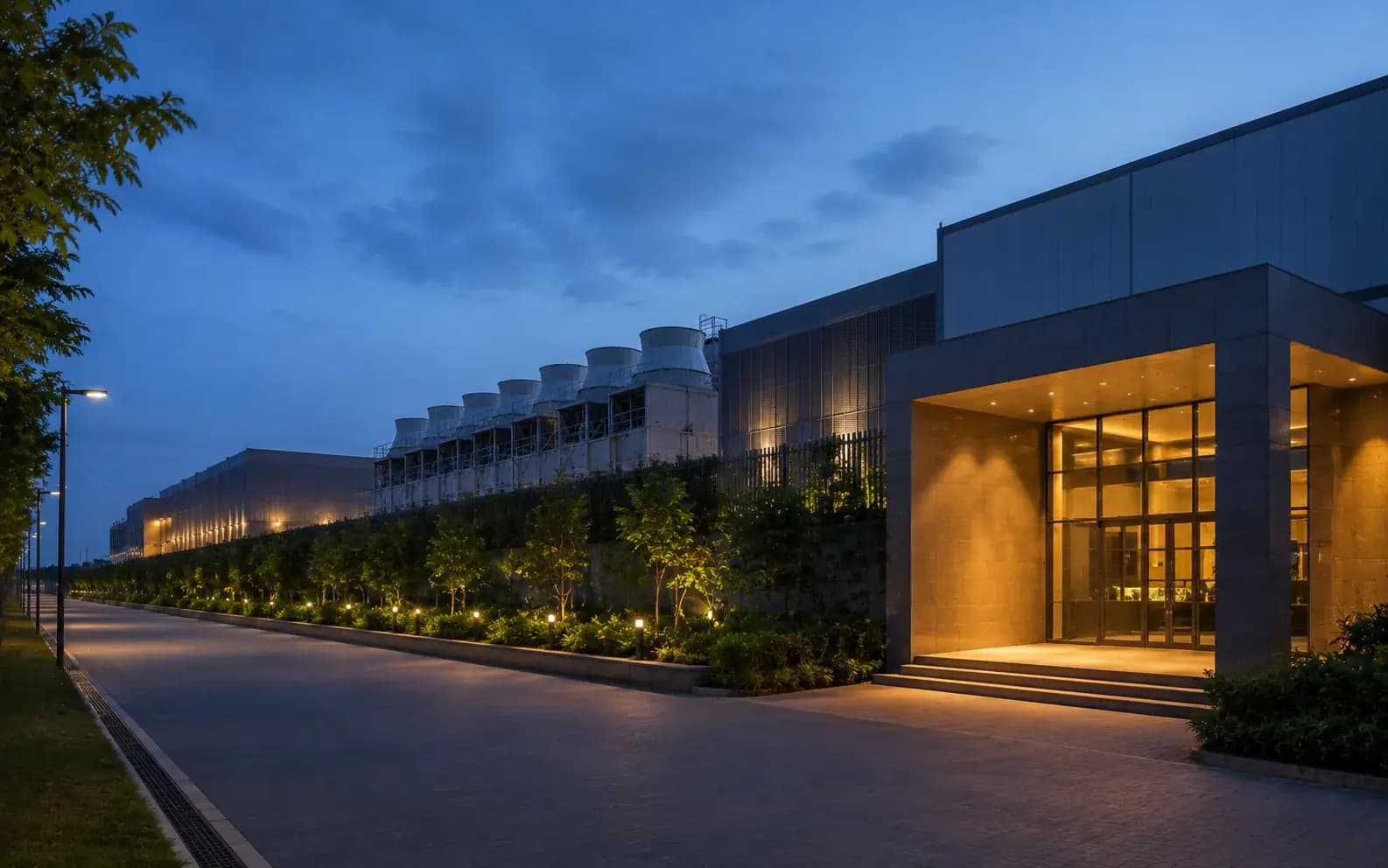
Sewage Treatment Plants · Data Centres & IT Parks
Sewage Treatment Plants for Data Centre and IT Park Campuses
On a data centre or IT park campus the sewage treatment plant is not merely a disposal system: its treated output is the reuse water that supports the zero-discharge position taken in the clearance and reduces the freshwater drawn for cooling make-up and landscape.
Screening view on your project, with the category and route named. No obligation.
What this means for data centres & it parks
A campus generating sewage above the exempt limit must treat it on site to the standards written into the MPCB consent, and for item 8(a) projects the clearance conditions almost always require reuse of treated sewage for flushing, landscape and, where feasible, cooling make-up, with no discharge outside the premises. The two occupancies on such a campus behave very differently. An IT park generates a large, sharply peaked domestic load tied to office hours and five-day weeks, with almost nothing at night. A data hall generates very little sewage, a small operations and security team, while consuming an enormous amount of water in the cooling towers. The result is a plant that must be sized for a peaky inflow yet is valued mainly for a continuous outflow, which is a design problem rather than a catalogue selection.
How KIPL runs it
KIPL designs, builds and commissions the plant against the load profile that the campus actually produces, with equalisation to absorb the working-day peak and tertiary treatment where the treated water is destined for cooling towers. Reuse for cooling is where most attention is needed: hardness, dissolved solids, nutrients and microbiological quality govern scaling, fouling and legionella risk, so the treatment train, disinfection and control regime are specified with the mechanical designer rather than handed over as generic tertiary output. Where an IT park is built in blocks, the plant is modularised so early tenants are not served by a unit running far below its turndown. The frequent failure is a plant sized on total headcount at full occupancy, commissioned when the first block is let, running at a fraction of design load and producing effluent that fails the consent parameters at sampling.
- Zero discharge
The clearance commits to reuse
Item 8(a) conditions typically require treated sewage to be reused on site with no discharge outside the premises, which makes the STP a supply asset rather than a disposal one.
- Consent standards
Sampling tests the output
The consent to operate fixes the discharge and reuse quality, and inspection sampling is against those parameters regardless of how lightly the plant is loaded.
Reuse offsets the cooling draw
Every cubic metre of treated sewage sent to cooling make-up or landscape reduces the freshwater or groundwater component the campus has to justify to CGWA and to the appraisal authority.
What you receive
Written for data centres & it parks, not adapted from a template.
- 01Load profiling separating IT park office-hours peaks from the low continuous data hall load
- 02STP process design with equalisation, and tertiary treatment where reuse to cooling towers is intended
- 03Reuse water quality specification agreed with the mechanical designer for cooling make-up
- 04Modular phasing so early blocks are served without running a plant below turndown
- 05Erection, commissioning and performance demonstration against the consent parameters
- 06Operator training, log formats and monitoring protocol feeding the half-yearly compliance report
Questions from data centres & it parks
What data centres & it parks ask before appointing us.
Answered against the regulation as it stands, not as a sales pitch. If your situation is not here, ask us directly.
Ask a question →Can treated sewage really be used for cooling tower make-up?
Yes, and it is increasingly expected, but only with treatment beyond conventional secondary standards. Cooling systems are sensitive to hardness, dissolved solids, nutrients and microbiological load, all of which drive scaling, biofouling and legionella risk, so tertiary treatment, reliable disinfection and continuous monitoring are part of the scheme rather than optional additions.
How is an STP sized for a data centre with very few people?
On the actual resident and visitor load, which for a data hall is small: operations, security, and contractors during maintenance windows. The mistake is scaling from built-up area, which is the wrong driver here, and the result is a heavily oversized plant that cannot hold its biology at a fraction of design load. Where an IT park shares the campus, the two loads are modelled separately and then combined.
What does zero discharge mean in the clearance?
That no treated or untreated sewage leaves the premises: the entire treated output is consumed on site through flushing, landscape irrigation and, where designed for, cooling make-up, with any residual accounted for. It is a commitment made in the EC and repeated in the consent, and it is checked by comparing generated, treated and reused quantities in the compliance reports.
How does the STP affect the groundwater NOC?
Directly. Treated-sewage reuse reduces the freshwater the campus needs, so it lowers the groundwater component in the CGWA water balance and strengthens the application. Conversely, a reuse claim in the NOC application that the plant cannot actually deliver creates an inconsistency between the abstraction record and the declared balance.
Who operates the plant once the campus is running?
Usually the facilities team or its contractor, which is why commissioning includes training, log formats and a clear monitoring protocol. A plant handed over without an operating discipline drifts within months, and the evidence of that drift is the sampling result in the compliance report.
What happens when an IT park is only partly let?
The plant runs well below design load, which is the most common cause of consent parameter failures on new campuses. The answer is modular capacity, commissioning only what the occupied blocks require and adding trains as occupancy grows: decided at design stage, because retrofitting modularity into an installed single-train plant is expensive.
Stage by stage
How sewage treatment plants actually runs, step by step.
Also for data centres & it parks
The rest of the environmental brief for this sector.
Primary sources
Verify any of this at the source.

Relevant proof
NAMAMI GANGE PROGRAMME
Environmental & Social Impact Assessment and EHS reporting for existing and proposed sewage treatment plants on the Ganga.
- Largest existing STP
- 130 MLD
- Assessed
- 5 plants
Where we do this
Sewage Treatment Plants for data centres & it parks, city by city.
Other sectors
Who else we run sewage treatment plants for.
Next step
Tell us the project, and we will tell you the category and the route.
Screening is the cheapest stage to get right and the most expensive to get wrong. We will say plainly what sewage treatment plants your data centres & it parks project needs, and what it does not.





























































Start the conversation