









Decentralised processing: treating wet waste where it is generated, instead of trucking it away.
Decentralised processing treats the biodegradable fraction at the premises that generates it: which is what the Solid Waste Management Rules 2016 expect of bulk generators, and what removes the largest, wettest and most odorous part of a waste stream from the road.
What it is
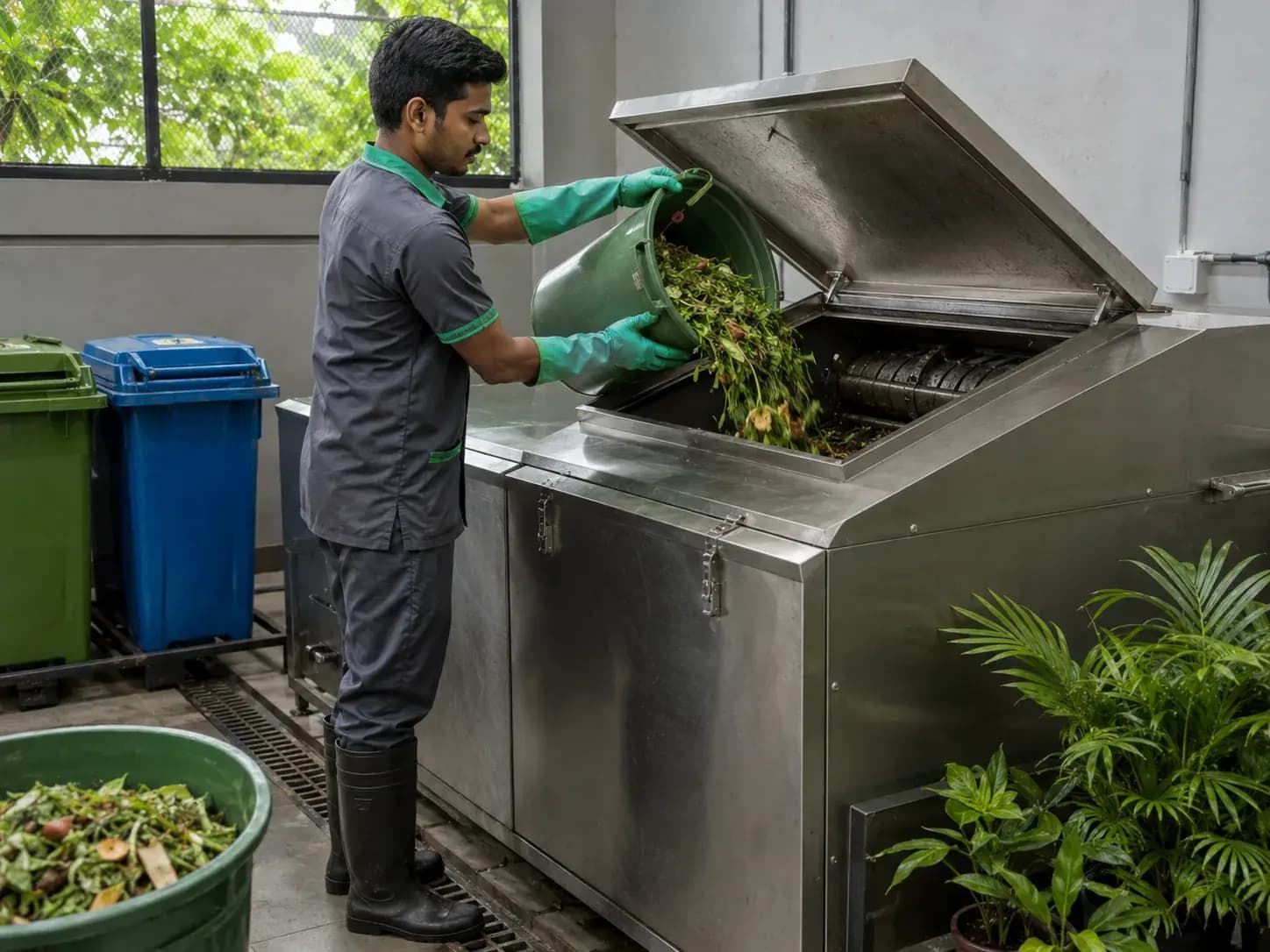
The options are a small range with real differences. An organic waste converter shreds and processes wet waste mechanically in a compact, enclosed unit suited to campuses and buildings with limited space. Windrow and pit composting are simpler and cheaper where land is available and volumes justify it. Vermicomposting produces higher-value output but is more sensitive to feed and conditions. Bio-methanation digests the wet fraction anaerobically and recovers biogas, which suits consistently segregated, high-moisture waste such as a canteen or food-court stream.
KIPL sizes decentralised processing on measured generation and composition rather than on headcount, and designs the surroundings the equipment needs to work: a covered, ventilated space with washdown and drainage, a bulking-agent supply, leachate handling, curing area, and an operator with a defined routine. The equipment is rarely what fails; what fails is an OWC installed without curing space, without a plan for the compost, or with mixed waste being fed into it.
What you get
The deliverables, in hand.
- Authority
- Solid Waste Management Rules 2016 · local body bye-laws
- Typical timeline
- Weeks from sizing to a commissioned, running unit
- Generation and composition data to size the unit realistically
- Technology selection, OWC, composting, vermicomposting or bio-methanation
- Layout with feed area, processing, curing, storage and washdown
- Utilities, ventilation, leachate and odour-control provisions
- Supply, installation and commissioning of the processing unit
- Operator training, running routine and an offtake plan for the output
Straight answers
Decentralised Processing: common questions.
01What is decentralised waste processing?
Processing the biodegradable fraction at or near the point of generation (inside a campus, township, hotel or institution) instead of transporting it to a central facility. It is what the Solid Waste Management Rules 2016 expect of bulk waste generators, and it removes the heaviest and most putrescible part of the stream from collection and transport altogether.
02How do an OWC, composting and bio-methanation compare?
An organic waste converter is enclosed, compact and fast, suited to premises with little space and a need for tidy operation, but it consumes power and needs a bulking agent and curing area. Windrow or pit composting costs far less to install and run but needs land, management and odour control. Bio-methanation recovers biogas and handles high-moisture food waste well, but demands cleanly segregated feed and more attentive operation.
03How is an OWC sized?
On measured daily wet-waste generation with an allowance for peak days, not on occupancy alone, a canteen serving one lunch sitting and a residential tower with the same headcount generate very different quantities and moisture. Undersizing leads to waste accumulating unprocessed; gross oversizing leaves an expensive machine running below its efficient load.
04What does an installation need beyond the machine?
A covered, ventilated space with water supply, washdown and drainage; storage for the bulking agent; a curing area, since output from a converter is not mature compost when it leaves the machine; a leachate route; power of the right rating; and a trained operator with a daily routine. Installations that skip the curing area or the operator are where most decentralised units quietly stop being used.
05What happens to the compost produced?
It should be planned for before the unit is bought: used in the premises landscaping, given to a horticulture contractor, or supplied to an offtaker. Compost produced with no destination accumulates, and the unit stops being fed. Output quality, which depends directly on how clean the incoming segregation is, largely determines whether an offtaker will accept it.
06How are odour and leachate controlled?
By enclosure and ventilation, by processing the day's waste promptly rather than letting it accumulate, by correct moisture control through bulking agents, by draining and treating leachate rather than letting it pool, and by regular washdown. Odour complaints are almost always a symptom of an operating routine that has slipped, not of the technology itself.
07Does on-site processing satisfy bulk generator obligations?
It addresses the central one. That the biodegradable fraction generated on the premises is processed there so far as possible. It does not cover the rest: the dry recyclable fraction still has to reach authorised recyclers, domestic hazardous waste has to go through its own channel, and records still have to be maintained and reported to the local body.
08What about the dry and reject fractions?
They are stored separately and handed to authorised waste collectors or recyclers, with only genuine rejects going into the municipal stream for disposal. A campus that installs an organic waste converter and continues to mix its dry fraction has solved half the problem and will still be receiving the local body's attention on the other half.
Within Integrated Solid Waste Management
Part of the whole route, the other components.
Relevant proof
Where this stage has already been delivered.

MIDC / AURIC · Shendra & Bidkin, Chhatrapati Sambhajinagar
SHENDRA AND BIDKIN INDUSTRIAL AREA, AURANGABAD
Environmental compliance audits, Consent to Establish and green certification support across two industrial nodes of the Delhi-Mumbai Industrial Corridor.
Where we do this
Integrated Solid Waste Management on the ground.
The authority, the timeline and the local ground differ by city. These pages set out how integrated solid waste management actually runs in each.
Featured projects
Work that carries its own evidence.
Our expertise
One team across the whole environmental brief.
Decentralised Processing is one stage of one practice. Most projects need several, and the commitments made at clearance are the ones we build and maintain.
Who we do this for
Integrated Solid Waste Management reads differently by industry.
- 01
Townships & Area DevelopmentCore
A township is a bulk waste generator at settlement scale: segregation, decentralised processing and material recovery under the SWM Rules 2016.
Integrated Solid Waste Management for Townships & Area Development - 02
Municipal CorporationsCore
The SWM Rules 2016 place the processing and disposal duty on the ULB itself, with decentralised capacity the practical route.
Integrated Solid Waste Management for Municipal Corporations - 03
Real Estate & Construction
A society generating over 100 kg/day is a bulk waste generator under the Solid Waste Management Rules 2016 and must process wet waste on site.
Integrated Solid Waste Management for Real Estate & Construction - 04
Hospitality, Healthcare & Education
General, wet and bio-medical streams have to be segregated at source and tracked separately, each to a different rule set.
Integrated Solid Waste Management for Hospitality, Healthcare & Education - 05
Industrial & Manufacturing
Non-hazardous process and canteen waste still falls under the SWM Rules 2016 bulk generator duty, separate from hazardous-waste authorisation.
Integrated Solid Waste Management for Industrial & Manufacturing - 06
Industrial Corridors & MIDC
A node needs shared collection, segregation and processing infrastructure before allotment, not a tenant-by-tenant improvisation.
Integrated Solid Waste Management for Industrial Corridors & MIDC - 07
River & Water Missions
Riverbank dumping and floating waste undo treatment gains, so collection and processing sit inside the mission scope, not beside it.
Integrated Solid Waste Management for River & Water Missions - 08
Corporate Campuses
Segregation, recovery and diversion-from-landfill rates are reported metrics, so campus waste needs a system with data behind it.
Integrated Solid Waste Management for Corporate Campuses
Trusted by
The organisations this work is done for.






In the press