









Bulk waste generator compliance: what the SWM Rules 2016 require of a campus generating 100 kg a day.
A premises generating 100 kg or more of solid waste a day is a bulk waste generator under the Solid Waste Management Rules 2016, and carries duties of its own: segregation, on-site processing of the wet fraction, and handover only to authorised channels.
What it is
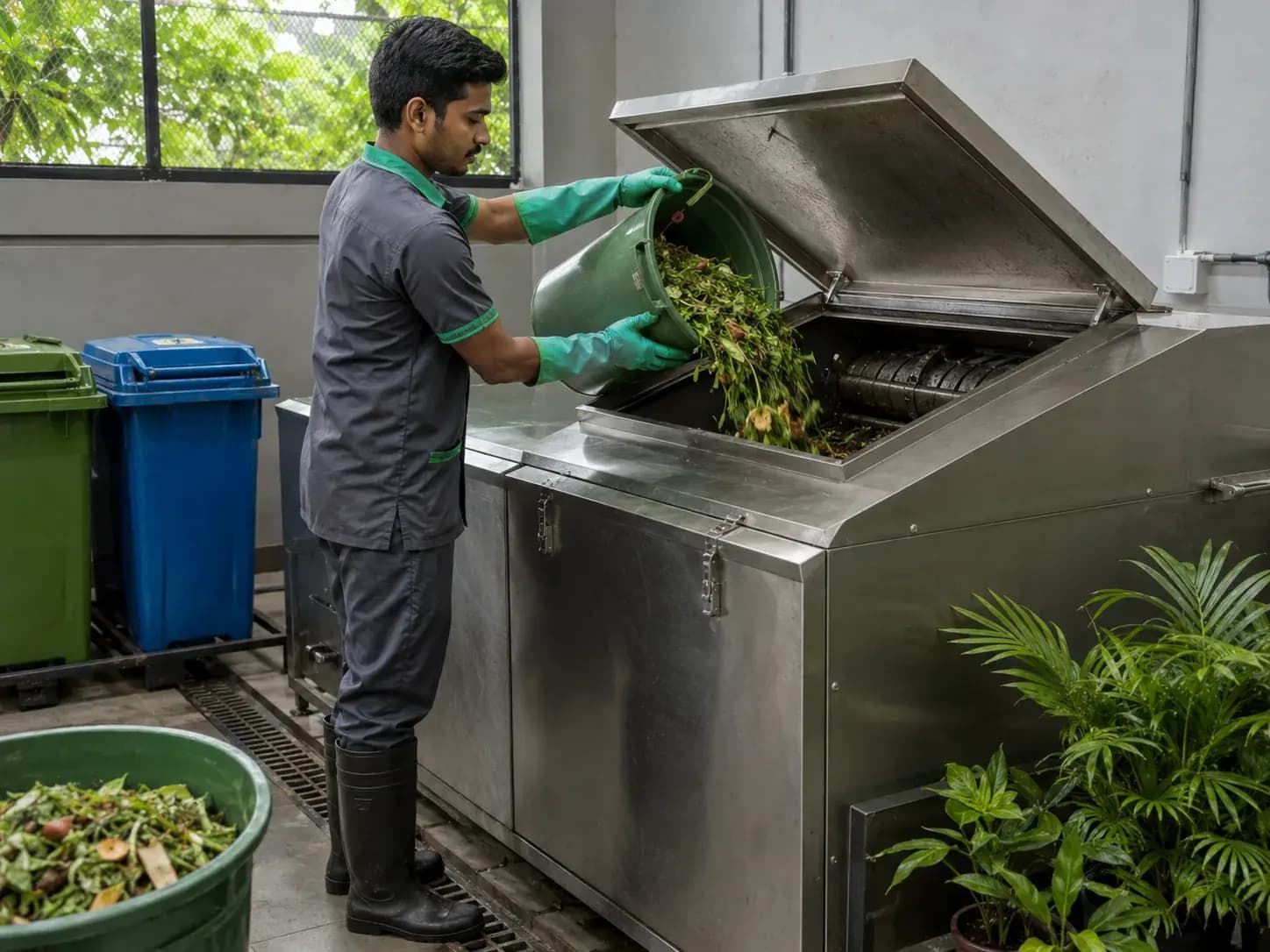
The Rules identify bulk waste generators as the larger institutional and commercial premises (government and public sector buildings, companies, hospitals, hotels, malls, educational institutions, hostels and large residential complexes) whose average waste generation reaches the notified threshold. Their obligations run beyond simply paying for collection: waste must be segregated at source into biodegradable, non-biodegradable and domestic hazardous streams; the biodegradable fraction is to be processed on the premises as far as possible; and the remaining fractions handed to authorised waste collectors, recyclers or the local body's system.
KIPL sets that up as a working system rather than a policy note: the bin infrastructure and segregation practice, the on-site wet-waste processing sized to what the premises actually generates, the tie-up with authorised recyclers and the local body, the records that evidence compliance, and the housekeeping training without which segregation degrades within weeks. Where the premises also holds an Environment Clearance, the waste conditions in that clearance are aligned with the same system, so one arrangement satisfies both.
What you get
The deliverables, in hand.
- Authority
- Solid Waste Management Rules 2016 · urban local body bye-laws
- Typical timeline
- Weeks to set up; compliance is continuing
- Applicability assessment against the bulk waste generator threshold
- Segregation system: bin infrastructure, signage, collection points, practice
- On-site wet-waste processing sized to measured generation
- Authorised handover arrangements for dry, hazardous and reject fractions
- Registration and coordination with the urban local body
- Records, monthly reporting and staff training for sustained compliance
Straight answers
Bulk Waste Generator Compliance: common questions.
01Who counts as a bulk waste generator?
Under the Solid Waste Management Rules 2016, premises such as government and public sector buildings, private companies, hospitals, hotels, shopping complexes, educational institutions, hostels and large residential societies whose average waste generation reaches 100 kg per day, together with premises of the area notified by the local body. Local bye-laws sometimes define the threshold more precisely for a given city, so the local body's notification is worth checking alongside the Rules.
02What are a bulk waste generator's actual obligations?
Segregating waste at source into biodegradable, non-biodegradable and domestic hazardous fractions; storing the segregated streams separately on the premises; processing the biodegradable fraction on site as far as possible; and handing over the remaining fractions only to authorised waste pickers, collectors or the local body. Records and coordination with the local body follow from these duties.
03Is on-site composting compulsory?
The Rules require bulk generators to ensure the biodegradable waste generated on their premises is processed there, so far as possible, through composting or bio-methanation. Where space or feasibility genuinely does not permit it, the alternative is an arrangement with the local body or an authorised processor: but the default expectation, and what most local bodies enforce, is on-site processing of the wet fraction.
04Do we have to register with the urban local body?
Bulk generators are expected to be identified and coordinated with the local body, and many cities require registration or intimation together with periodic reporting of quantities generated and processed. Because implementation is through municipal bye-laws, the exact procedure varies by city, and the local body's own requirement is the operative one.
05What are the consequences of not complying?
Local bodies enforce through user charges, spot fines and penalties under their bye-laws, may refuse to collect unsegregated waste, and can escalate to the State Pollution Control Board. For a project holding an Environment Clearance with waste-management conditions, non-compliance also surfaces in the half-yearly compliance report, which is a more consequential exposure than a municipal fine.
06What records should be kept?
Quantities generated by stream, quantities processed on site and the compost or output produced, quantities handed over with the authorised recipient identified, disposal receipts for the domestic hazardous fraction, and the maintenance and operating log for on-site processing equipment. These are what an inspection or a compliance report is built from.
07How does this interact with e-waste, battery and biomedical waste?
Those streams sit under their own rules and their own authorised channels, and must not enter the municipal waste stream. A campus therefore runs parallel arrangements (an authorised e-waste recycler, battery take-back, and for a hospital a registered biomedical waste facility) alongside the SWM Rules 2016 system. The domestic hazardous fraction under the SWM Rules is a distinct, smaller category from these.
08Why does segregation degrade after the first few months?
Because it depends on daily practice by housekeeping and occupants rather than on equipment. Systems hold when bins and signage are consistent, when collection does not remix what occupants separated, when housekeeping staff are trained and re-trained through turnover, and when someone is accountable for the record. Where those are absent, a well-designed system reverts to mixed waste quickly.
Within Integrated Solid Waste Management
Part of the whole route, the other components.
Relevant proof
Where this stage has already been delivered.

MIDC / AURIC · Shendra & Bidkin, Chhatrapati Sambhajinagar
SHENDRA AND BIDKIN INDUSTRIAL AREA, AURANGABAD
Environmental compliance audits, Consent to Establish and green certification support across two industrial nodes of the Delhi-Mumbai Industrial Corridor.
Where we do this
Integrated Solid Waste Management on the ground.
The authority, the timeline and the local ground differ by city. These pages set out how integrated solid waste management actually runs in each.
Featured projects
Work that carries its own evidence.
Our expertise
One team across the whole environmental brief.
Bulk Waste Generator Compliance is one stage of one practice. Most projects need several, and the commitments made at clearance are the ones we build and maintain.
Who we do this for
Integrated Solid Waste Management reads differently by industry.
- 01
Townships & Area DevelopmentCore
A township is a bulk waste generator at settlement scale: segregation, decentralised processing and material recovery under the SWM Rules 2016.
Integrated Solid Waste Management for Townships & Area Development - 02
Municipal CorporationsCore
The SWM Rules 2016 place the processing and disposal duty on the ULB itself, with decentralised capacity the practical route.
Integrated Solid Waste Management for Municipal Corporations - 03
Real Estate & Construction
A society generating over 100 kg/day is a bulk waste generator under the Solid Waste Management Rules 2016 and must process wet waste on site.
Integrated Solid Waste Management for Real Estate & Construction - 04
Hospitality, Healthcare & Education
General, wet and bio-medical streams have to be segregated at source and tracked separately, each to a different rule set.
Integrated Solid Waste Management for Hospitality, Healthcare & Education - 05
Industrial & Manufacturing
Non-hazardous process and canteen waste still falls under the SWM Rules 2016 bulk generator duty, separate from hazardous-waste authorisation.
Integrated Solid Waste Management for Industrial & Manufacturing - 06
Industrial Corridors & MIDC
A node needs shared collection, segregation and processing infrastructure before allotment, not a tenant-by-tenant improvisation.
Integrated Solid Waste Management for Industrial Corridors & MIDC - 07
River & Water Missions
Riverbank dumping and floating waste undo treatment gains, so collection and processing sit inside the mission scope, not beside it.
Integrated Solid Waste Management for River & Water Missions - 08
Corporate Campuses
Segregation, recovery and diversion-from-landfill rates are reported metrics, so campus waste needs a system with data behind it.
Integrated Solid Waste Management for Corporate Campuses
Trusted by
The organisations this work is done for.






In the press