










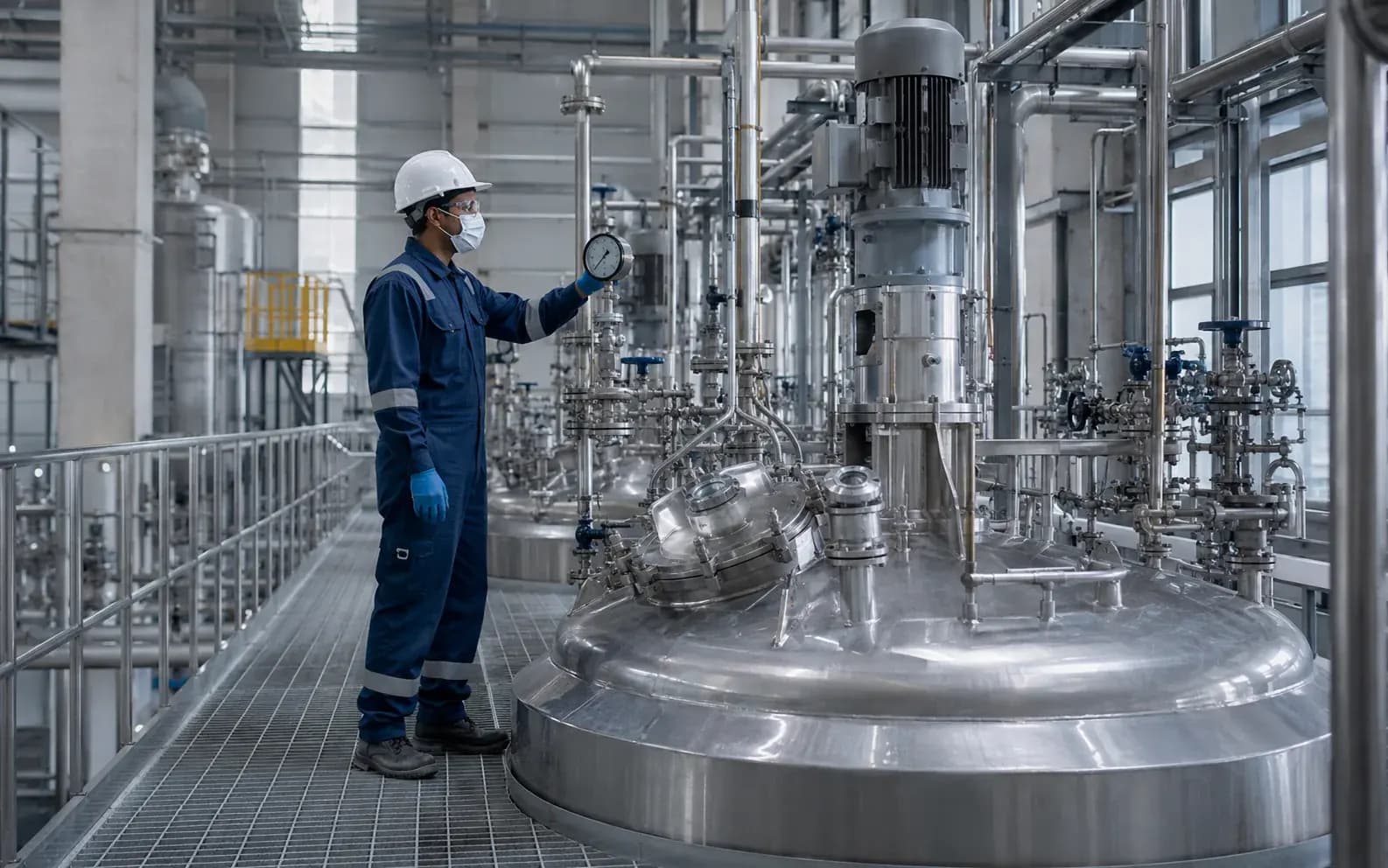
Effluent Treatment Plants · Distilleries & Ethanol
Spent Wash Treatment and ETP for Distilleries
Distillery effluent treatment is spent wash treatment: several litres per litre of alcohol at extreme organic strength, routed through bio-methanation, concentration and incineration to reach the zero liquid discharge the regulator expects.
Screening view on your project, with the category and route named. No obligation.
What this means for distilleries & ethanol
Spent wash is not a difficult effluent; it is a different one. It leaves the distillation column hot, acidic and with a chemical oxygen demand an order of magnitude above ordinary industrial wastewater, at a volume of several litres for every litre of alcohol produced. Conventional treatment does not reduce it to a dischargeable standard, and there is no receiving body that would accept it if it did. The route that works is a sequence in which each stage exists to make the next one possible: bio-methanation to remove the bulk of the organic load and recover biogas that displaces boiler fuel, multiple-effect evaporation to concentrate the digested spent wash to a solids content that will burn, and an incineration boiler that fires that concentrate, leaving a potash-rich ash rather than a liquid. Evaporator condensate is polished and reused, and the smaller streams (spent lees, fermenter and floor washings, utility blowdown) are handled conventionally rather than allowed into the concentrated route.
How KIPL runs it
KIPL designs the train around the plant's real operating pattern, which for a molasses distillery attached to a sugar mill is seasonal and for a standalone grain or syrup unit is not. The variables that decide whether a design works in practice are the ones that are easiest to assume away: digester performance during start-up and upsets, evaporator scaling and cleaning downtime, the concentrate solids the boiler can actually fire and hold, and the lagoon storage that bridges every one of those interruptions within the days the consent permits. What goes wrong otherwise is the pattern the sector is known for: a plant with the full ZLD train installed, a digester underperforming, an evaporator down for cleaning, and spent wash accumulating in a lagoon beyond its permitted holding period, which is where the notices begin.
- Volume and strength
Several litres per litre of alcohol
Spent wash generation at several litres per litre of alcohol, at very high COD and BOD, rules out conventional treatment and discharge as an option.
- ZLD
Zero liquid discharge is the expectation
For molasses-based distillation the regulator's default position is zero liquid discharge, which makes concentration and incineration, or a demonstrated equivalent, the design basis.
- Storage days
Accumulation is capped
Lagoon storage is permitted as a volume and a holding period, so every hour of digester or evaporator downtime consumes a limited buffer rather than being absorbed indefinitely.
What you receive
Written for distilleries & ethanol, not adapted from a template.
- 01Spent wash quantification and characterisation from feedstock and capacity, with spent lees, condensate and washings assessed separately
- 02Bio-methanation design with biogas recovery and its utilisation as boiler fuel, including digester start-up and upset behaviour
- 03Multiple-effect evaporator design and concentration duty, with a cleaning and downtime allowance built into the balance
- 04Incineration boiler feed specification for concentrated spent wash, ash quantification and the ash handling and utilisation route
- 05Condensate polishing and reuse scheme, and conventional treatment for the low-strength streams
- 06Storage lagoon sizing to the permitted holding period, with lining, leachate protection and groundwater monitoring
Questions from distilleries & ethanol
What distilleries & ethanol ask before appointing us.
Answered against the regulation as it stands, not as a sales pitch. If your situation is not here, ask us directly.
Ask a question →How much spent wash does a distillery generate?
Several litres for every litre of alcohol produced, with the ratio depending on feedstock and process configuration, molasses-based distillation is at the higher end. The figure for a specific project should be derived from its feedstock and design capacity rather than taken from a general ratio, because the entire treatment train is sized on it.
Why is bio-methanation used before evaporation?
Because it removes the bulk of the organic load and recovers biogas that displaces boiler fuel, which improves the economics of the stages that follow. It does not by itself produce a dischargeable effluent, digested spent wash still carries a high COD and the full salt load: so it is a first stage, not a solution.
What happens to the ash from the incineration boiler?
Firing concentrated spent wash produces a potash-rich ash whose quantity and handling have to be planned for, including storage clear of rainfall and a defined utilisation or disposal route. Ash accumulating in the open is a recurring inspection finding at distilleries running the incineration route.
Can we store spent wash instead of treating it during the off-season?
Only within the permitted lagoon capacity and holding period. Storage is designed to bridge interruptions in the treatment train, not to substitute for it, and a lagoon carrying spent wash beyond the permitted period is directly observable and among the first things an inspection looks at.
Does a grain-based ethanol plant have the same problem?
The effluent is different in character (thin stillage rather than molasses spent wash, with a route through decantation and evaporation to a dried co-product), but the principle is the same: a high-strength stream with no discharge route, requiring concentration and recovery. The design differs; the requirement to demonstrate a closed route does not.
Does KIPL design the plant or also build it?
Both. The reason it matters here is that the assumptions in the design (digester performance, evaporator availability, concentrate solids the boiler will accept) are what the consent conditions are later enforced against, so the team that made them should be present when the plant is commissioned.
Stage by stage
How effluent treatment plants actually runs, step by step.
Also for distilleries & ethanol
The rest of the environmental brief for this sector.
Primary sources
Verify any of this at the source.
Relevant proof
EIA for Synthetic Organic Chemical Industry
CTE/CTO application, ToR application, baseline data collection, EIA report and appraisal before the EAC: Category 5(f), the sector KIPL holds Category A accreditation in.
- Capacity
- 20 → 140 TPM
- 5(f) accredited
- Cat A
Where we do this
Effluent Treatment Plants for distilleries & ethanol, city by city.
Other sectors
Who else we run effluent treatment plants for.
Next step
Tell us the project, and we will tell you the category and the route.
Screening is the cheapest stage to get right and the most expensive to get wrong. We will say plainly what effluent treatment plants your distilleries & ethanol project needs, and what it does not.





























































Start the conversation