









Organic Waste Converters: on-site composting for bulk-generator compliance.
At a glance
OWC- Authority
- Solid Waste Management Rules 2016 (bulk generators)
- Typical timeline
- Install in weeks; O&M ongoing
- Who needs it
- Housing societies, campuses, hotels, canteens, food processors
- organic waste converter
- OWC supplier
- mechanical composter
- in-vessel composting
- vermicomposting
- biomethanation
- bulk generator wet waste
What it is
Organic Waste Converters, without the guesswork.
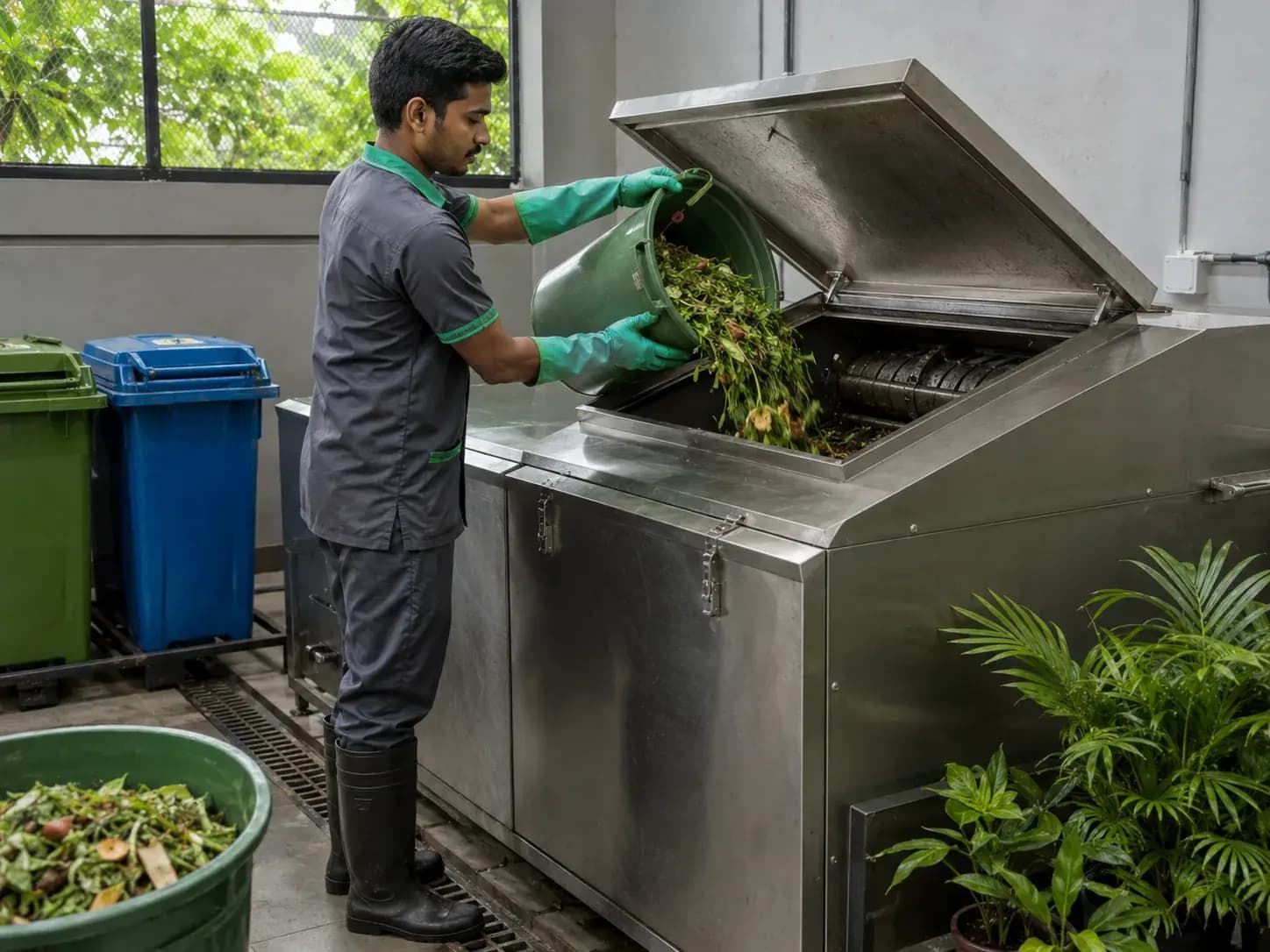
An organic waste converter is how most bulk generators actually meet the wet-waste half of the Solid Waste Management Rules 2016. Kitchen and garden waste (the heaviest, fastest-rotting fraction) is converted on-site into compost or gas instead of being trucked to a landfill. KIPL specifies, installs and maintains the right converter for the load, and keeps it running, which is where most society-level systems fail.
The technology is chosen to the site: mechanical composters for speed and small footprints, in-vessel systems for larger and odour-sensitive locations, vermicomposting where space and patience allow, and anaerobic digesters where the volume justifies capturing biogas. We size the unit to the measured organic load, plan the curing and the compost off-take, and run the O&M so the system is still working a year later.
What’s included
Every component of organic waste converters.
6 components, each a service in its own right: open any one, or bring us the whole scope and one team carries it.
One accountable team, start to finish
The process
How the file moves.
You see the whole route on day one; then one accountable team holds it, stage after stage.
Load & technology selection
Organic quantity and type measured, then the converter choice (mechanical, in-vessel, vermicompost or digester) that fits the load and the space.
Installation & commissioning
Unit installed and integrated with the segregation flow, with staff trained on feed and operation.
Curing & off-take plan
The curing stage and a plan for the finished compost (landscaping, gardens or removal) so output doesn't pile up.
Operations & maintenance
Routine O&M, culture and moisture management, and the records that show continuous, compliant processing.
Organic Waste Converters
Buying the machine is easy. Keeping it composting is the job.

Why KIPL
Credentials you can check.
A firm that sells regulatory compliance has to be beyond reproach on its own. Every credential below is verifiable, and every figure traces to a document.
Proof
The same practice, on the ground.

MIDC / AURIC · Shendra & Bidkin, Chhatrapati Sambhajinagar
SHENDRA AND BIDKIN INDUSTRIAL AREA, AURANGABAD
Environmental compliance audits, Consent to Establish and green certification support across two industrial nodes of the Delhi-Mumbai Industrial Corridor.
Straight answers
Organic Waste Converters: the questions clients ask first.
01What is an organic waste converter?
An organic waste converter (OWC) is an on-site system that breaks segregated wet waste, food and garden waste: into compost, often within days for mechanical units, through microbial or vermi-action. It lets a bulk generator process biodegradable waste within the premises as the SWM Rules 2016 require.
02Which is better, mechanical composter or vermicomposting?
Mechanical composters are fast and compact but need power and a curing area; vermicomposting is low-energy and produces excellent compost but needs more space, time and care. For larger or odour-sensitive sites, in-vessel systems or biomethanation may suit better. The load and the site decide.
03Why do so many society OWCs stop working?
Almost always operations, not the machine: poor segregation feeding the unit, neglected curing, moisture or culture imbalance, and no clear owner. That is why we treat O&M and staff training as part of the system, not an afterthought.
04What happens to the compost produced?
It is cured and used on the site's own gardens and landscaping, given to residents, or removed by an off-taker. Planning the off-take up front is what stops finished compost accumulating and the system stalling.
Where we work
Filed where your project is.
Organic Waste Converters, carried with the deepest roots across the Mumbai Metropolitan Region and Maharashtra: and wherever a good project needs it. Every filing lands on the right desk, argued by named, accredited people.
Home turf
Mumbai Metropolitan Region- Navi Mumbai
- Mumbai
- Thane
- Panvel
- Kalyan-Dombivli
- Vasai-Virar
- Mira-Bhayandar
- Bhiwandi
- Ulhasnagar
- Ambernath
- Badlapur
- Uran
- Taloja
- Kharghar
By state
State-wide pagesNot listed? We carry organic waste converters across the region all the same, tell us where your project is.
Who we do this for
The same filing reads differently by industry.
What organic waste converters demands of a data centre is not what it demands of a distillery. These set out the item code, the conditions that bite and the evidence each sector is asked for.
Trusted by
The builders, industry and public bodies we file for.












Bring us your organic waste converters file.
One conversation to map the route, and the team that will carry it.