









OWC technology selection: choosing the composting route a site can actually run.
Selecting an organic waste converter is a waste-characterisation exercise before it is a procurement one: the right technology follows from the quantity, composition and moisture of what a site actually generates.
What it is
The Solid Waste Management Rules 2016 require bulk waste generators to segregate their waste and process the wet fraction on the premises, or make arrangements for it, rather than handing it to the municipal stream. That obligation can be met by several routes (powered mechanical composting, enclosed in-vessel composting, vermicomposting, or anaerobic digestion for biogas) and they behave very differently in terms of space, power, operator skill, odour risk and what comes out at the end.
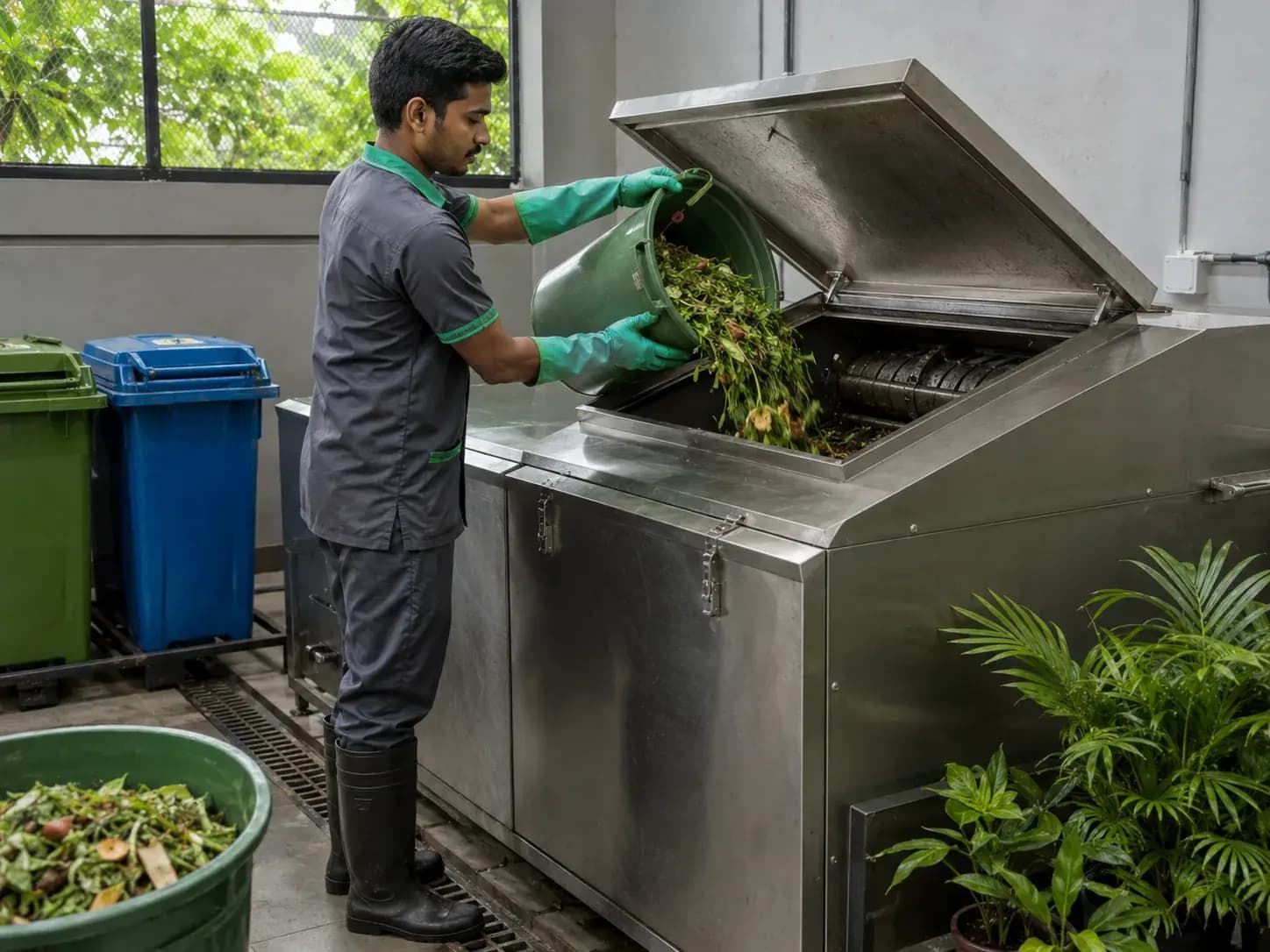
KIPL starts with a waste audit rather than a catalogue. We measure or reliably estimate the wet-waste stream in kilograms per day, characterise it for moisture, oil, salt and non-compostable contamination, note the peaks a canteen or a festival creates, and then match a technology to the site's real footprint, power availability, drainage, ventilation and staffing. The output is a reasoned recommendation and a specification a client can tender against, not a preference for one vendor's machine.
What you get
The deliverables, in hand.
- Authority
- Solid Waste Management Rules 2016 · municipal bye-laws
- Typical timeline
- Two to four weeks, driven by the waste audit
- Waste audit and characterisation of the wet-waste stream
- Quantity projection in kg/day, including peak and seasonal load
- Comparison of aerobic composting, in-vessel, vermicomposting and bio-methanation options
- Capacity sizing with space, power, water and drainage requirements
- Indicative capital and operating cost comparison across options
- Recommendation note and technical specification for tendering
Straight answers
Technology Selection: common questions.
01What is an organic waste converter?
An organic waste converter (OWC) is on-site equipment that processes segregated wet waste (food and kitchen waste, garden trimmings) into compost or biogas at the premises where it is generated. It replaces transporting wet waste to a distant processing site or a landfill, which is exactly what the Solid Waste Management Rules 2016 push generators away from.
02Who is required to install an organic waste converter?
Bulk waste generators. The Solid Waste Management Rules 2016 place on-site processing obligations on bulk generators, commonly defined as premises generating 100 kg per day or more of waste, and on housing societies above a threshold that the local body sets. Because the qualifying threshold for group housing and the enforcement route are set locally, the applicable bye-law should be confirmed with the municipal corporation.
03Aerobic composting or bio-methanation, which should we choose?
Aerobic composting uses oxygen and produces compost; it is simpler to run, tolerates variable feed and suits sites that can use or dispose of the compost. Bio-methanation is anaerobic, produces biogas that can offset cooking fuel or generate power, and needs a steadier, high-moisture food-waste feed and a more capable operator. Sites with a large, consistent kitchen waste stream and a use for the gas favour digestion; mixed and variable streams usually favour composting.
04What determines the capacity we need?
The measured wet-waste generation in kg per day, not headcount alone. Sizing has to allow for the peak day rather than the average (a canteen, a banquet season or a festival can double the load) and for the residence time the chosen technology needs. Undersizing forces waste back into the municipal stream on exactly the days an inspection is most likely.
05How much space and power does an OWC need?
It varies with the route and the capacity. A powered mechanical composter occupies a compact machine room but draws power through its shredding and heating cycle; vermicomposting needs more area but little power; a digester needs a plant footprint plus gas storage and a slurry-handling area. The space, three-phase power, water point and drainage requirement should be confirmed against the specific model before a location is fixed.
06What happens to the compost that is produced?
Most sites use it in their own landscaping, which is the cleanest answer because it closes the loop on the premises. Where output exceeds landscape demand, it is handed to the local body or to an agricultural or horticultural offtaker. The offtake route should be settled before commissioning, since unmanaged output accumulating on site becomes its own nuisance.
07Do we need a pollution control board consent for an OWC?
It depends on the technology, the scale and the state. A small on-site composter within a premises is generally treated as part of the generator's waste management obligation rather than a separate consented activity, while a bio-methanation plant with gas utilisation or power generation attracts closer scrutiny. The position should be confirmed with the State Pollution Control Board and the local body before installation.
Within Organic Waste Converters
Part of the whole route, the other components.
Relevant proof
Where this stage has already been delivered.

MIDC / AURIC · Shendra & Bidkin, Chhatrapati Sambhajinagar
SHENDRA AND BIDKIN INDUSTRIAL AREA, AURANGABAD
Environmental compliance audits, Consent to Establish and green certification support across two industrial nodes of the Delhi-Mumbai Industrial Corridor.
Where we do this
Organic Waste Converters on the ground.
The authority, the timeline and the local ground differ by city. These pages set out how organic waste converters actually runs in each.
Featured projects
Work that carries its own evidence.

Our expertise
One team across the whole environmental brief.
Technology Selection is one stage of one practice. Most projects need several, and the commitments made at clearance are the ones we build and maintain.
Who we do this for
Organic Waste Converters reads differently by industry.
- 01
Hospitality, Healthcare & EducationCore
Kitchen and canteen waste puts a campus well past the 100 kg/day bulk generator line under the SWM Rules 2016.
Organic Waste Converters for Hospitality, Healthcare & Education - 02
Corporate CampusesCore
Canteen waste at campus scale crosses the 100 kg/day bulk generator threshold under the SWM Rules 2016, requiring on-site processing.
Organic Waste Converters for Corporate Campuses - 03
Real Estate & Construction
Municipal bye-laws across MCGM, NMMC and PMC make an OWC the practical way a large housing project meets its wet-waste obligation.
Organic Waste Converters for Real Estate & Construction - 04
Townships & Area Development
Decentralised composting sized per sector or cluster is how the township meets its wet-waste commitment without a municipal tie-in.
Organic Waste Converters for Townships & Area Development - 05
Municipal Corporations
Ward-level composting is how a corporation reduces landfill load and enforces the bulk generator rule on its own societies.
Organic Waste Converters for Municipal Corporations
Trusted by
The organisations this work is done for.












In the press