









OWC installation, commissioning and O&M: what keeps a converter running after handover.
Most organic waste converters do not fail as machines; they fail as operations: which is why installation, commissioning on real waste and a written O&M regime matter more than the specification sheet.
What it is
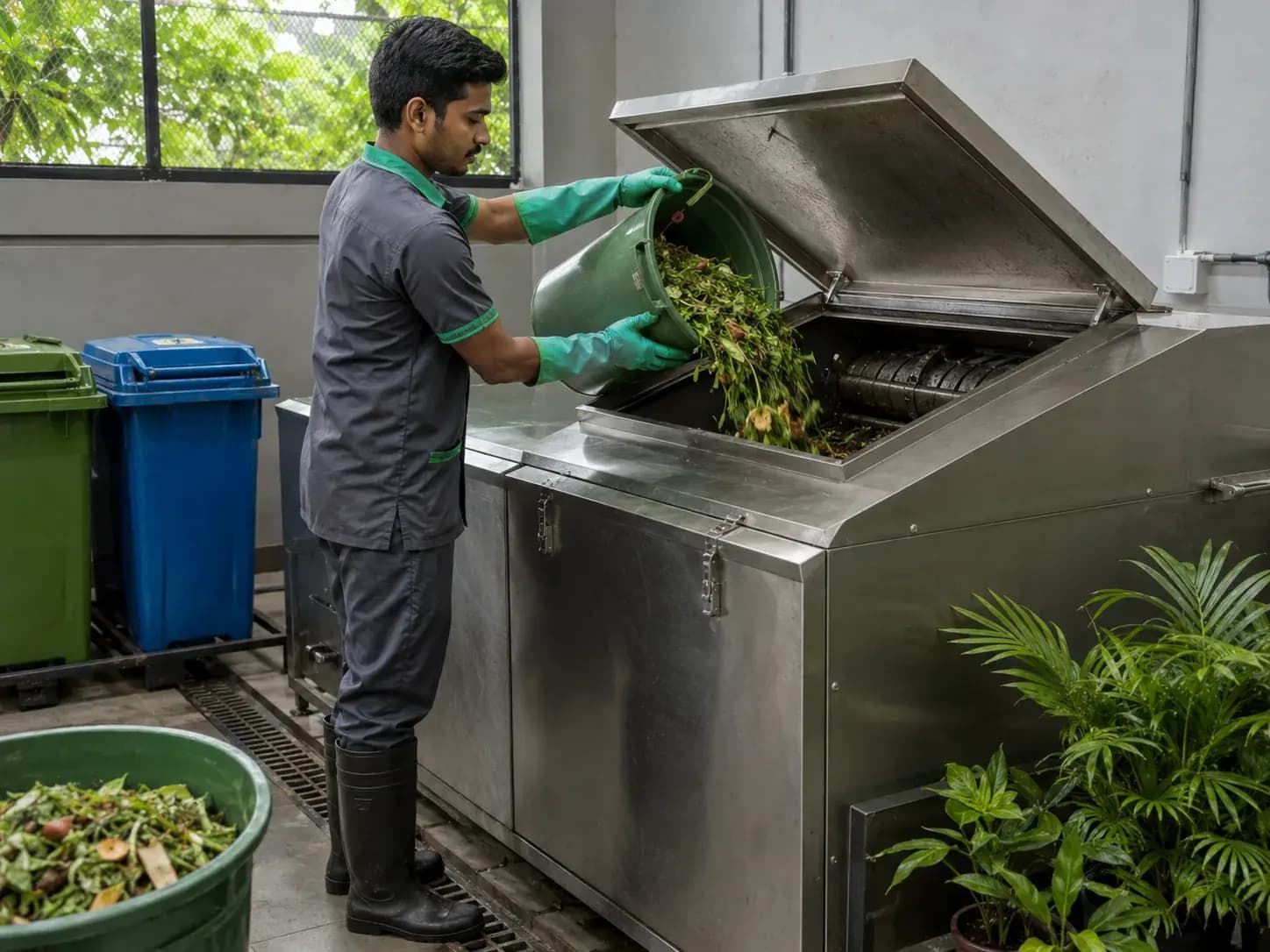
Installation is the point at which a machine becomes a working system: a level foundation, three-phase power, a water point, a drainage path for leachate, ventilation, a covered feed area, bulking-agent storage and curing bays. Commissioning then has to be done on the site's own waste rather than a demonstration charge, because that is the only test that shows how the unit behaves with the segregation quality, moisture and contamination it will actually receive.
KIPL handles installation and commissioning and then puts the operating regime in writing: who loads the machine, at what time, with how much bulking agent, what is recorded, when curing bays are turned, where the compost goes, and what triggers a call to maintenance. We train the housekeeping staff who will actually run it, and set up the log formats a municipal inspection will ask for. Under the Solid Waste Management Rules 2016 the compliance obligation stays with the generator, so the point of the regime is to make compliance a routine rather than a scramble.
What you get
The deliverables, in hand.
- Authority
- Solid Waste Management Rules 2016 · municipal bye-laws
- Typical timeline
- Installation in weeks; commissioning and stabilisation follow the process
- Civil foundation, power, water, drainage and ventilation works for the unit
- Erection, installation and utility connection
- Commissioning and trial run on the site's own segregated waste
- Operator training and a written daily, weekly and monthly routine
- Log formats and compliance records for local-body inspection
- Annual maintenance contract with defined visit frequency and response times
Straight answers
Installation, Commissioning & O&M: common questions.
01What site services does an OWC installation need?
A level load-bearing base, a suitable power supply, commonly three-phase for powered units: a water point, a drainage path for leachate, ventilation or an exhaust route, and covered space for bulking agent and for curing. These should be settled before the machine is ordered, because retrofitting drainage and ventilation into an already-chosen corner is where most installations lose time.
02Why does commissioning have to use our own waste?
Because a demonstration charge of clean, uniform waste tells you nothing about how the unit will behave with the moisture, oil, salt and packaging contamination your premises actually produces. Commissioning on live waste exposes segregation problems, capacity shortfalls and odour issues while the supplier is still on site and accountable.
03Who is responsible for compliance once the unit is handed over?
The waste generator. Under the Solid Waste Management Rules 2016 the obligation to process wet waste sits with the bulk generator and does not transfer to the equipment supplier or the O&M contractor. What a contract can do is allocate the tasks and the response times; it cannot move the statutory liability.
04What should an annual maintenance contract cover?
Preventive visits at a defined frequency, a stated response time for breakdowns, coverage of wear items such as blades and bearings, servicing of blowers, heaters and drives, and a clear line between what is included and what is charged extra. A contract without a response time obligation is of limited use on the day the machine stops and waste keeps arriving.
05What records should be kept?
Daily quantity of waste fed, bulking agent and culture consumed, output quantity and its destination, breakdown and maintenance events, and any odour or leachate observations. These serve two purposes: running the system properly, and answering the local body when it asks for evidence that on-site processing is genuinely happening.
06What usually goes wrong in the first six months?
Segregation slips at source, so contamination reaches the machine; curing bays fill because no offtake was arranged for the compost; bulking agent runs out; and the trained operator leaves without the routine being handed over. All four are operational rather than mechanical, which is why the training and the written routine matter as much as the installation.
07Can an existing under-performing OWC be revived rather than replaced?
Often, yes. A unit that is odorous, choked or producing poor output is frequently suffering from overloading, wrong moisture balance, missing curing capacity or lapsed maintenance rather than a terminal fault. An operational audit is the cheaper first step, and only if the capacity is genuinely mismatched to the waste load does replacement become the answer.
Within Organic Waste Converters
Part of the whole route, the other components.
Relevant proof
Where this stage has already been delivered.

MIDC / AURIC · Shendra & Bidkin, Chhatrapati Sambhajinagar
SHENDRA AND BIDKIN INDUSTRIAL AREA, AURANGABAD
Environmental compliance audits, Consent to Establish and green certification support across two industrial nodes of the Delhi-Mumbai Industrial Corridor.
Where we do this
Organic Waste Converters on the ground.
The authority, the timeline and the local ground differ by city. These pages set out how organic waste converters actually runs in each.
Featured projects
Work that carries its own evidence.

Our expertise
One team across the whole environmental brief.
Installation, Commissioning & O&M is one stage of one practice. Most projects need several, and the commitments made at clearance are the ones we build and maintain.
Who we do this for
Organic Waste Converters reads differently by industry.
- 01
Hospitality, Healthcare & EducationCore
Kitchen and canteen waste puts a campus well past the 100 kg/day bulk generator line under the SWM Rules 2016.
Organic Waste Converters for Hospitality, Healthcare & Education - 02
Corporate CampusesCore
Canteen waste at campus scale crosses the 100 kg/day bulk generator threshold under the SWM Rules 2016, requiring on-site processing.
Organic Waste Converters for Corporate Campuses - 03
Real Estate & Construction
Municipal bye-laws across MCGM, NMMC and PMC make an OWC the practical way a large housing project meets its wet-waste obligation.
Organic Waste Converters for Real Estate & Construction - 04
Townships & Area Development
Decentralised composting sized per sector or cluster is how the township meets its wet-waste commitment without a municipal tie-in.
Organic Waste Converters for Townships & Area Development - 05
Municipal Corporations
Ward-level composting is how a corporation reduces landfill load and enforces the bulk generator rule on its own societies.
Organic Waste Converters for Municipal Corporations
Trusted by
The organisations this work is done for.












In the press