









Mechanical composters: powered aerobic units that convert wet waste on site.
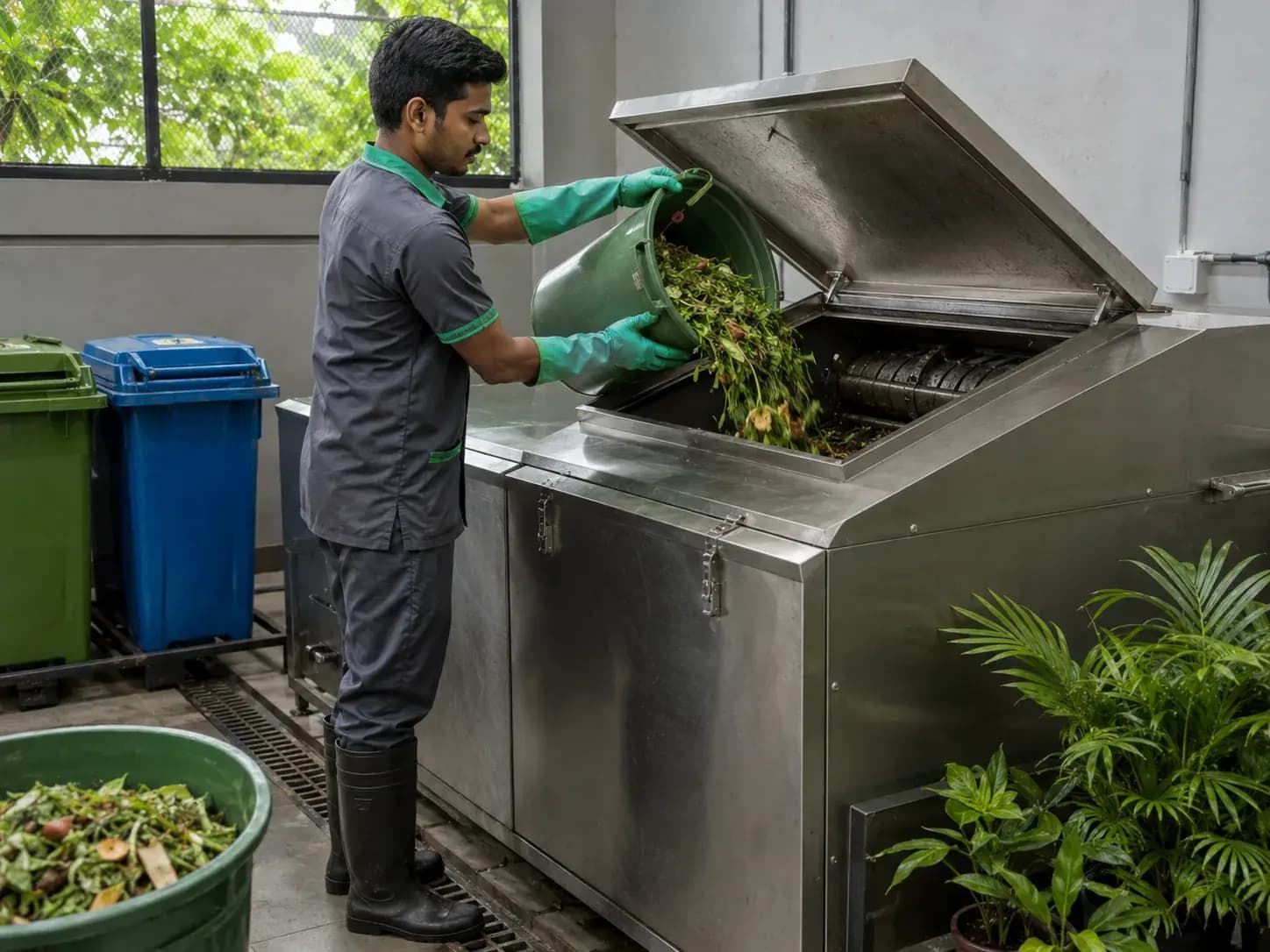
A mechanical composter shreds, mixes and aerates segregated wet waste inside a powered vessel, so a bulk generator can convert its own organic waste on the premises rather than sending it out.
What it is
A mechanical composter accelerates aerobic decomposition by doing mechanically what a compost pit does slowly: it reduces particle size, mixes the charge with a bulking agent and a microbial culture, holds it warm and aerated, and discharges a stabilised pre-compost within a short cycle. It is the most common answer for offices, hotels, hospitals, campuses and housing societies because it is compact, contained and predictable in daily operation.
KIPL specifies, supplies and installs mechanical composters sized to the audited waste load, and, just as importantly, designs the part most installations get wrong: the curing area. Machine output is not finished compost; it needs a maturation period in a covered, ventilated space before it is fit to use. We plan the feed point, the bulking-agent store, the curing bays, the leachate drainage and the operator routine together, because an OWC fails on housekeeping far more often than on hardware.
What you get
The deliverables, in hand.
- Authority
- Solid Waste Management Rules 2016 · municipal bye-laws
- Typical timeline
- Manufacturing lead time, then installation and a short commissioning run
- Capacity sizing and machine specification against the audited waste load
- Civil foundation, power, water and drainage layout for the machine room
- Supply, installation and commissioning with the site's actual waste
- Curing and maturation area design with leachate management
- Operator training and a written daily and weekly operating routine
- Log formats and records for local-body inspection
Straight answers
Mechanical Composters: common questions.
01How is a mechanical composter different from a compost pit?
A pit relies on time, area and natural aeration; a mechanical composter uses a shredder, an agitator and controlled aeration inside an enclosed vessel to compress the active phase into a short cycle within a small footprint. The pit is cheaper but needs land and tolerates odour and pests poorly in a built-up premises. The machine costs more to buy and run but is the practical option where space is the constraint.
02Does the machine produce finished compost?
No. Most mechanical composters discharge a stabilised, partially decomposed pre-compost that still needs a curing or maturation period (typically a few weeks in covered, ventilated bays) before it is mature enough to use on plants. Installations that skip curing produce a material that damages landscaping and gives the whole system a bad name.
03What consumables does it need?
A bulking agent (cocopeat, sawdust or dried shredded garden waste) to correct moisture and carbon balance, and a microbial culture or inoculum to seed the process. Consumption tracks the wet-waste load, so it should be budgeted as a running cost rather than treated as a one-time supply. The bulking agent also needs dry covered storage on site.
04Will it smell?
A correctly loaded and correctly aerated aerobic unit should not produce a strong odour; persistent smell usually signals excess moisture, a shortfall of bulking agent, overloading beyond rated capacity, or anaerobic pockets from poor mixing. Odour is therefore a useful diagnostic, and it is what a housing society will judge the installation on within the first month.
05What determines the size of the machine we buy?
The measured wet-waste generation in kg per day, allowing for the peak day rather than the average, plus the cycle time the equipment needs. Segregation quality matters as much as quantity: if plastics, glass and packaging arrive with the wet waste, effective throughput falls and the shredder suffers, so segregation discipline is part of the sizing assumption.
06Who is responsible for running it after installation?
The generator remains responsible for compliance under the Solid Waste Management Rules 2016, that obligation cannot be transferred to a supplier. Day-to-day operation is usually done by trained housekeeping staff, with the supplier or a contractor holding an annual maintenance contract for the mechanical and electrical side. The split should be written into the contract so that neither party assumes the other is doing the daily loading and record-keeping.
07What maintenance does a mechanical composter need?
Routine cleaning of the feed and discharge points, checking and greasing of the drive and agitator, inspection of the shredder blades, and periodic attention to heaters, blowers and the odour-control media where fitted. Blades and bearings are wear items with a finite life. An annual maintenance contract with defined visit frequency and response time is the normal arrangement.
Within Organic Waste Converters
Part of the whole route, the other components.
Relevant proof
Where this stage has already been delivered.

MIDC / AURIC · Shendra & Bidkin, Chhatrapati Sambhajinagar
SHENDRA AND BIDKIN INDUSTRIAL AREA, AURANGABAD
Environmental compliance audits, Consent to Establish and green certification support across two industrial nodes of the Delhi-Mumbai Industrial Corridor.
Where we do this
Organic Waste Converters on the ground.
The authority, the timeline and the local ground differ by city. These pages set out how organic waste converters actually runs in each.
Featured projects
Work that carries its own evidence.

Our expertise
One team across the whole environmental brief.
Mechanical Composters is one stage of one practice. Most projects need several, and the commitments made at clearance are the ones we build and maintain.
Who we do this for
Organic Waste Converters reads differently by industry.
- 01
Hospitality, Healthcare & EducationCore
Kitchen and canteen waste puts a campus well past the 100 kg/day bulk generator line under the SWM Rules 2016.
Organic Waste Converters for Hospitality, Healthcare & Education - 02
Corporate CampusesCore
Canteen waste at campus scale crosses the 100 kg/day bulk generator threshold under the SWM Rules 2016, requiring on-site processing.
Organic Waste Converters for Corporate Campuses - 03
Real Estate & Construction
Municipal bye-laws across MCGM, NMMC and PMC make an OWC the practical way a large housing project meets its wet-waste obligation.
Organic Waste Converters for Real Estate & Construction - 04
Townships & Area Development
Decentralised composting sized per sector or cluster is how the township meets its wet-waste commitment without a municipal tie-in.
Organic Waste Converters for Townships & Area Development - 05
Municipal Corporations
Ward-level composting is how a corporation reduces landfill load and enforces the bulk generator rule on its own societies.
Organic Waste Converters for Municipal Corporations
Trusted by
The organisations this work is done for.












In the press