









Anaerobic digesters: bio-methanation that turns food waste into biogas and digestate.
Anaerobic digestion breaks down food waste in the absence of oxygen to produce biogas, usable as cooking fuel or for power. And a nutrient-rich digestate that has to be managed as part of the system.
What it is
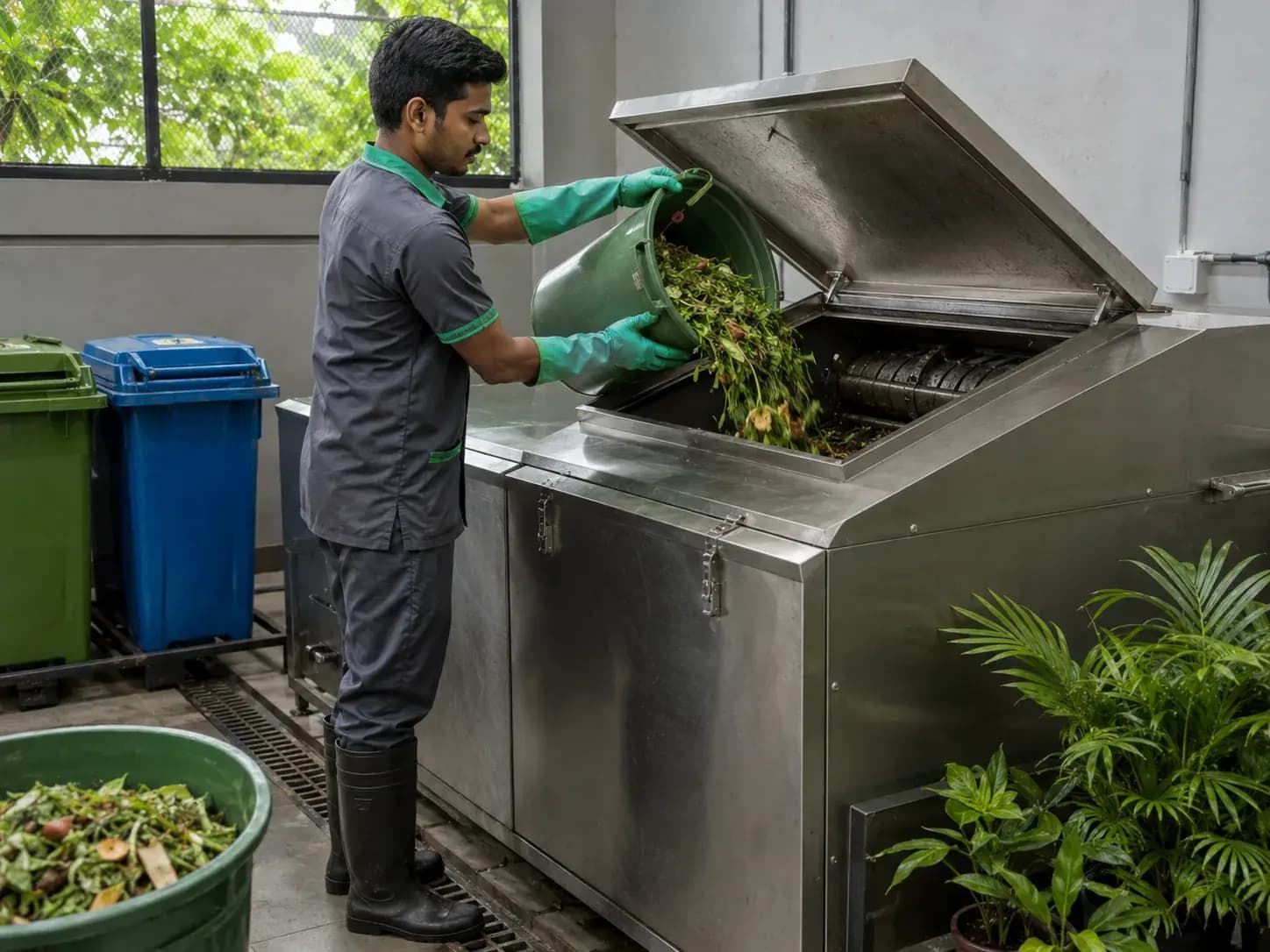
A bio-methanation plant holds segregated wet waste in a sealed digester where anaerobic bacteria convert it to biogas, principally methane and carbon dioxide, over a retention period. The gas can displace LPG in a kitchen or run a generator; the liquid and solid digestate leaving the plant is a fertiliser resource but also a continuing output that needs a defined destination. Digestion suits high-moisture, readily degradable food waste and rewards a steady daily feed.
KIPL specifies digesters where the waste stream justifies them (large kitchens, canteens, hotels, food-processing units and institutional campuses) and designs around the parts that decide whether a plant survives its second year: consistent feed and segregation, slurry and digestate handling, gas storage and utilisation, and the safety arrangements around a flammable gas on an occupied premises. A digester is a process plant, and it needs to be operated as one.
What you get
The deliverables, in hand.
- Authority
- Solid Waste Management Rules 2016 · SPCB consent where applicable
- Typical timeline
- Construction plus a stabilisation period before steady gas output
- Feed assessment: quantity, composition and consistency of the food-waste stream
- Digester sizing, retention time and gas yield expectation
- Feed preparation, slurry handling and digestate management arrangement
- Gas storage, piping and utilisation design with safety provisions
- Installation, commissioning and process stabilisation
- Operating procedure, monitoring log and operator training
Straight answers
Anaerobic Digesters: common questions.
01How is anaerobic digestion different from composting?
Composting is aerobic: it needs oxygen, gives off heat and carbon dioxide, and produces compost. Digestion is anaerobic, it happens in a sealed vessel without oxygen and produces biogas plus a digestate. Digestion recovers energy, which composting does not, but it needs a more consistent feed, a more capable operator and a plan for the digestate.
02What waste suits a digester?
High-moisture, readily degradable food and kitchen waste with clean segregation. Fibrous garden waste, packaging, plastics and inerts do not digest and cause problems in the feed system. A premises whose wet waste is mostly garden trimmings is a composting case, not a digestion case.
03What can the biogas be used for?
Most commonly to displace LPG in a kitchen through a dedicated burner line, and in larger installations to run a generator or a boiler. The utilisation route has to be decided at design stage, because it determines gas storage, cleaning, piping and safety requirements. Gas with no use is gas that gets flared or vented, which loses the main advantage of the technology.
04What happens to the digestate?
It leaves the plant continuously as slurry and sometimes as separated solids, and it needs a destination: land application on the premises' own landscape, dewatering and use as a soil conditioner, or an agreed offtake. Digestate handling is where under-designed plants fail, because the volume does not stop while a destination is being found.
05What determines the size of a digester?
The daily quantity of suitable feed, its composition and moisture, and the retention time the process needs. Because retention time is measured in days, a digester is physically larger than a mechanical composter of comparable daily throughput. Consistency matters as much as quantity, a plant sized for a steady canteen load behaves badly if fed erratically.
06What safety and statutory requirements apply?
Biogas is flammable, so gas storage, piping, ventilation, leak detection, flame arrestors and electrical classification around the plant have to be designed properly and maintained. Whether a plant additionally requires State Pollution Control Board consent depends on its scale, its gas utilisation and the state's position, and should be confirmed with the Board before construction rather than after.
07Who operates a bio-methanation plant?
It needs a trained operator on the premises with a defined daily routine (feeding, monitoring gas production and pressure, checking the slurry line, and recording readings) supported by a maintenance contract for the mechanical and gas systems. Responsibility for compliance stays with the generator under the Solid Waste Management Rules 2016, whoever runs the plant day to day.
Within Organic Waste Converters
Part of the whole route, the other components.
Relevant proof
Where this stage has already been delivered.

MIDC / AURIC · Shendra & Bidkin, Chhatrapati Sambhajinagar
SHENDRA AND BIDKIN INDUSTRIAL AREA, AURANGABAD
Environmental compliance audits, Consent to Establish and green certification support across two industrial nodes of the Delhi-Mumbai Industrial Corridor.
Where we do this
Organic Waste Converters on the ground.
The authority, the timeline and the local ground differ by city. These pages set out how organic waste converters actually runs in each.
Featured projects
Work that carries its own evidence.

Our expertise
One team across the whole environmental brief.
Anaerobic Digesters is one stage of one practice. Most projects need several, and the commitments made at clearance are the ones we build and maintain.
Who we do this for
Organic Waste Converters reads differently by industry.
- 01
Hospitality, Healthcare & EducationCore
Kitchen and canteen waste puts a campus well past the 100 kg/day bulk generator line under the SWM Rules 2016.
Organic Waste Converters for Hospitality, Healthcare & Education - 02
Corporate CampusesCore
Canteen waste at campus scale crosses the 100 kg/day bulk generator threshold under the SWM Rules 2016, requiring on-site processing.
Organic Waste Converters for Corporate Campuses - 03
Real Estate & Construction
Municipal bye-laws across MCGM, NMMC and PMC make an OWC the practical way a large housing project meets its wet-waste obligation.
Organic Waste Converters for Real Estate & Construction - 04
Townships & Area Development
Decentralised composting sized per sector or cluster is how the township meets its wet-waste commitment without a municipal tie-in.
Organic Waste Converters for Townships & Area Development - 05
Municipal Corporations
Ward-level composting is how a corporation reduces landfill load and enforces the bulk generator rule on its own societies.
Organic Waste Converters for Municipal Corporations
Trusted by
The organisations this work is done for.












In the press