









In-vessel composting: enclosed, controlled aerobic conversion of organic waste.
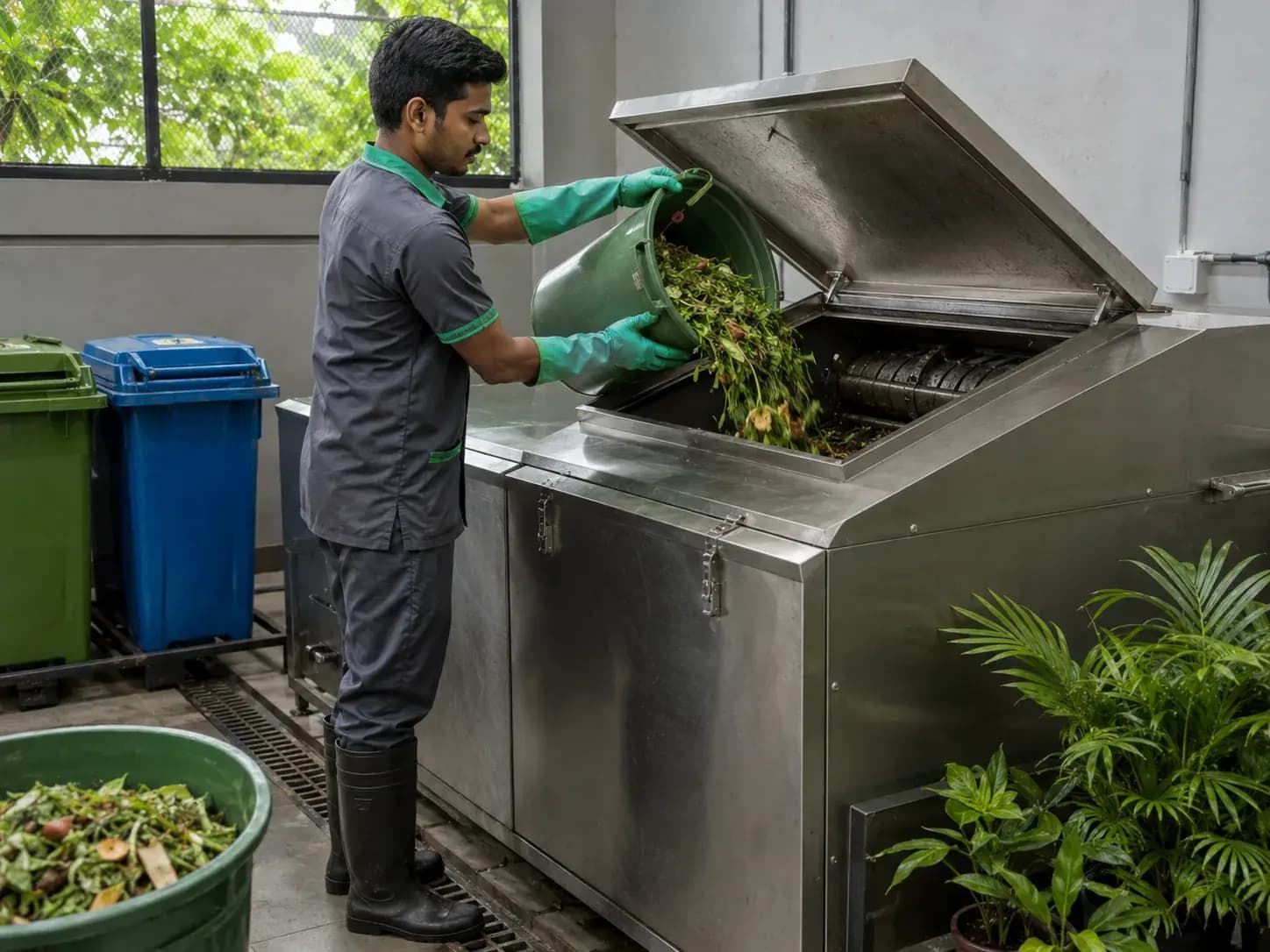
In-vessel composting confines the whole aerobic process inside a closed reactor, so temperature, aeration, moisture and odour are controlled rather than left to the weather.
What it is
In an in-vessel system the composting mass sits within an enclosed drum, tunnel or container while air is forced through it and the process conditions are held within range. The enclosure buys three things that matter on a constrained urban site: containment of odour and leachate, protection from rain and pests, and a reliable thermophilic phase, the sustained high-temperature stage that sanitises the material and reduces weed seeds and pathogens.
KIPL specifies in-vessel systems where the site cannot tolerate an open process (hospitals, hotels, food-processing premises, dense residential campuses) and sizes them to the audited load with the same discipline as any other route. The design work is in the supporting arrangements: the aeration and exhaust path, odour treatment media where required, the leachate line, and the maturation bays for the material that leaves the vessel still needing to cure.
What you get
The deliverables, in hand.
- Authority
- Solid Waste Management Rules 2016 · municipal bye-laws
- Typical timeline
- Procurement lead time plus installation and process stabilisation
- System selection and capacity sizing against the characterised waste stream
- Enclosure, aeration and exhaust arrangement with odour-control provision
- Civil, electrical and drainage interfaces for the plant room
- Installation, commissioning and process stabilisation on live waste
- Maturation and curing area design
- Operating procedure, monitoring log and operator training
Straight answers
In-Vessel Composters: common questions.
01What does in-vessel composting mean?
It means the aerobic composting process is carried out inside a closed container (a drum, tunnel or insulated vessel) with forced aeration, rather than in open windrows or pits. The enclosure lets the operator hold temperature and airflow within range and keeps odour, leachate, rain and pests contained.
02How is it different from an open or windrow process?
Windrow composting is cheaper and needs no vessel, but it needs land, is exposed to rain, and is difficult to run without odour in a populated area. In-vessel costs more in capital and power but fits a small footprint, controls emissions, and holds the thermophilic phase reliably. On most urban premises the deciding factor is available area and tolerance for odour, not cost.
03Why does the thermophilic phase matter?
Because it is what sanitises the material. Sustained elevated temperature during active composting reduces pathogens and weed seeds, which matters particularly for waste streams from hospitals' kitchens, hotels and food processing. An enclosed, aerated vessel holds that phase far more consistently than an open heap exposed to ambient conditions.
04What sizing information does the supplier need?
Measured wet-waste quantity in kg per day with its peak, the composition and moisture of that waste, the available floor area and headroom, the power supply, and the drainage point for leachate. Retention time inside the vessel is a design parameter, so the throughput and the vessel volume have to be reconciled rather than assumed.
05Does in-vessel output still need curing?
Yes. Material discharged from the vessel is stabilised but generally not mature; it needs a curing period in covered bays before use. Curing area is often omitted from the layout at design stage and then improvised badly, so we treat it as part of the system rather than an afterthought.
06What monitoring should the operator record?
Daily input quantity, bulking agent added, process temperature, and any odour or leachate observation, along with output quantity and its destination. Those records are also what a municipal inspection asks for, so the log should be designed to answer that question directly rather than reconstructed later.
Within Organic Waste Converters
Part of the whole route, the other components.
Relevant proof
Where this stage has already been delivered.

MIDC / AURIC · Shendra & Bidkin, Chhatrapati Sambhajinagar
SHENDRA AND BIDKIN INDUSTRIAL AREA, AURANGABAD
Environmental compliance audits, Consent to Establish and green certification support across two industrial nodes of the Delhi-Mumbai Industrial Corridor.
Where we do this
Organic Waste Converters on the ground.
The authority, the timeline and the local ground differ by city. These pages set out how organic waste converters actually runs in each.
Featured projects
Work that carries its own evidence.

Our expertise
One team across the whole environmental brief.
In-Vessel Composters is one stage of one practice. Most projects need several, and the commitments made at clearance are the ones we build and maintain.
Who we do this for
Organic Waste Converters reads differently by industry.
- 01
Hospitality, Healthcare & EducationCore
Kitchen and canteen waste puts a campus well past the 100 kg/day bulk generator line under the SWM Rules 2016.
Organic Waste Converters for Hospitality, Healthcare & Education - 02
Corporate CampusesCore
Canteen waste at campus scale crosses the 100 kg/day bulk generator threshold under the SWM Rules 2016, requiring on-site processing.
Organic Waste Converters for Corporate Campuses - 03
Real Estate & Construction
Municipal bye-laws across MCGM, NMMC and PMC make an OWC the practical way a large housing project meets its wet-waste obligation.
Organic Waste Converters for Real Estate & Construction - 04
Townships & Area Development
Decentralised composting sized per sector or cluster is how the township meets its wet-waste commitment without a municipal tie-in.
Organic Waste Converters for Townships & Area Development - 05
Municipal Corporations
Ward-level composting is how a corporation reduces landfill load and enforces the bulk generator rule on its own societies.
Organic Waste Converters for Municipal Corporations
Trusted by
The organisations this work is done for.












In the press