









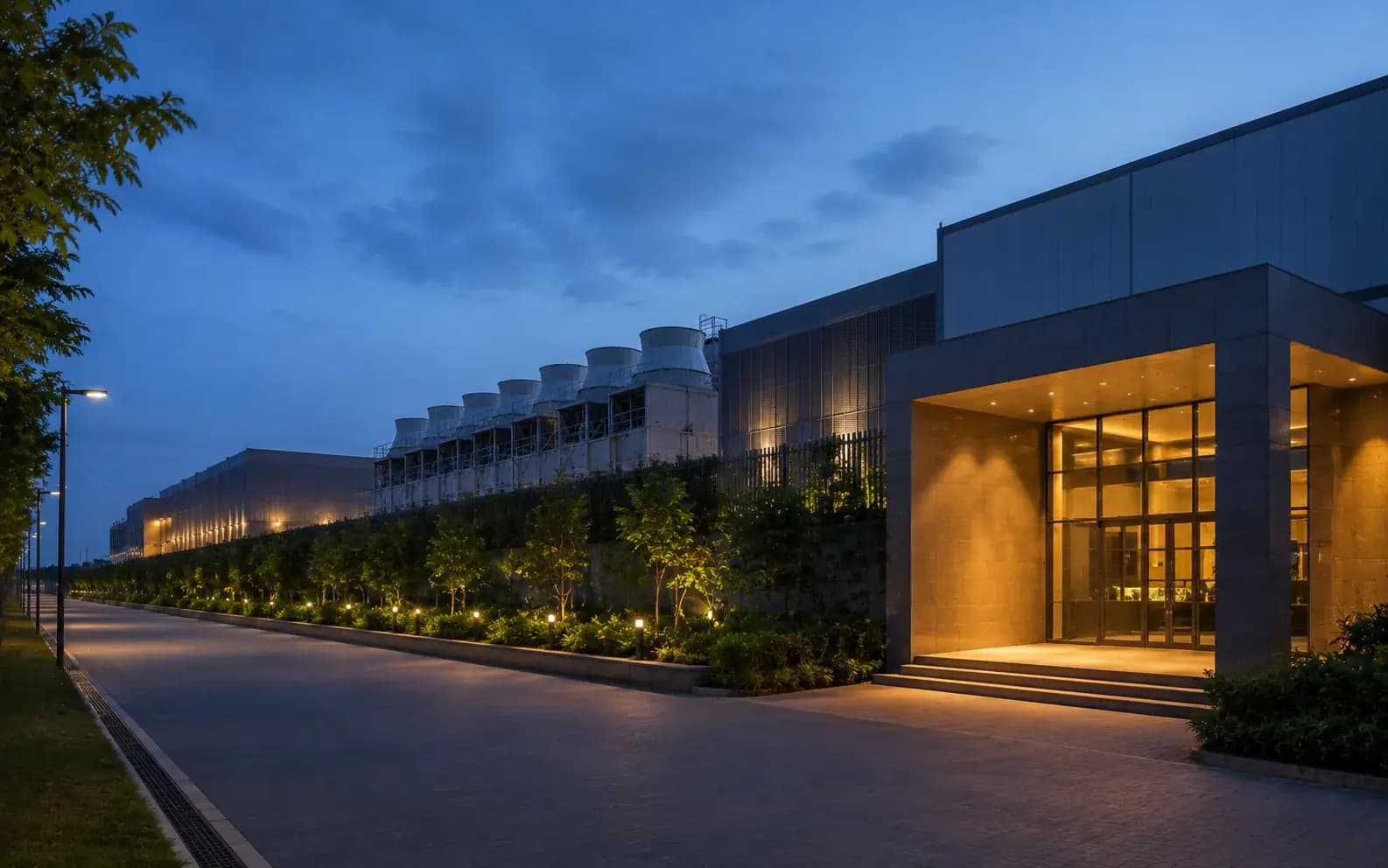
CGWA Groundwater NOC · Data Centres & IT Parks
CGWA Groundwater NOC for Data Centre Cooling and IT Park Campuses
Where a data centre or IT park draws groundwater for cooling make-up or campus use, it needs a No Objection Certificate from the Central Ground Water Authority, supported by a water balance that treats evaporative losses honestly.
Screening view on your project, with the category and route named. No obligation.
What this means for data centres & it parks
Groundwater abstraction by industrial and infrastructure users is regulated by the Central Ground Water Authority under the Environment (Protection) Act 1986, and applications are made through the Authority's online system, now the Bhu-Neer portal. What the Authority examines is the quantum sought against the condition of the assessment unit (safe, semi-critical, critical or over-exploited) with abstraction in stressed units restricted, conditioned or refused and, where allowed, attracting a water conservation fee. A data centre is an unusual applicant in this regime: its consumption is not seasonal, does not fall at night, and is dominated by evaporation in the cooling towers, which is a genuine consumptive loss rather than a return to the system. An IT park's demand looks more conventional but is still continuous through the working year.
How KIPL runs it
KIPL builds the water balance the application stands on: total demand split into cooling make-up, blowdown, domestic and landscape; treated sewage reuse quantified as an offset; and the residual groundwater component justified against the availability in the assessment unit. We reconcile that with the figures already filed in the Environment Clearance and the MPCB consent, because inconsistent water numbers across three files is the single most common cause of a query. Recharge and rooftop harvesting measures are designed for the campus's actual roof and paved area rather than quoted generically, and metering and reporting obligations are handed to the facilities team as a live duty, since the NOC's renewal depends on the abstraction record.
- CGWA
Abstraction is permitted, not assumed
Any groundwater component in the campus supply requires an NOC, granted against the category of the assessment unit and subject to conditions and a conservation fee.
- Evaporative loss
Cooling water is consumed, not returned
Tower evaporation removes water permanently from the local balance, which is why a data centre's demand is scrutinised differently from an office campus of the same area.
Uptime makes the draw continuous
Cooling cannot be curtailed in a dry season without risking the facility, so the abstraction case has to be viable in the worst month, not the average one.
What you receive
Written for data centres & it parks, not adapted from a template.
- 01Campus water balance separating cooling make-up, blowdown, domestic, landscape and reuse
- 02Assessment unit categorisation and availability assessment for the site
- 03Bhu-Neer application with hydrogeological report and abstraction structure details
- 04Treated-sewage reuse case quantified as a reduction in the groundwater component
- 05Rainwater harvesting and artificial recharge design based on the campus roof and paved areas
- 06Metering, water-level monitoring and periodic reporting protocol for renewal
Questions from data centres & it parks
What data centres & it parks ask before appointing us.
Answered against the regulation as it stands, not as a sales pitch. If your situation is not here, ask us directly.
Ask a question →Does a data centre need a CGWA NOC if it is on municipal water?
Not for the municipal component. The NOC is required for groundwater abstraction, so a campus fully supplied by the local body or an industrial water utility does not need one: but many campuses keep a borewell for reliability or for cooling make-up, and that abstraction requires the NOC regardless of how small a share of total demand it represents.
How much water does cooling actually consume?
It depends on the cooling technology and the local climate, not on a rule of thumb: an evaporative system consumes water continuously through evaporation and blowdown, an air-cooled or hybrid system trades water for energy, and cycles of concentration determine how much blowdown is generated. The application has to present the actual design figures, because a generic per-square-metre number will not withstand examination.
What if the site falls in an over-exploited assessment unit?
Abstraction in stressed units is restricted, and where permitted at all it comes with tighter quantum, higher conservation fee and firmer recharge obligations. The practical response is to reduce the groundwater component of the design (municipal or utility supply, treated-sewage reuse for make-up, and a cooling selection that trades water for power) before applying, rather than seeking a quantum the unit cannot support.
Can treated sewage be used for cooling make-up?
It is done, and it strengthens both the NOC application and the clearance position, but the treated water has to meet the quality the cooling system tolerates: hardness, dissolved solids, nutrients and microbiological load all affect scaling, fouling and legionella risk. That means tertiary treatment and a proper control regime, designed with the plant, not a nominal reuse claim on paper.
How do the CGWA, EC and consent water figures relate?
They must agree. The Environment Clearance carries a declared demand and source, the MPCB consent carries the effluent side, and the CGWA NOC carries the abstraction. Divergences between them are found easily and read as either an understated demand at appraisal or an unauthorised expansion, so the three files are prepared from one water balance.
What are the ongoing obligations after the NOC is granted?
Typically metered abstraction within the sanctioned quantum, monitoring of water levels in the observation arrangement, implementation and maintenance of the recharge measures, payment of the applicable conservation fee, and periodic returns. The renewal is assessed on that record, so gaps in metering are difficult to remedy at renewal time.
Stage by stage
How cgwa groundwater noc actually runs, step by step.
Also for data centres & it parks
The rest of the environmental brief for this sector.
Primary sources
Verify any of this at the source.

Relevant proof
NAMAMI GANGE PROGRAMME
Environmental & Social Impact Assessment and EHS reporting for existing and proposed sewage treatment plants on the Ganga.
- Largest existing STP
- 130 MLD
- Assessed
- 5 plants
Where we do this
CGWA Groundwater NOC for data centres & it parks, city by city.
Other sectors
Who else we run cgwa groundwater noc for.
Next step
Tell us the project, and we will tell you the category and the route.
Screening is the cheapest stage to get right and the most expensive to get wrong. We will say plainly what cgwa groundwater noc your data centres & it parks project needs, and what it does not.





























































Start the conversation