









Notified and over-exploited block assessment: finding out what your site is actually allowed to draw.
Whether a site sits in a safe, semi-critical, critical, over-exploited or notified assessment unit determines what abstraction can be permitted at all, and it is the first thing to establish before any groundwater application is planned.
What it is
The Central Ground Water Board, jointly with the States, carries out a periodic dynamic groundwater resource assessment that classifies each assessment unit (commonly a block, taluka or mandal) by its stage of groundwater extraction: safe, semi-critical, critical or over-exploited. Separately, the Central Ground Water Authority notifies specific areas where groundwater development is regulated and drilling and abstraction are restricted. The two are related but distinct, and both bear on what a project can apply for.
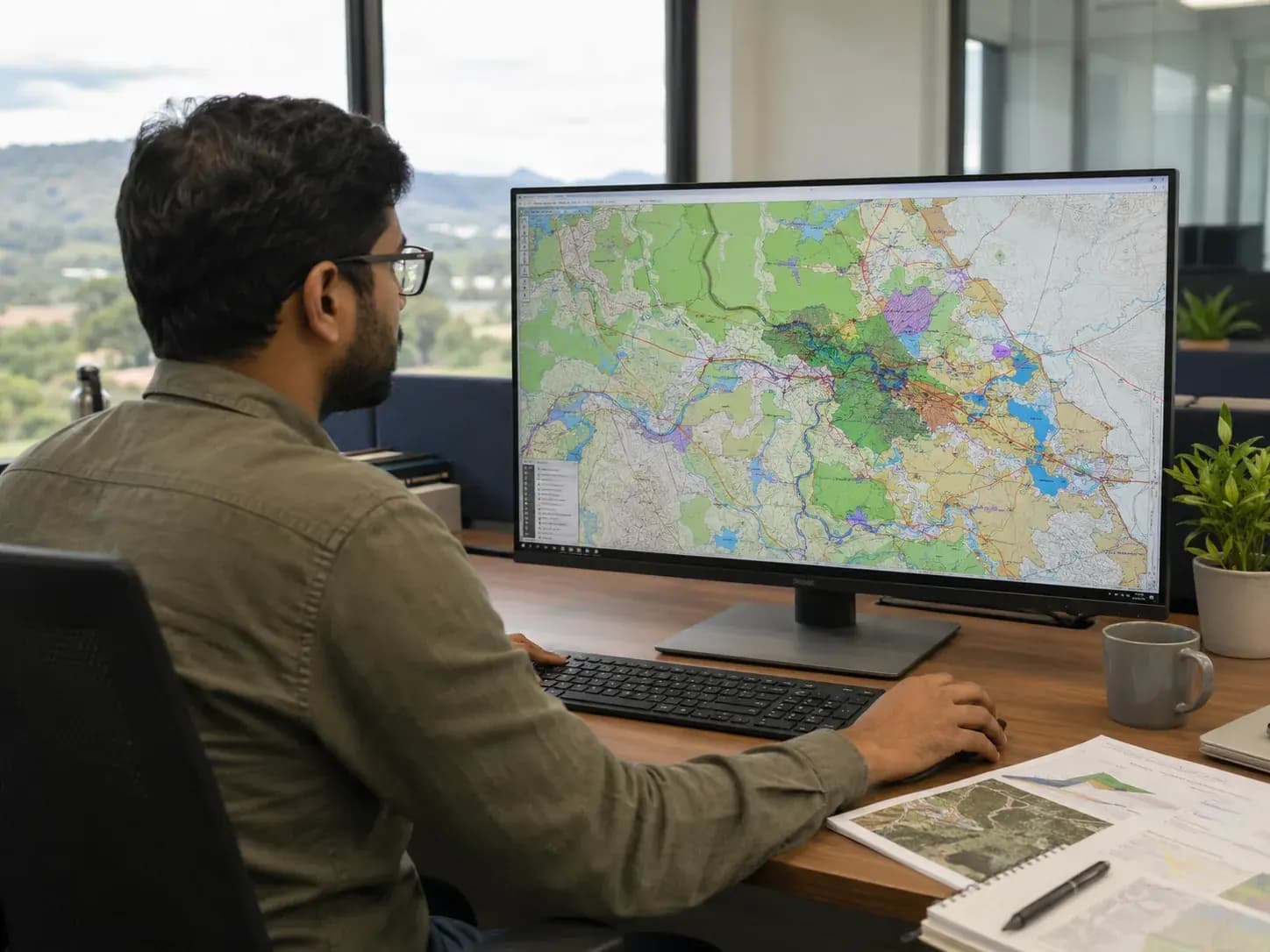
KIPL establishes the position for a specific site rather than a general district: the assessment unit it falls in, its current category, whether it is within an area notified by CGWA or regulated under State groundwater legislation, and what the applicable guidelines then permit for that user category and quantum. Projects that plan a groundwater-dependent design and only later discover they are in an over-exploited or notified unit lose the most time, because the remedy is usually a redesign of the water strategy (surface or municipal supply, reuse, recharge), rather than a better application.
What you get
The deliverables, in hand.
- Authority
- CGWB dynamic groundwater resource assessment · CGWA notified areas
- Typical timeline
- Days, once the site location is fixed
- Identification of the assessment unit containing the site, with mapping
- Current category (safe, semi-critical, critical or over-exploited) from the CGWB assessment
- Check against CGWA notified areas and applicable State groundwater legislation
- What the category permits for the user type and quantum contemplated
- Feasibility view on groundwater as a source, with alternatives where it is constrained
- Written position note to inform the water strategy before an application is drafted
Straight answers
Notified / Over-exploited Block Assessment: common questions.
01What is an over-exploited block?
It is an assessment unit where the annual groundwater extraction exceeds the annual extractable groundwater resource, a stage of extraction above 100 percent in the dynamic groundwater resource assessment. Critical and semi-critical units sit below that but are also stressed. The classification drives how restrictively an abstraction application is treated.
02What is the difference between an over-exploited block and a notified area?
Over-exploited is a resource classification from the periodic assessment. A notified area is a legal designation by the Central Ground Water Authority, or by a State authority under State groundwater legislation, in which groundwater development is regulated and drilling and abstraction are restricted or prohibited. Many notified areas are over-exploited, but the categories are not the same thing and both should be checked.
03Can a project in an over-exploited block get an NOC at all?
It depends on the user category, the quantum sought and the applicable guidelines, which treat stressed units far more restrictively and in some cases bar new abstraction for certain uses. Where abstraction is possible, it is normally conditional on demonstrated demand minimisation, reuse and recharge. This is why the category should be established before the water strategy is fixed.
04Who decides the category and how often does it change?
The Central Ground Water Board carries out the dynamic groundwater resource assessment with the State agencies, and the classification is revised periodically as extraction and recharge data are updated. A unit can move between categories between one application and the next, so a category relied on at an earlier grant should be re-verified.
05Does the State have its own groundwater regime?
Several States have enacted their own groundwater legislation with State authorities, permits and notified areas that operate alongside the central CGWA framework. Where such a regime exists, compliance with it is required in addition to, or in place of, the central route depending on the State. The applicable regime must be identified for the specific location.
06What are the alternatives if groundwater is constrained?
Municipal or industrial estate supply, surface water allocation from an irrigation or water resources department, treated effluent reuse within the project, rainwater harvesting, and process redesign to reduce specific water consumption. In a stressed unit these are not fallbacks but the primary strategy, with groundwater covering only what remains.
07How early should this assessment be done?
Before site selection is finalised where there is a choice, and in every case before the project water strategy and the design demand are fixed. It is a short exercise, and it prevents the far more expensive outcome of a project committed to a groundwater supply that cannot be permitted.
Within CGWA Groundwater NOC
Part of the whole route, the other components.
Primary sources
Check it at source.
This page describes CGWB dynamic groundwater resource assessment · CGWA notified areas. The regulation and the filing portal are public, these are the official endpoints, not our summary of them.
Relevant proof
Where this stage has already been delivered.

Shapoorji Pallonji · Kanpur & Unnao, Uttar Pradesh
NAMAMI GANGE PROGRAMME
Environmental & Social Impact Assessment and EHS reporting for existing and proposed sewage treatment plants on the Ganga.
Where we do this
CGWA Groundwater NOC on the ground.
The authority, the timeline and the local ground differ by city. These pages set out how cgwa groundwater noc actually runs in each.
Featured projects
Work that carries its own evidence.



Our expertise
One team across the whole environmental brief.
Notified / Over-exploited Block Assessment is one stage of one practice. Most projects need several, and the commitments made at clearance are the ones we build and maintain.
Who we do this for
CGWA Groundwater NOC reads differently by industry.
- 01
Real Estate & ConstructionCore
Borewells for construction water and flushing supply need a CGWA NOC through Bhuneer, and most Mumbai-belt talukas sit in semi-critical or over-exploited blocks.
CGWA Groundwater NOC for Real Estate & Construction - 02
Townships & Area DevelopmentCore
The township water balance has to reconcile municipal supply, groundwater abstraction and reuse before CGWA will issue an NOC on the abstraction component.
CGWA Groundwater NOC for Townships & Area Development - 03
Distilleries & EthanolCore
Fermentation and cooling water demand is high and the sugar belt sits in stressed blocks, so groundwater abstraction is scrutinised at NOC stage.
CGWA Groundwater NOC for Distilleries & Ethanol - 04
Data Centres & IT Parks
Evaporative cooling makes a data centre a serious water consumer, and any groundwater component needs a Bhuneer NOC with a defensible water balance.
CGWA Groundwater NOC for Data Centres & IT Parks - 05
Hospitality, Healthcare & Education
Round-the-clock water demand for laundry, kitchens and cooling usually means a borewell, and therefore a CGWA NOC with a water balance behind it.
CGWA Groundwater NOC for Hospitality, Healthcare & Education - 06
Chemical Industry
Process and cooling water drawn from borewells needs a Bhuneer NOC, and the hydrogeological report must survive the same scrutiny as the EIA.
CGWA Groundwater NOC for Chemical Industry - 07
Sugar Industry
Mills in the Krishna and Godavari belts draw groundwater in blocks already assessed as semi-critical, so the NOC case has to be built carefully.
CGWA Groundwater NOC for Sugar Industry - 08
Industrial & Manufacturing
Units outside MIDC water supply run on borewells, and a Bhuneer NOC with a hydrogeological report is a precondition to consent.
CGWA Groundwater NOC for Industrial & Manufacturing
Trusted by
The organisations this work is done for.















In the press