










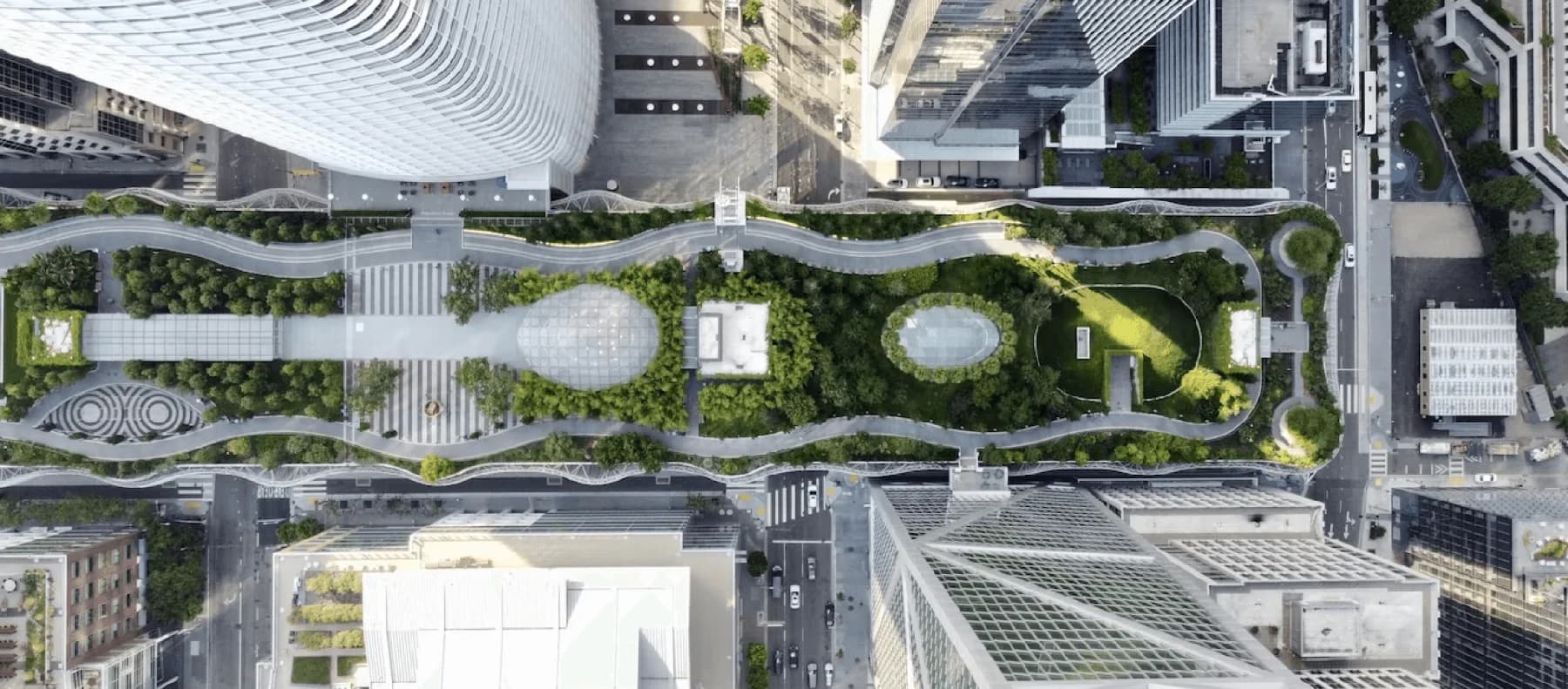
Open spaces: internal roads, paving and public realm works built to code.
Internal roads and open spaces are pavement engineering problems disguised as finishes: the subgrade, the drainage and the pavement design decide how long the surface lasts.
What it is
Pavement work begins with the subgrade: its strength, measured as CBR, and its drainage. On that basis a flexible or rigid pavement is designed to the applicable IRC guidance for the anticipated traffic, or an interlocking concrete block pavement is designed where paved open space, service roads and pedestrian areas suit it. Storm-water drainage, camber and levels are designed with the pavement rather than after it, because standing water destroys pavements faster than traffic does.
KIPL executes roads, paving, kerbs, footpaths, storm-water drains and associated public realm works, with construction-stage environmental control treated as part of the method: dust suppression and covering, controlled working hours for noise, silt control in runoff, and segregation and lawful disposal of construction and demolition waste under the C&D Waste Management Rules 2016. Footpaths and crossings are detailed for accessibility, since a footpath that a wheelchair or a pram cannot use is not a footpath.
What you get
The deliverables, in hand.
- Authority
- IRC codes · MoRTH specifications · C&D Waste Management Rules 2016
- Typical timeline
- Weeks to months, sensitive to monsoon and to service diversions
- Subgrade investigation and pavement design for the anticipated traffic
- Road, paving and interlocking block works with kerbs and edge restraint
- Storm-water drainage, levels, camber and outfall connections
- Footpaths, crossings and accessibility detailing
- Street furniture, signage and markings where in scope
- Dust, noise and C&D waste control during construction
Straight answers
Open Spaces: common questions.
01What decides whether a road is flexible or rigid pavement?
Traffic loading, subgrade strength, drainage conditions and whole-life cost. Flexible bituminous pavement is quicker and cheaper to lay and easier to patch; rigid concrete pavement costs more initially but performs better under heavy slow-moving loads, in poorly drained locations and where water-logging is a recurring problem. The design is done to the applicable IRC guidance rather than by preference.
02Why is the subgrade so important?
Because every layer above it is designed on its strength. A weak or wet subgrade forces thicker pavement layers, and a subgrade that was never tested is the usual explanation for a road that fails in its first monsoon. Testing before design is a small cost against the cost of reconstruction.
03When are interlocking concrete blocks appropriate?
For open spaces, parking areas, service roads, footpaths and low-to-moderate traffic areas: particularly where the surface may need to be lifted for services and relaid, and where some infiltration is desirable. They still require a properly designed base, bedding sand and, critically, edge restraint; blocks laid without edge restraint spread and fail regardless of their quality.
04How is drainage handled?
By designing levels, camber and cross-fall so that water leaves the surface, and by providing storm-water drains with a defined outfall that actually has capacity to receive the flow. Drainage designed after the road levels are fixed rarely works, and an outfall assumed rather than verified is the most common defect in internal road schemes.
05What environmental controls apply during road works?
Dust suppression by water sprinkling and covering of stockpiles and haulage, working hour restrictions for noise, silt control so that runoff does not carry sediment into drains and water bodies, and segregation, storage and lawful disposal of construction and demolition waste in accordance with the C&D Waste Management Rules 2016. Where the site sits under a clearance or consent, those conditions apply on top.
06What causes the most delay on internal road projects?
Underground services (water, sewer, power and telecom lines that are not where the drawings say they are) and monsoon. Both are managed by early trial pits and service mapping and by sequencing the earthworks and base layers outside the wet season, rather than by adding float at the end of the programme.
07Are footpaths part of the same scope?
They should be, along with kerbs, crossings, ramps and tactile provisions, because a footpath built later to a different level rarely reconciles with the road. Accessible detailing (continuous level, adequate width, gentle gradients at crossings) is set at design stage and is very difficult to retrofit.
Within Civil EPC
Part of the whole route, the other components.
Relevant proof
Where this stage has already been delivered.
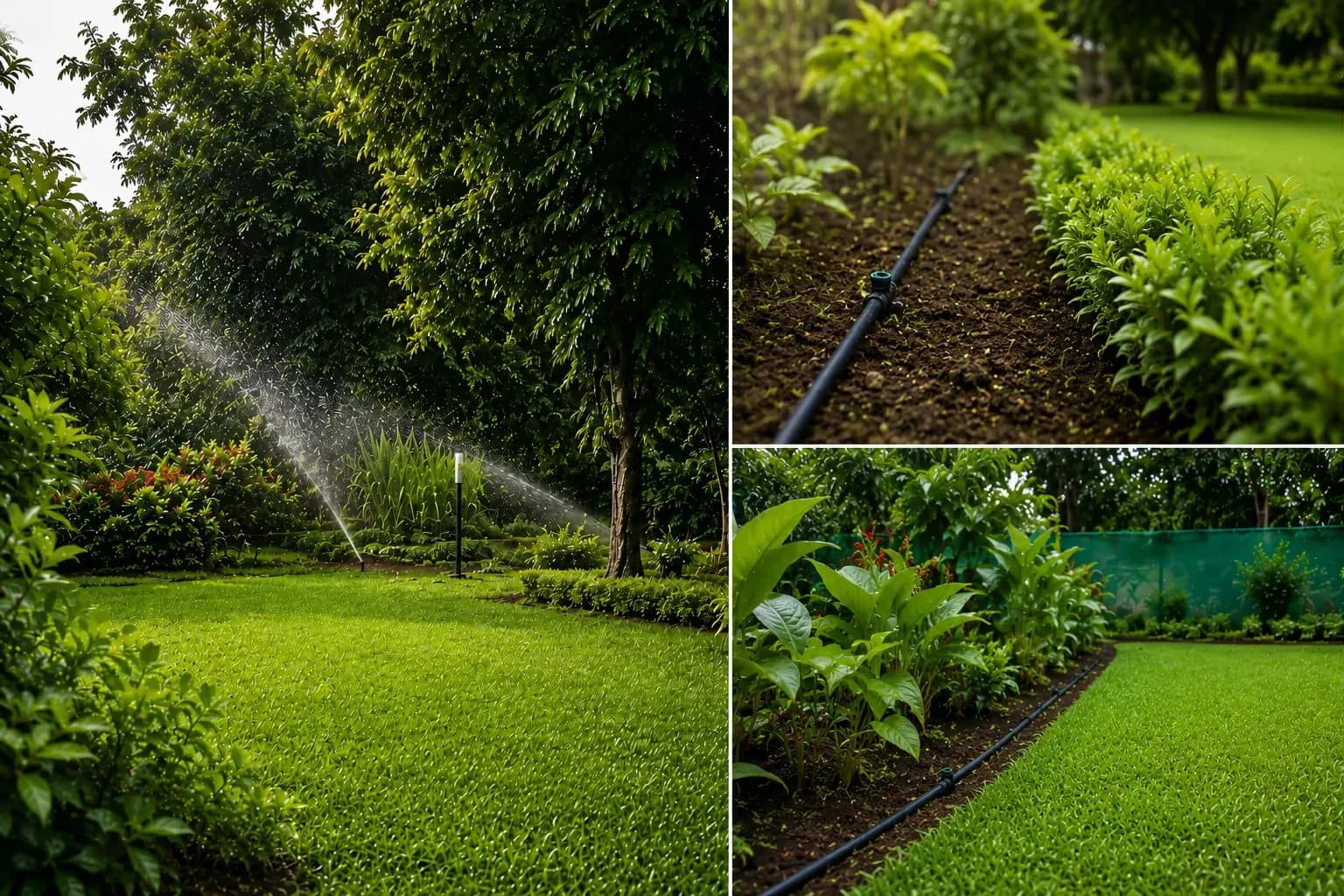
TCS, Banyan Park · Mumbai
IRRIGATION WORK AT TCS BANYAN PARK
Design and execution of an efficient drip-irrigation network across ~10,000 m² of landscape and plantation zones: pipeline, network and testing, completed in 45 days.
Where we do this
Civil EPC on the ground.
The authority, the timeline and the local ground differ by city. These pages set out how civil epc actually runs in each.
Featured projects
Work that carries its own evidence.
Our expertise
One team across the whole environmental brief.
Open Spaces is one stage of one practice. Most projects need several, and the commitments made at clearance are the ones we build and maintain.
Who we do this for
Civil EPC reads differently by industry.
- 01
Townships & Area Development
Internal roads, open spaces and playgrounds are the physical form of the layout commitments the clearance was granted against.
Civil EPC for Townships & Area Development - 02
Municipal Corporations
Playgrounds, garden works, roads and open spaces are tendered as civil packages that still have to deliver an environmental outcome.
Civil EPC for Municipal Corporations - 03
Industrial Corridors & MIDC
Roads, open spaces and water infrastructure are the physical trunk services that carry the node's environmental commitments.
Civil EPC for Industrial Corridors & MIDC - 04
River & Water Missions
Ghats, embankments, interception chambers and water infrastructure are the civil works through which the mission is actually visible.
Civil EPC for River & Water Missions
Trusted by
The organisations this work is done for.






In the press