










Playground development: safe, code-referenced play spaces built end to end.
A playground is a safety installation before it is a landscape feature: the layout, the fall heights, the surfacing and the clearances decide whether it is fit for children to use unsupervised.
What it is
Playground design begins with age zoning, because equipment appropriate for older children is hazardous to toddlers and vice versa. From there it is a sequence of safety-driven decisions: free space and clearance around each item, the fall height of every elevated element and the impact-attenuating surfacing that must sit beneath it, entrapment and protrusion checks, edge treatment, fencing and gates, shade, seating for accompanying adults, and drainage so that the surface does not become a pond after rain.
KIPL delivers playgrounds as a single package (design, equipment procurement, civil works, surfacing and handover) with equipment specified to recognised outdoor play equipment safety standards, including IS 15869, and access provisions taken from the Harmonised Guidelines for accessibility. We also hand over the part that is usually missing: a written inspection and maintenance regime, because play equipment degrades with use and weather and its safety depends on somebody checking it.
What you get
The deliverables, in hand.
- Authority
- IS 15869 (outdoor play equipment safety) · NBC 2016 · municipal bye-laws
- Typical timeline
- Weeks to a few months, driven by equipment lead time
- Age-zoned layout with clearance and free-space checks
- Equipment specification and procurement to recognised safety standards
- Impact-attenuating surfacing selected against fall heights
- Civil works: foundations, edging, drainage, fencing, pathways and seating
- Accessibility and shade provisions
- Post-installation inspection report and a written maintenance regime
Straight answers
Playgrounds: common questions.
01What determines the surfacing under play equipment?
The fall height of the equipment above it. Impact-attenuating surfaces (rubber tiles, poured-in-place rubber, or a loose fill of adequate depth) are selected so that a fall from the highest accessible part is attenuated. Grass, compacted soil and paving are not acceptable beneath elevated equipment, whatever they cost.
02Why does age zoning matter?
Because equipment scaled and rated for older children presents hazards to toddlers (higher platforms, wider gaps, faster moving parts) while equipment for the very young is quickly misused by older children in ways it was never rated for. Separating the zones physically, with their own equipment and surfacing, is the most basic safety decision in the layout.
03What is a safety or free-space zone?
The clear area around and beneath each item of equipment that must remain free of obstructions, other equipment and hard edges, so that a child leaving the equipment, deliberately or by falling: does not strike something. It is set by the equipment type and its dimensions, and it is the reason a crowded playground with many items in a small area is less safe than a sparser one.
04How often should a playground be inspected?
Routine visual inspection frequently, daily to weekly depending on use intensity: for damage, vandalism, missing components, loose fixings and surfacing displacement, with a detailed operational inspection at longer intervals and a full annual inspection covering structural condition and foundations. The frequency should be written into the handover, since equipment safety is a maintenance function, not a one-time certification.
05Who is responsible for the playground after handover?
The owner or the operating body: a municipal corporation, a society, a school or an estate. The contractor's obligation runs to the specification, the workmanship and the defects liability period. Safety in continuing use depends on the owner's inspection and maintenance regime, which is why we hand over a written one rather than only a completion certificate.
06Do accessibility requirements apply to playgrounds?
Public play spaces are expected to be reachable and usable by children and accompanying adults with disabilities, which affects approach paths, gate widths, level changes, surfacing firmness along routes, and the inclusion of accessible play elements. The Harmonised Guidelines for accessibility are the reference point for the built environment around the play area.
07What civil works does a playground actually need?
Equipment foundations designed for the loads and the soil, surfacing base preparation, edge restraint, positive drainage away from the play surface, fencing and gates where the site requires separation from traffic, pathways, seating and shade. The visible equipment is often a minority of the cost; the ground it stands on is the rest.
Within Civil EPC
Part of the whole route, the other components.
Relevant proof
Where this stage has already been delivered.
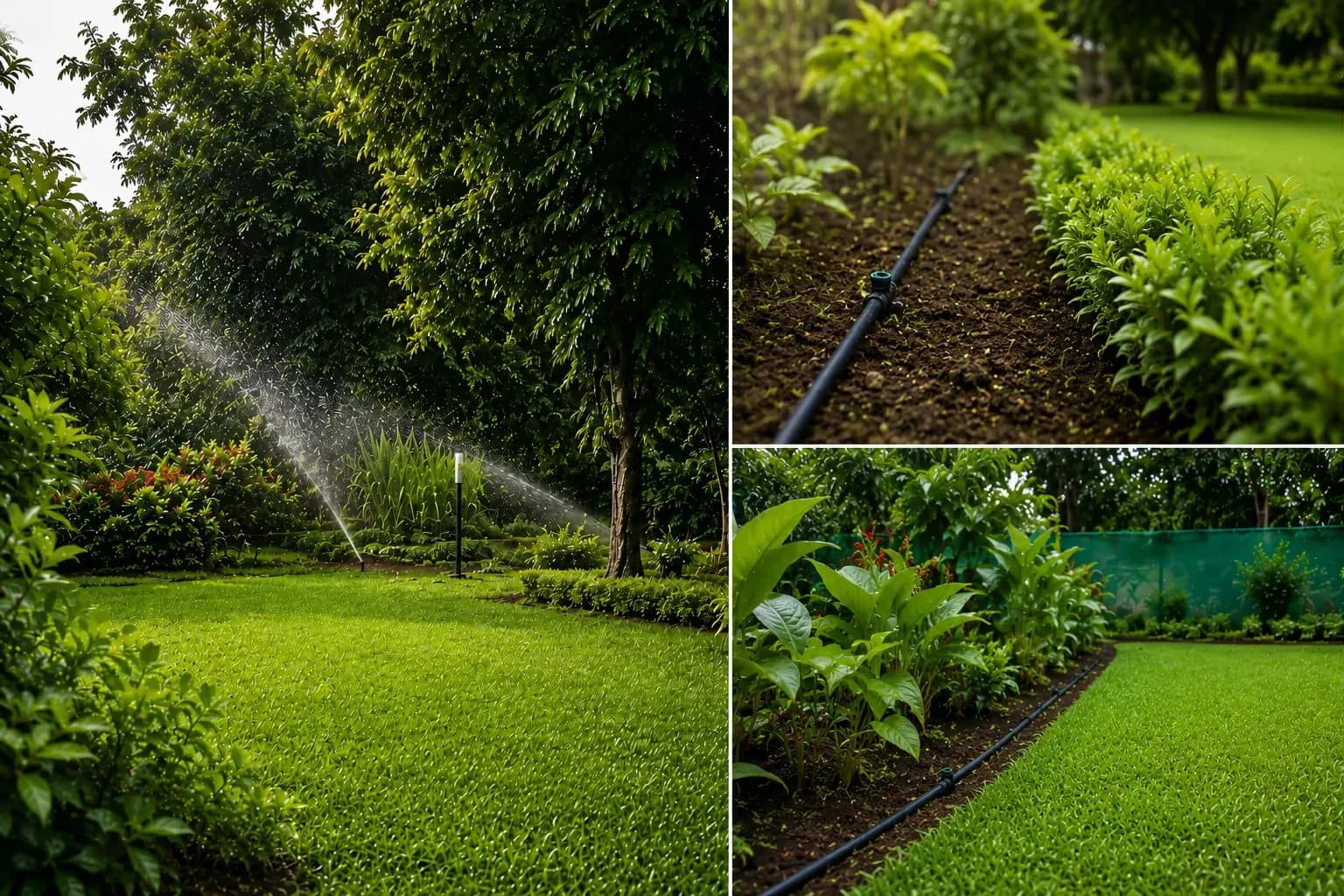
TCS, Banyan Park · Mumbai
IRRIGATION WORK AT TCS BANYAN PARK
Design and execution of an efficient drip-irrigation network across ~10,000 m² of landscape and plantation zones: pipeline, network and testing, completed in 45 days.
Where we do this
Civil EPC on the ground.
The authority, the timeline and the local ground differ by city. These pages set out how civil epc actually runs in each.
Featured projects
Work that carries its own evidence.
Our expertise
One team across the whole environmental brief.
Playgrounds is one stage of one practice. Most projects need several, and the commitments made at clearance are the ones we build and maintain.
Who we do this for
Civil EPC reads differently by industry.
- 01
Townships & Area Development
Internal roads, open spaces and playgrounds are the physical form of the layout commitments the clearance was granted against.
Civil EPC for Townships & Area Development - 02
Municipal Corporations
Playgrounds, garden works, roads and open spaces are tendered as civil packages that still have to deliver an environmental outcome.
Civil EPC for Municipal Corporations - 03
Industrial Corridors & MIDC
Roads, open spaces and water infrastructure are the physical trunk services that carry the node's environmental commitments.
Civil EPC for Industrial Corridors & MIDC - 04
River & Water Missions
Ghats, embankments, interception chambers and water infrastructure are the civil works through which the mission is actually visible.
Civil EPC for River & Water Missions
Trusted by
The organisations this work is done for.






In the press