









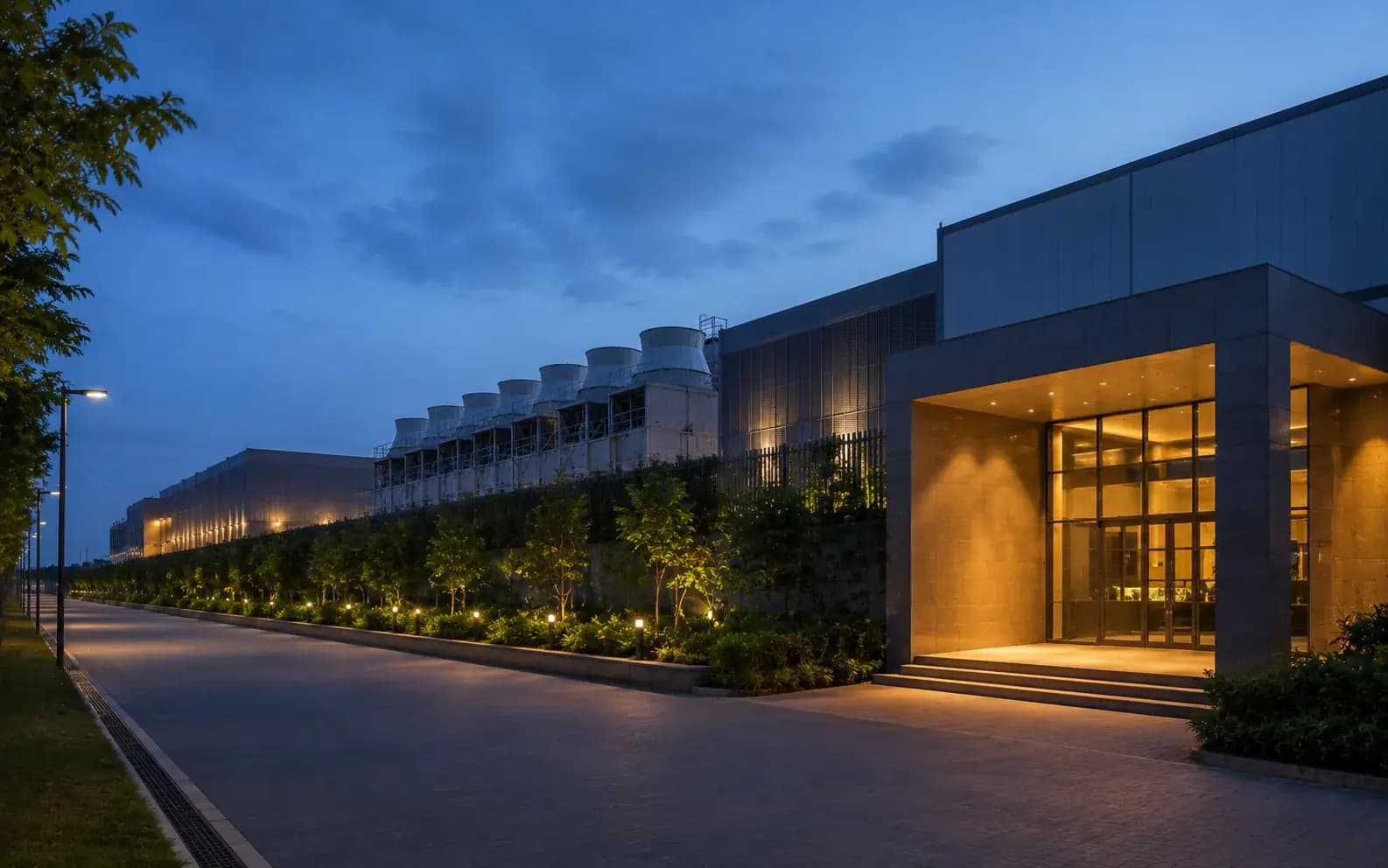
Statutory Compliance Management · Data Centres & IT Parks
Statutory Compliance Management for Data Centres and IT Parks
A data centre or IT park campus carries a continuous environmental compliance calendar (consent renewals, hazardous and e-waste returns, Form-V, EC and eco-sensitive zone conditions) that a small facilities team running a 24x7 site cannot realistically carry alone.
Screening view on your project, with the category and route named. No obligation.
What this means for data centres & it parks
The obligations attached to an operating campus of this kind come from several statutes at once and fall due on different dates. Consent to Operate under the Water Act 1974 and the Air Act 1981 must be renewed before expiry and amended when DG or cooling capacity changes. Used oil from DG servicing and spent batteries bring authorisation and returns under the Hazardous and Other Wastes (Management and Transboundary Movement) Rules 2016, with the manifest system for each consignment. Retired IT equipment and UPS strings bring returns under the E-Waste Rules 2022 and the Battery Waste Management Rules 2022. The annual environmental statement in Form-V under the Environment (Protection) Rules 1986 falls due by 30 September for the year ended 31 March. EC compliance reports fall half-yearly, and where the campus sits in an eco-sensitive zone the wildlife board conditions are reported alongside.
How KIPL runs it
KIPL runs this as a managed calendar with ownership and evidence rather than as a set of reminders. Each obligation is mapped to its source document, its due date, the data it needs and the person who produces it; monitoring is scheduled far enough ahead that results exist before a filing date; and renewals are initiated with margin, because a lapsed consent on a live campus is not a paperwork problem but an operating one. The pattern this addresses is specific to the sector: sites are frequently operated by a third-party facilities contractor who was not involved in the clearance, staffing is deliberately lean, and the conditions with the longest tails (CER, green belt survival, ESZ lighting and noise) are precisely the ones nobody has been told about.
- Consent renewal
A lapsed consent stops a live campus
Consent to Operate has a fixed validity and must be renewed before expiry, and amended whenever DG or cooling capacity is added: a risk no uptime-obligated site should carry.
- Form-V
Annual return with a fixed date
The environmental statement under the Environment (Protection) Rules 1986 falls due by 30 September for the preceding financial year, drawing on data that must already have been collected.
Third-party operations, inherited conditions
Facilities contractors who never saw the clearance end up responsible for its conditions, so the obligations have to be transferred explicitly rather than assumed.
What you receive
Written for data centres & it parks, not adapted from a template.
- 01Consolidated obligation register drawn from the EC, wildlife, CRZ, consent, CGWA and waste authorisations
- 02Compliance calendar with owners, due dates and the data each filing requires
- 03Consent renewal and amendment filings sequenced against capacity phasing
- 04Hazardous waste, e-waste and battery returns with manifest and recycler documentation maintained
- 05Form-V annual environmental statement and half-yearly EC compliance reports
- 06Inspection readiness pack and representation during MPCB and regional office visits
Questions from data centres & it parks
What data centres & it parks ask before appointing us.
Answered against the regulation as it stands, not as a sales pitch. If your situation is not here, ask us directly.
Ask a question →What environmental filings does an operating data centre have each year?
Typically the half-yearly EC compliance reports, the Form-V annual environmental statement by 30 September, returns under the hazardous waste rules and the e-waste and battery waste rules, and consent renewal in its cycle, plus any reporting attached to eco-sensitive zone or CRZ conditions and the CGWA NOC. The exact set depends on which approvals the campus holds, which is why the register is built from the actual letters.
Our facilities contractor manages the site. Who is liable?
The occupier and clearance holder remain accountable to the regulators. A contract can allocate work but not statutory responsibility, so the practical control is to make the obligations explicit in the contractor's scope, fund the monitoring they require, and retain visibility of the filings. Conditions that were never handed over are the most common gap found at inspection.
What happens if the consent to operate lapses?
The campus is operating without valid consent under the Water Act 1974 and the Air Act 1981, which exposes it to directions including, in serious cases, action affecting operation. For a facility with uptime commitments to tenants, that is a disproportionate consequence for a missed renewal, which is why renewals are initiated well before expiry rather than close to it.
Is used oil from DG servicing hazardous waste?
Yes. Used or spent oil is a regulated stream under the Hazardous and Other Wastes (Management and Transboundary Movement) Rules 2016, requiring authorisation, storage in the prescribed manner, transfer only to authorised recyclers, the manifest documentation for each consignment, and annual returns. Servicing a large DG bank generates it routinely, so it is a standing obligation, not an occasional one.
Do eco-sensitive zone conditions need ongoing management?
They do. Lighting design and spill, DG testing hours, drainage away from the habitat and boundary vegetation are continuing obligations that persist for the life of the campus and are reviewed at monitoring visits. They are also the conditions most likely to be breached inadvertently, because they can be undone by a routine facilities decision such as a lighting upgrade.
Can compliance be managed for a portfolio of campuses?
Yes, and it is usually more reliable than site-by-site management, because the obligations repeat while the dates and conditions differ. A portfolio register makes divergence visible (one site behind on monitoring, another approaching a consent expiry) and lets a single monitoring and reporting cycle serve several campuses.
Stage by stage
How statutory compliance management actually runs, step by step.
Also for data centres & it parks
The rest of the environmental brief for this sector.
Primary sources
Verify any of this at the source.

Relevant proof
SHENDRA AND BIDKIN INDUSTRIAL AREA, AURANGABAD
Environmental compliance audits, Consent to Establish and green certification support across two industrial nodes of the Delhi-Mumbai Industrial Corridor.
- Shendra + Bidkin
- 4,024 ha
- City scale
- IGBC Gold
Where we do this
Statutory Compliance Management for data centres & it parks, city by city.
Other sectors
Who else we run statutory compliance management for.
Next step
Tell us the project, and we will tell you the category and the route.
Screening is the cheapest stage to get right and the most expensive to get wrong. We will say plainly what statutory compliance management your data centres & it parks project needs, and what it does not.





























































Start the conversation