










Environment Clearance · River & Water Missions
Environment Clearance for River & Water Mission Works
River-front development, treatment facilities and channel interventions under a water mission need clearance in their own right under the EIA Notification 2006, and on a publicly funded programme the social assessment runs alongside the environmental one rather than after it.
Screening view on your project, with the category and route named. No obligation.
What this means for river & water missions
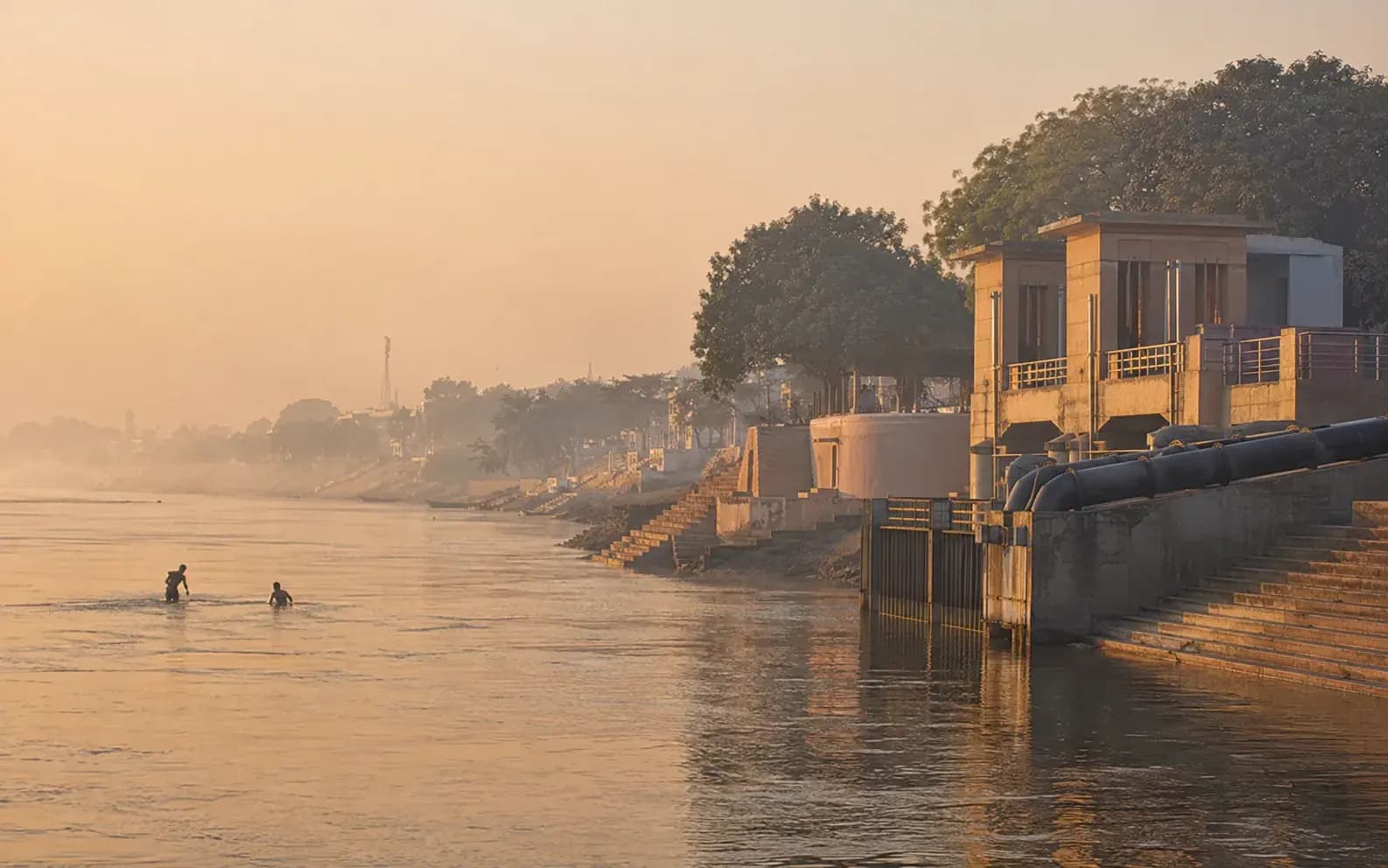
Programme sanction is not clearance. A mission may have approved a package and released funds, but the works still have to be screened against the EIA Notification 2006 schedule on their own facts: the schedule item, the category, and whether public consultation applies. River-front development, embankments and channel interventions attract particular scrutiny because they sit on a floodplain, often adjoin a notified wetland, and touch public and religious use of the ghats. Where the reach is tidal, the CRZ Notification 2019 regime applies in addition. A programme that treats clearance as a formality discovers at appraisal that its works were never screened correctly, and the package stalls.
How KIPL runs it
KIPL screens mission works against the schedule at the earliest stage, before design is frozen, because the category determines whether a season of baseline monitoring and a public hearing sit in the critical path. On these programmes the appraisal committee will ask about the social dimension in any case, so the assessment is built as a combined environmental and social document from the start rather than retrofitted. The pattern to avoid is a package designed to a programme deadline, submitted late, and then found to require a public consultation that adds months no one budgeted for.
- EIA 2006
Works are screened on their own facts
Programme sanction does not substitute for screening under the EIA Notification 2006; the schedule item and category are determined by the works themselves.
- CRZ 2019
Tidal reaches add a second regime
Where the river stretch is tidal-influenced, the CRZ Notification 2019 applies alongside the clearance, with its own recommendation route through the coastal zone management authority.
Public and religious use of the reach
Ghats and bathing reaches are in continuous community use, which makes consultation and social assessment substantive rather than procedural on a river programme.
What you receive
Written for river & water missions, not adapted from a template.
- 01Schedule screening and category determination for each mission work package
- 02Form-1 and Pre-feasibility Report filed on the Parivesh portal
- 03Terms of Reference submission and the granted scope for works requiring assessment
- 04Combined environmental and social impact assessment covering floodplain, wetland and community use
- 05Public consultation support where the category requires it, including ghat and riverbank users
- 06Appraisal representation before the committee and the granted clearance with its conditions mapped to the works contract
Questions from river & water missions
What river & water missions ask before appointing us.
Answered against the regulation as it stands, not as a sales pitch. If your situation is not here, ask us directly.
Ask a question →Does a treatment plant built under a national mission need its own EC?
It has to be screened against the EIA Notification 2006 schedule like any other project; the mission's sanction is a funding approval, not an environmental one. Consent to Establish and Consent to Operate from the state pollution control board are required regardless. Whether a full clearance is needed depends on the schedule item and thresholds the works fall under.
What triggers a public hearing on river-front works?
The category of the project under the Notification. Where public consultation applies, it is conducted by the state pollution control board in the district concerned. On a river programme the participants include ghat users and riverbank residents whose access and livelihood are affected, so the hearing is usually substantive.
How does a tidal reach change the position?
The CRZ Notification 2019 extends along tidal-influenced water bodies, so works within the regulated zone require clearance under that regime, routed through the state coastal zone management authority, in addition to whatever the EIA Notification requires. Mangrove areas within the zone carry their own restrictions.
What if the works adjoin a wetland?
The Wetlands (Conservation and Management) Rules 2017 restrict specified activities in and around notified wetlands, and permission from the State Wetlands Authority is required for regulated activity. Floodplain wetlands and oxbow lakes on a river reach commonly fall in this category, so their status has to be checked before siting is fixed.
How long does clearance take on a mission package?
It depends on the category, whether baseline monitoring across seasons is required, whether public consultation applies, and on the appraisal committee's meeting calendar. The controllable part is screening early: a package screened before design freeze can run its baseline in parallel with detailed engineering rather than after it.
Can several packages be cleared together?
Sometimes, where they form a single project on the facts. But packages that are genuinely separate projects have to be applied for separately, and splitting a single project into sub-threshold parts to avoid clearance is not permissible. The correct approach is to define the project honestly and screen it as such.
Stage by stage
How environment clearance actually runs, step by step.
Also for river & water missions
The rest of the environmental brief for this sector.
Primary sources
Verify any of this at the source.

Relevant proof
Cyber Square IT Park, Nerul
Category B1 under Schedule 8(b): EIA and EMP prepared and carried through SEIAA appraisal for the expansion at Nerul.
- Built-up
- 2,85,592.45 m²
- EC granted
- 07.10.2026
Where we do this
Environment Clearance for river & water missions, city by city.
Other sectors
Who else we run environment clearance for.
Next step
Tell us the project, and we will tell you the category and the route.
Screening is the cheapest stage to get right and the most expensive to get wrong. We will say plainly what environment clearance your river & water missions project needs, and what it does not.





























































Start the conversation