









In-situ treatment: remediating a water body or contaminated medium where it lies.
In-situ treatment improves water or soil quality in position (through aeration, biological dosing, planted systems or reactive amendments) without excavating, dredging or transporting the medium away.
What it is
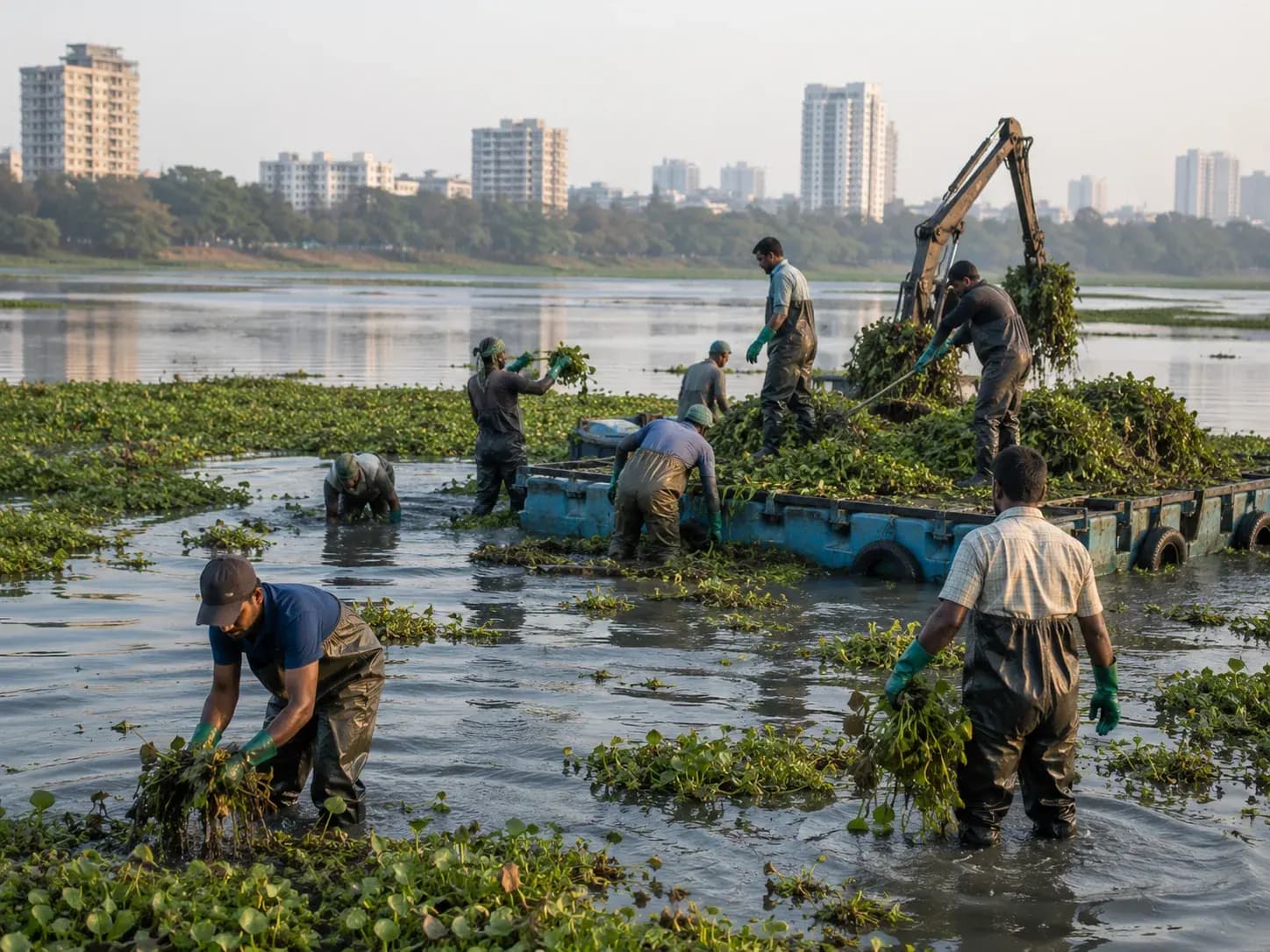
In-situ methods work by changing conditions in place: introducing oxygen so that aerobic degradation can proceed, adding cultured micro-organisms or nutrients to accelerate breakdown, or establishing plants and floating wetlands that take up nutrients and support the microbial community in their root zone. Because nothing is excavated or trucked out, disturbance, cost and disposal liability are lower: which is why in-situ is usually the first option considered for lakes, ponds and urban drains.
The limit of in-situ treatment is that it treats the symptom, not the source. KIPL is explicit about this: a water body receiving untreated sewage will not stay improved on dosing and aeration alone, because the loading continues after the treatment stops. We specify in-situ measures alongside inlet and catchment control, size them against measured loading, and set up the monitoring (dissolved oxygen, BOD, COD, ammonia, coliforms) that shows whether the intervention is actually working rather than merely visible.
What you get
The deliverables, in hand.
- Authority
- CPCB guidelines · NGT directions · SPCB consent conditions
- Typical timeline
- Improvement over months, sustained only while the source is controlled
- Baseline water and sediment characterisation with pollution loading estimate
- Selection of in-situ measures: aeration, bioremediation, phytoremediation, wetlands
- Sizing, layout and dosing regime with power and access requirements
- Source and inlet control measures specified alongside treatment
- Monitoring protocol with parameters, frequency and sampling points
- Performance reporting against the agreed baseline
Straight answers
In-Situ Treatment: common questions.
01What is the difference between in-situ and ex-situ treatment?
In-situ treats the water or soil where it is, by changing conditions in place. Ex-situ removes the medium (by dredging, excavation or pumping) and treats or disposes of it elsewhere. In-situ is less disruptive and cheaper but slower and limited by what can be achieved without removal; ex-situ deals decisively with accumulated contaminated sediment or soil but brings handling, transport and disposal obligations.
02When is in-situ treatment not enough?
When the source keeps loading the system. If untreated sewage or industrial effluent continues to enter a lake or a drain, aeration and bioremediation are treating a flow they cannot outrun, and the water body reverts once dosing stops. In-situ measures are appropriate as an interim step or as polishing once interception and diversion are in place, not as a substitute for source control.
03How do we know whether it is working?
By measurement against a baseline taken before the intervention. Dissolved oxygen, BOD, COD, ammoniacal nitrogen, total suspended solids and faecal coliform at fixed sampling points and a fixed frequency give a defensible picture. Visual clarity and odour improve first and can be misleading; the laboratory numbers are what stand up in a compliance or NGT context.
04What does bioremediation actually involve?
Introducing or stimulating micro-organisms that degrade the organic load, usually through a dosing regime combined with aeration so that aerobic conditions can be maintained. It is a continuing operation with a consumable and a power cost, not a one-time application, and its performance depends on temperature, oxygen availability and the nature of the loading.
05How do floating wetlands and phytoremediation contribute?
Planted floating islands and fringe vegetation take up nutrients, provide surface area for microbial growth in the root zone, and shade the water, which suppresses algal blooms. They are a slow, low-energy contribution to nutrient reduction and habitat value rather than a rapid treatment step, and they need periodic harvesting so that captured nutrients leave the system.
06Who is responsible for continuing operation?
In-situ measures are an operating regime, not a construction handover: aerators need power and maintenance, dosing needs supply and labour, and wetlands need harvesting. The owner, usually a local body or an estate, has to carry that after the project period. Projects that do not settle the operating responsibility and budget at the design stage regress within a season or two.
07What statutory obligation drives this work?
Most commonly directions of the National Green Tribunal, State Pollution Control Board consent or closure conditions, and river and lake rejuvenation programmes that set water quality targets for a stretch or a water body. The applicable direction determines which parameters are reported and how often, so it should shape the monitoring protocol from the start.
Within Project Management Consultancy
Part of the whole route, the other components.
Primary sources
Check it at source.
This page describes CPCB guidelines · NGT directions · SPCB consent conditions. The regulation and the filing portal are public, these are the official endpoints, not our summary of them.
Relevant proof
Where this stage has already been delivered.

MIDC / AURIC · Shendra & Bidkin, Chhatrapati Sambhajinagar
SHENDRA AND BIDKIN INDUSTRIAL AREA, AURANGABAD
Environmental compliance audits, Consent to Establish and green certification support across two industrial nodes of the Delhi-Mumbai Industrial Corridor.
Where we do this
Project Management Consultancy on the ground.
The authority, the timeline and the local ground differ by city. These pages set out how project management consultancy actually runs in each.
Featured projects
Work that carries its own evidence.

Our expertise
One team across the whole environmental brief.
In-Situ Treatment is one stage of one practice. Most projects need several, and the commitments made at clearance are the ones we build and maintain.
Who we do this for
Project Management Consultancy reads differently by industry.
- 01
River & Water MissionsCore
In-situ and ex-situ treatment programmes run across many drains and contractors, needing procurement, supervision and MIS as one discipline.
Project Management Consultancy for River & Water Missions - 02
Municipal Corporations
Corporations need vendor prequalification, techno-commercial bid evaluation and supervision to make an environmental tender defensible.
Project Management Consultancy for Municipal Corporations - 03
Industrial Corridors & MIDC
Corridor authorities procure environmental infrastructure through competitive tender and need prequalification, bid evaluation and supervision to hold it together.
Project Management Consultancy for Industrial Corridors & MIDC
Trusted by
The organisations this work is done for.






In the press