










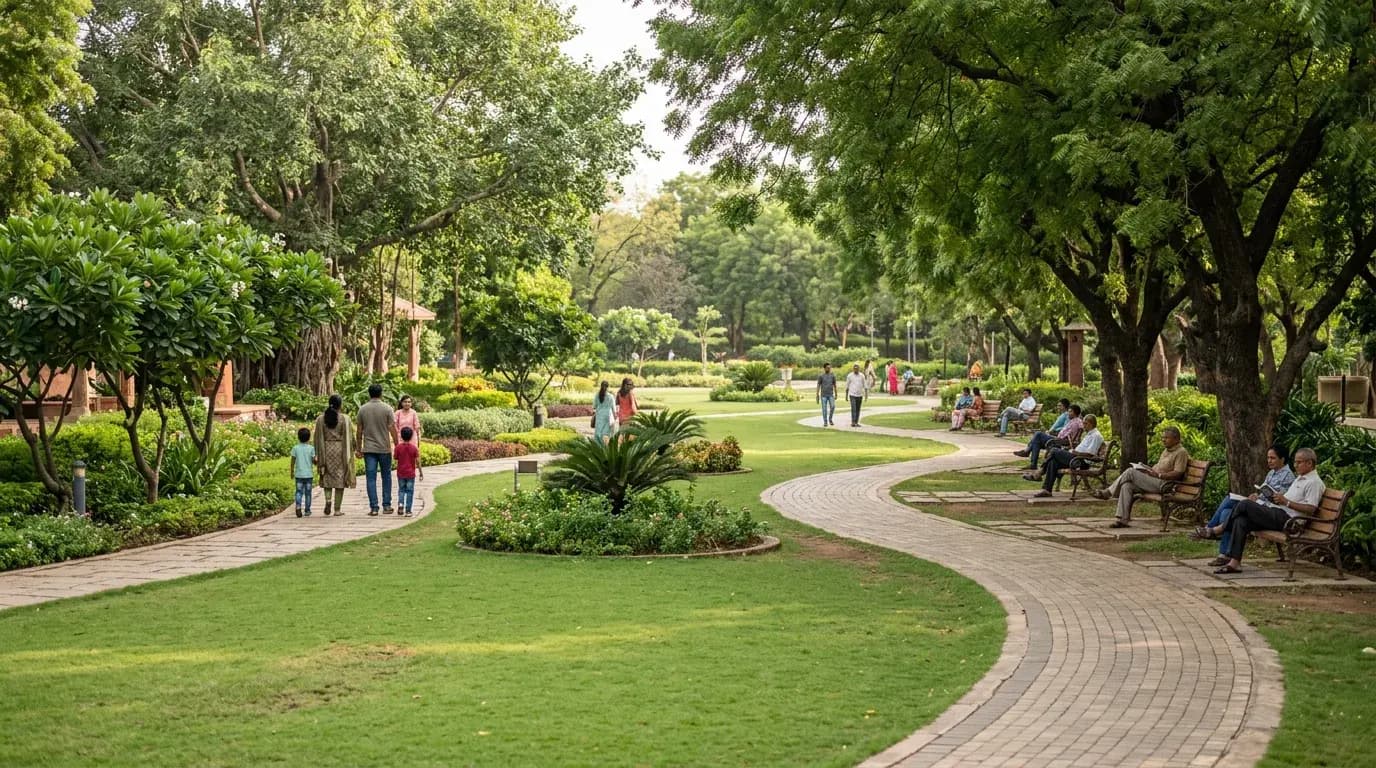
Public Gardens & Biodiversity Parks in Central Park belt, Kharghar.
Public Gardens & Biodiversity Parks for Central Park belt: read against this area's own ground, not the city's average.
Why Central Park belt
The ground this work sits on here.
- Area
- Central Park belt, Kharghar
- Practice
- Urban Ecology and Green Infrastructure Services
- Typically for
- Municipal corporations, developers, townships, institutions
A park at this scale lives or dies by maintenance. Lawns worn to dust by walkers, water features that turn green, play equipment that breaks and is fenced off: these are the usual signs. We assess the park zone by zone (paths, lawns, trees, water, equipment, lighting) and set out repairs and a maintenance regime the corporation can fund. Worn lawns can give way to shade planting and durable paths where people actually walk, instead of being re-turfed each year.
The Central Park belt is the stretch of Kharghar around the large park CIDCO planned at the node's centre, with the golf course beside it and the Kharghar hills rising behind. The park holds lawns, walking tracks, water features and play areas, and on weekends it draws families from all over Navi Mumbai. Residential towers on the surrounding sectors are sold on their view of it. Up the slope, the hills open into grassland dotted with trees, and the Pandavkada falls run down in the monsoon. This is Kharghar's greenest ground, and new buildings here are turned to face it.
How it works
Public Gardens & Biodiversity Parks, from survey to survival.
- 01/03
Design & master planning
A plan that balances lawns, planting, pathways, shade and play for real, sustained use.
- 02/03
Execution & commissioning
Softscape and hardscape built and planted, then commissioned as a working space.
- 03/03
Maintenance contracts
Ongoing horticulture and upkeep so the garden is still healthy years after opening.
Proof
Comparable work we've delivered.
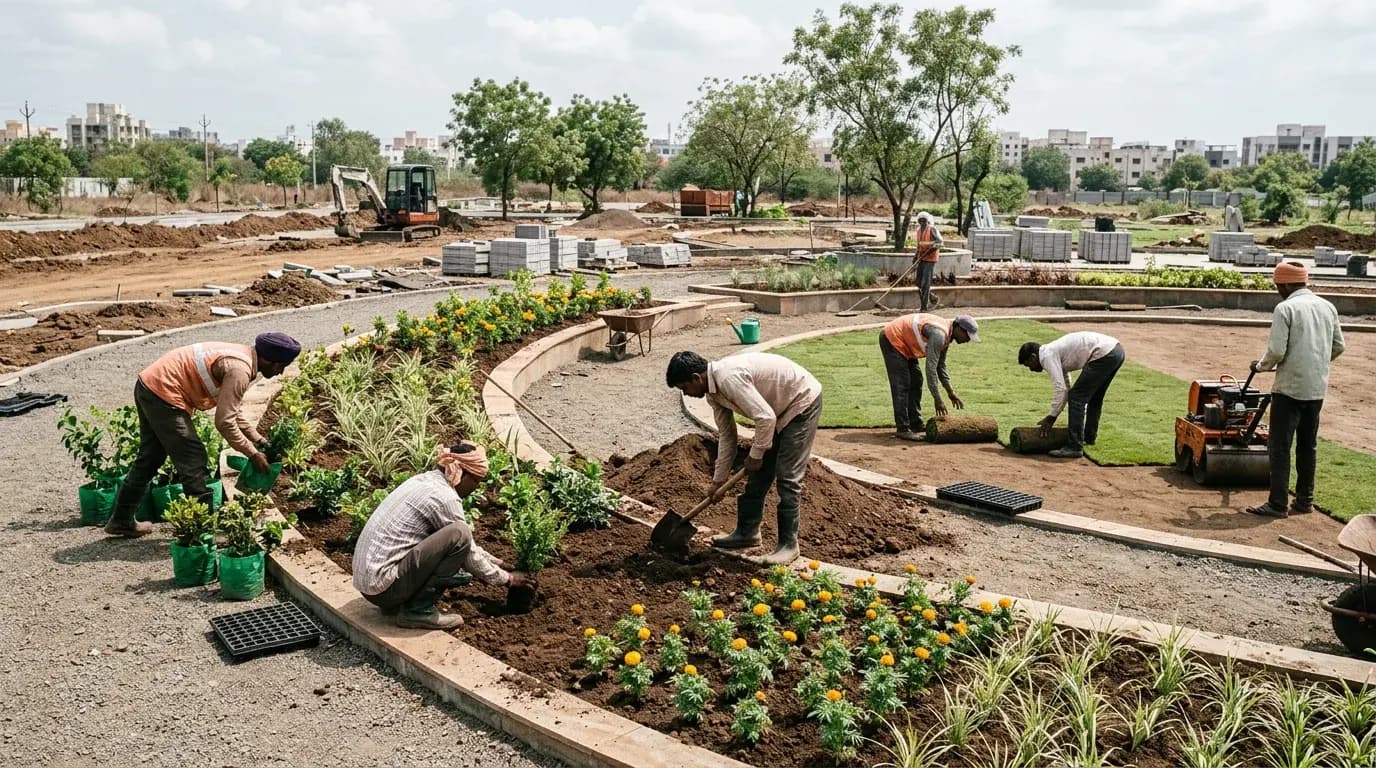
MCGM · Eastern Suburbs, Mumbai
MCGM GARDEN DEVELOPMENT- MIYAWAKI PLANTATION
Miyawaki dense forestation across 27 locations in 7 wards using native species, delivered under the municipal greening programme.
See the full case →The record
The work, project by project.
Mandate, method and measured outcome, written end to end for every project on this list.
A 120 KLD effluent treatment plant on a conventional treatment process.
Read the case studyStraight answers
Public Gardens & Biodiversity Parks in Central Park belt: common questions.
01Why do the lawns in our large park turn bare every summer?
Usually a mix of heavy foot traffic, compacted soil and thin summer watering. Re-seeding alone does not last. Routing paths where people already walk, loosening the soil, resting worn areas in turn, and replacing some lawn with shade planting work better. We map the wear and propose a plan.
02How long does public gardens & biodiversity parks take in Central Park belt?
On timing: design to commissioning by scope; maintenance ongoing. A realistic Central Park belt schedule is set once the site and the scope have been read, and the work is carried through to the outcome by the same named people.
In the press
Covers, features and conversations: the work, talked through.



Keep exploring
Where this connects.
Also in Central Park belt
Other work written for Central Park belt's own ground.
All of Central Park beltPublic Gardens & Biodiversity Parks nearby
The same work, elsewhere across Kharghar.
Public Gardens & Biodiversity Parks: the full serviceClients & partners
The work is trusted where the stakes are highest.
Two decades of clearances, treatment plants and green infrastructure delivered for India’s builders, industry and public bodies, and the global engineering firms beside them.





























































Public Gardens & Biodiversity Parks in Central Park belt? Start with the ground you have.
One conversation to walk the site and plan for what survives: not just what gets planted.